How to Launch a Consulting Business with No Experience
If you want to launch a consulting business, you are entering one of the most practical paths to self-employment. You…
If you want to launch a consulting business, you are entering one of the most practical paths to self-employment. You do not need a large budget, a physical office, or a team to get started. What you need is expertise that others are willing to pay for, a clear understanding of who you serve, and a structured approach to building your practice.
This guide walks through every step of starting a consulting business, from choosing your niche to signing your first client and building toward long-term growth. Whether you are leaving a corporate job, freelancing on the side, or starting fresh, the process is the same.
What a Consulting Business Actually Is
A consulting business is a professional service where you provide expert advice, guidance, or implementation support to clients in exchange for payment. Clients hire consultants because they need knowledge or capability they do not have internally, or because they want an outside perspective on a problem they are too close to see clearly.
Consulting businesses operate across every industry and function. Marketing consultants, financial advisors, HR consultants, technology specialists, operations experts, and business coaches all fall under the broad consulting umbrella. The common thread is that clients pay for your knowledge and judgment, not for a physical product.
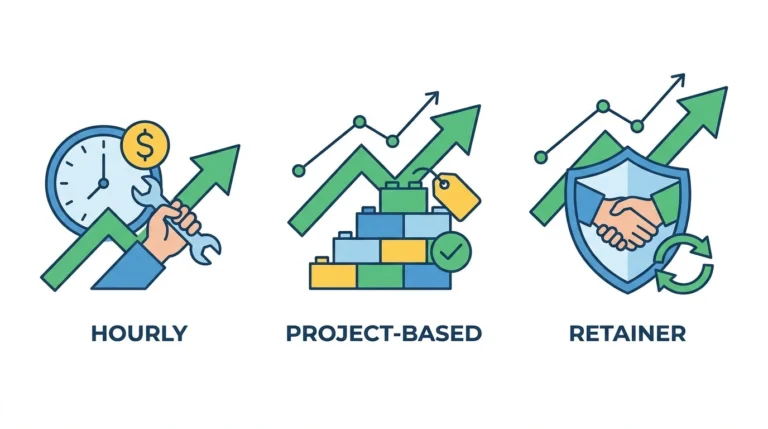
The three most common ways consultants charge for their work are hourly rates, project-based fees, and monthly retainers. Most established consultants use a combination of all three depending on the engagement type and client relationship.
Why Consulting Is a Smart Business to Start
Consulting has structural advantages that most other businesses do not. The startup cost is low. A laptop, an internet connection, and a professional online presence are enough to begin. There is no inventory, no manufacturing, and no retail overhead.
The income potential is high. Experienced consultants in specialized fields charge anywhere from $150 to $500 per hour or more. A modest client base at professional rates produces a comfortable full-time income.
The work is location-flexible. Most consulting is done remotely through video calls, email, and shared documents. You can serve clients across the country or internationally without relocating. The model is scalable. A solo consultant can eventually hire subcontractors, build a small team, or productize their knowledge into courses, templates, or group programs.
None of this means consulting is easy. Building a client base takes time and consistent effort. But the fundamentals are accessible to anyone with genuine expertise and the discipline to follow through.
Step 1: Choose Your Consulting Niche
The single most important decision you will make when starting a consulting business is choosing your niche. Your niche defines who you help, what problem you solve, and how you position yourself in the market.
Consultants who try to serve everyone end up attracting no one. A specific niche makes your marketing more focused, your credibility more obvious, and your client acquisition more efficient.
Your niche should sit at the intersection of three things: what you know deeply, what the market will pay for, and what you genuinely want to do consistently.
Start with your professional background. What have you done for years that others struggle with? What do colleagues, former employers, or peers ask you about regularly? What results have you produced that you could help others replicate? Then evaluate market demand. Are businesses actively hiring or paying for help in this area? Can you find job postings, consulting firms, or competitors serving this need? If the market is paying for it, there is room for another strong provider.
Finally, consider audience fit. Some consultants thrive working with startups. Others prefer established businesses. Some enjoy working directly with founders. Others prefer working inside larger organizations. Choose a client type you will enjoy engaging with day after day.
For a deeper look at this decision, including how to evaluate and test potential niches before committing, read the full guide on how to choose your consulting niche.
Step 2: Validate Your Business Idea Before You Invest
Before you build a website, print business cards, or invest significant time in marketing, validate that real clients will pay for what you are offering.
Validation does not mean running surveys or asking friends what they think. It means having actual conversations with people who fit your target client profile and finding out whether the problem you plan to solve is real, urgent, and something they would pay to address.
Talk to at least ten potential clients. Ask about their current challenges. Find out how they currently solve the problem you intend to address. Ask whether they have hired consultants before and what that experience was like. Ask what a solution would be worth to them. You do not need to sell anything in these conversations. You are gathering information that will sharpen your positioning, refine your service offering, and tell you whether the demand is real or assumed.
If multiple potential clients respond with genuine interest and ask how they can work with you, that is meaningful validation. If conversations are consistently met with indifference or the problem you are solving does not register as urgent, reconsider your niche or your framing before investing further.
The supporting article on how to validate your consulting business idea covers this process in detail, including the specific questions to ask and how to interpret what you hear.
Step 3: Define Your Service Offering
Once you have a validated niche, define exactly what you offer. Vague positioning leads to vague proposals and confused clients. Specific positioning leads to faster decisions and cleaner engagements.
A well-defined service offering answers these questions clearly: What specific problem do you solve? Who do you solve it for? What does the engagement look like? What does the client get at the end?
You do not need a long menu of services. Most successful solo consultants start with one or two clearly defined offerings and expand from there based on client demand. Consider whether your service is better structured as a defined project with a deliverable, an ongoing advisory retainer, or a diagnostic assessment that leads into a larger engagement. Each structure has different implications for how you sell, how you deliver, and how you price.
Step 4: Price Your Consulting Services
Pricing is where many new consultants make their most costly mistake: they charge too little. Underpricing signals inexperience, attracts low-quality clients, and creates a rate structure that is difficult to correct over time.
Your consulting rate should reflect the value you deliver, not the hours you spend. A consultant who helps a business increase revenue by $200,000 in six months has delivered substantial value regardless of how many hours the engagement required.
Three pricing models are most common in consulting.
Hourly rates work for advisory relationships, coaching, and engagements where scope is difficult to define in advance. They are straightforward to communicate but create an incentive misalignment where efficiency is penalized. Project fees work for defined deliverables with clear scope, such as a marketing audit, a hiring process redesign, or a technology implementation. They are easier for clients to budget and allow consultants to earn more when they work efficiently.
Monthly retainers work for ongoing advisory relationships where the client wants regular access, consistent support, and a predictable engagement structure. Retainers provide income stability and are the goal for most consulting practices.
Research what other consultants in your niche and market charge. Do not set your rates based on what feels comfortable. Set them based on what the market pays for the value you deliver. If your rates are not causing at least occasional pushback from prospective clients, they are probably too low. The full guide on how to price your consulting services covers rate calculation, packaging, value-based pricing, and how to handle pricing conversations with clients.
Step 5: Set Up Your Business Legally and Financially
Setting up the legal and financial foundation of your consulting business is not complicated, but it needs to be done correctly before you sign your first client. Choose a business structure. Most solo consultants start as a sole proprietor or form a single-member LLC. An LLC provides liability protection that a sole proprietorship does not. Consult with a local accountant or attorney to determine the right structure for your situation and location.
Register your business. Requirements vary by state, province, and country. In the United States, LLC formation is done at the state level. Most states also require a business license for professional services. Check your local requirements. Open a business bank account. Separate your personal and business finances from day one. This simplifies bookkeeping, makes tax preparation cleaner, and protects your liability protection if you have formed an LLC.
Set up accounting. Use accounting software such as QuickBooks, Wave, or FreshBooks to track income and expenses. Keep records of every business expense. Understand your tax obligations, including quarterly estimated tax payments if you are self-employed in the United States. Create a client contract template. Every engagement should be covered by a written agreement that defines the scope of work, payment terms, intellectual property ownership, confidentiality obligations, and termination provisions. Invest in having an attorney draft or review your standard contract. It will protect you repeatedly over the life of your practice.
Step 6: Build Your Professional Presence
Your professional presence is the combination of how you appear online and what potential clients find when they search for you. You do not need an elaborate marketing infrastructure to start, but you do need a credible baseline.
LinkedIn is the most important platform for most consultants. An optimized LinkedIn profile with a clear description of who you serve, what you do, and what results you have produced is often the difference between being taken seriously and being overlooked. Recommendations from former colleagues and clients add meaningful credibility. A simple website communicates your positioning, explains your services, and provides a way for potential clients to contact you. It does not need to be elaborate. A one-page or three-page site is sufficient at the start.
A professional email address using your domain rather than a generic Gmail or Yahoo address signals that you take your business seriously. The cost is minimal, and the credibility impact is immediate. Focus on these three elements before investing in any other marketing infrastructure. They are what prospective clients will evaluate when considering whether to engage you.
Step 7: Find Your First Clients
Client acquisition is the activity that most new consultants underinvest in. Building a website and waiting for inquiries is not a client acquisition strategy. Getting clients requires active outreach, consistent relationship building, and repeated conversations.
Your first clients are almost always found within your existing professional network. Former employers, colleagues, clients from previous roles, and professional contacts are the most likely sources of your first paid engagements.
Start there before investing in any outbound marketing. Reach out directly. Let your network know you have started a consulting practice, what you specialize in, and what type of clients you are looking to work with. Be specific. “I am now consulting with manufacturing companies on operational efficiency improvements” is more actionable than “I am doing some consulting work.”
Ask for introductions. When someone in your network does not need your services directly, ask whether they know anyone who might. A warm introduction is significantly more effective than cold outreach. Be consistent. Client acquisition is a long-term activity. Most consulting practices take 12 to 18 months to reach consistent revenue. The consultants who succeed are those who maintain business development activity even when it feels uncomfortable or unproductive in the short term.
Step 8: Deliver Excellent Work and Build Your Reputation
In consulting, your reputation is your business. Every client engagement either strengthens or weakens your ability to attract the next client. Deliver what you promise. Scope engagements conservatively and over-deliver on quality. Be transparent when challenges arise rather than waiting for clients to discover problems. Communicate proactively.
After every successful engagement, ask for a referral and a testimonial. Most satisfied clients are happy to provide both if you ask directly. A portfolio of specific, results-oriented testimonials is one of the most effective marketing assets a consultant can build. Build case studies that describe the client’s situation, the work you did, and the measurable outcome. Case studies are more persuasive than credentials because they show prospective clients what working with you actually produces.
Step 9: Scale Your Practice Over Time
Once you have a stable base of clients and consistent revenue, you can begin thinking about how to grow beyond trading your time for money.
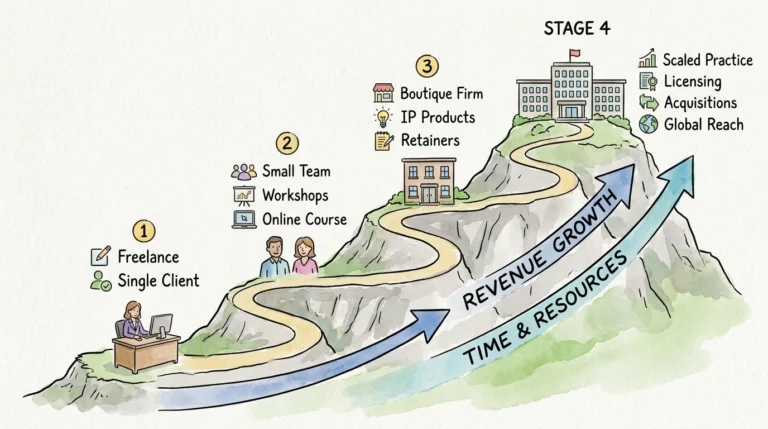
Scaling in consulting typically follows one of several paths. You can raise your rates and work with fewer, higher-value clients. You can hire subcontractors or associates and take on more work than you can handle alone. You can productize part of your expertise into courses, templates, or group programs that generate income without proportional time investment. You can build a small agency with a team.
Each path has different implications for how you work, what you enjoy, and how much operational complexity you want to manage. There is no single right answer. Our article on how to scale your consulting business covers each of these paths in detail and helps you evaluate which direction fits your goals and working style.
Common Mistakes New Consultants Make
Understanding what goes wrong for other consultants helps you avoid the same patterns. Choosing a niche that is too broad is the most common mistake. “Business consulting” or “marketing consulting” without further specialization is not a viable position in a competitive market.
Waiting too long to charge is another frequent error. Some new consultants spend months building infrastructure, creating content, and refining their website before approaching a single potential client. Revenue validates your business faster than any amount of preparation. Pricing based on hours rather than value leads to a ceiling on income and a misalignment between what you spend time on and what produces results for clients.
Neglecting business development once client work gets busy is a pattern that leads to feast-and-famine revenue cycles. Set aside consistent time for client acquisition activity every week regardless of how full your schedule feels.
How much money do I need to start a consulting business?
Most consulting businesses can be started for less than $1,000. Core expenses include business registration fees, a domain and basic website, accounting software, and a professional email. If you already have a computer and internet access, the cash investment is minimal.
How long does it take to get the first consulting client?
With active outreach to an existing professional network, many consultants land their first client within 30 to 90 days. Without a network or with passive marketing only, it takes longer. The speed depends almost entirely on how consistently and directly you pursue conversations with potential clients.
Do I need a business license to start consulting?
Requirements vary by location and industry. In most U.S. states, professional services consulting does not require a specific professional license, though a general business license may be required in your city or county. Some niches, such as financial advising, legal consulting, and healthcare consulting, have licensing requirements. Research the specific requirements for your niche and location.
Should I quit my job before starting a consulting business?
Most consultants benefit from validating demand and landing at least one or two clients before leaving employment. The financial pressure of having no income while building a client base can lead to poor pricing decisions and premature compromises. Starting part-time while employed reduces that pressure significantly.
What is the difference between a consultant and a freelancer?
The distinction is not always clear, but consultants typically provide strategic advice, analysis, and recommendations, while freelancers typically execute specific tasks such as writing, design, or coding. In practice, many solo practitioners do both, and the label matters less than the clarity of your service offering and value proposition.
Conclusion
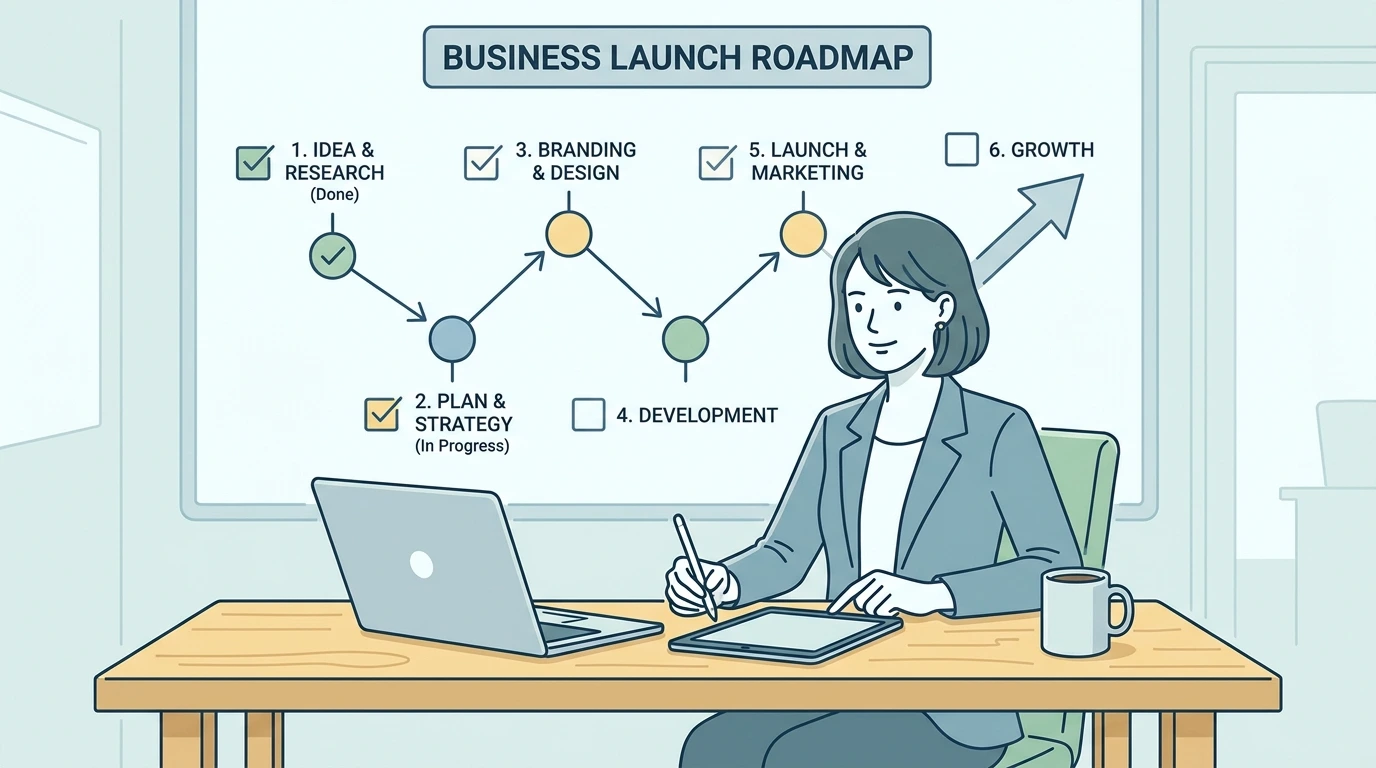
Starting a consulting business is a realistic and rewarding path for professionals who have expertise worth sharing. The process is straightforward: choose a focused niche, validate real demand, price your services confidently, set up the legal foundation, build a credible presence, and pursue clients actively. None of these steps are complicated. But they all require consistent follow-through, and that is where most new consultants fall short.