How to Price Your Consulting Services: A Complete Guide for Independent Consultants
Knowing how to price your consulting services is one of the most important decisions you will make as a consultant….
Knowing how to price your consulting services is one of the most important decisions you will make as a consultant. Pricing is where many new consultants make their most damaging early mistake. They charge too little, driven by discomfort with quoting higher fees, fear of rejection, or the mistaken belief that lower prices make it easier to win clients.
In reality, the opposite is often true. Low prices can attract low-quality clients, signal inexperience, and create a pricing structure that becomes difficult to increase later. Setting the right rates from the beginning helps position your expertise, attract better clients, and build a consulting business that is both profitable and sustainable.
This guide explains how to price your consulting services by covering the major consulting pricing models, calculating rates based on your value and goals, presenting your pricing with confidence, and responding to pricing objections without relying on unnecessary discounts.
Why Consultants Undercharge and Why It Hurts Them
The tendency to underprice consulting services comes from several places. Many new consultants compare their intended rates to what they earned as employees and feel uncomfortable charging more than their previous hourly equivalent. Others worry that higher prices will make client acquisition harder. Some simply have not thought carefully about what their work is actually worth to the client.
All of these concerns are understandable, and all of them lead consultants to leave significant income on the table.
Clients do not evaluate consulting services the way they evaluate commodity products. A client is not buying your hours. They are buying the outcome those hours produce. If your advice helps a company increase revenue by $300,000, the value of that advice is measured against $300,000, not against how many hours you spent delivering it.
Pricing that reflects the value of outcomes rather than the cost of your time produces better client relationships, higher income, and a more sustainable practice.
The Three Primary Consulting Pricing Models
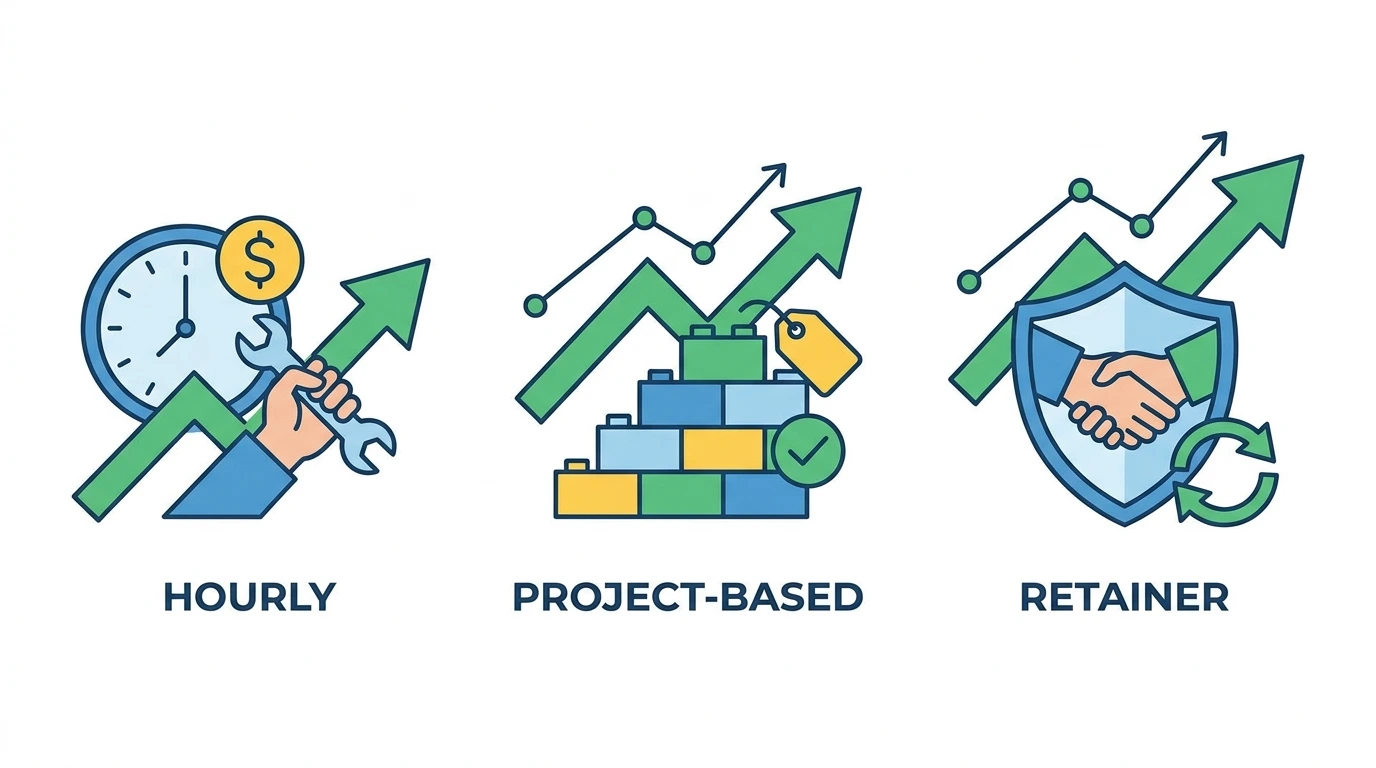
Most consulting businesses use one or more of three core pricing structures. Understanding how each works and when to use it is the foundation of a sound pricing strategy.
Hourly Rate Pricing
Hourly pricing charges clients a fixed rate for each hour of your time. It is the simplest pricing model to explain and the easiest to implement at the start of a consulting practice.
Hourly pricing works well for advisory engagements where scope is genuinely difficult to define in advance, for coaching relationships where session frequency varies, and for engagements where clients want flexibility to engage you as needed without a fixed commitment.
The primary limitation of hourly pricing is that it creates an inverse relationship between your efficiency and your income. The faster you solve a problem, the less you earn. As you gain expertise and solve problems more quickly, hourly pricing penalizes you for that improvement.
Hourly pricing is also less attractive to many clients because it creates open-ended financial exposure. Clients cannot budget accurately for engagements billed by the hour without a clear estimate of total hours required.
Despite its limitations, hourly pricing is a reasonable starting point for new consultants who have not yet developed enough market data to price projects confidently.
Project-Based Pricing
Project-based pricing charges a fixed fee for a defined scope of work with a specific deliverable. The client knows exactly what they will pay before the engagement begins, and you are paid for the outcome rather than the time spent producing it.
This model aligns incentives far better than hourly pricing. When you work efficiently and deliver results quickly, you earn more per hour of effort. When you invest extra time to produce exceptional work, that investment is your choice rather than an obligation.
Project-based pricing works well for clearly defined deliverables such as a marketing audit, a hiring process redesign, a technology implementation plan, a compensation benchmarking report, or an operational assessment.
Scoping project engagements accurately is the critical skill. Underscoping leads to scope creep, where you deliver more than you priced for. Overscoping leads to inflated prices that lose proposals. Develop standard project scopes based on your experience and include clear change order provisions in your contracts for work that falls outside the agreed scope.
Retainer Pricing
Retainer pricing charges a fixed monthly fee for ongoing access, advisory support, or a defined set of services delivered consistently over time. It is the most financially stable consulting pricing model and the goal for most mature consulting practices.
Retainers work well when clients need consistent engagement over multiple months, when the value of your relationship compounds over time, and when the nature of the work does not easily fit discrete project boundaries.
A fractional HR consultant who provides ongoing employment compliance support, employee relations guidance, and policy management for a small business is a natural retainer arrangement. A marketing consultant who manages a client’s content strategy month over month is another example.
Retainer pricing requires a clear definition of what is included in the monthly fee and what falls outside it. Without clear boundaries, retainer engagements tend to expand scope without corresponding fee increases.
The income stability that retainers provide makes them worth pursuing actively. Four to six retainer clients at reasonable monthly fees can produce a full-time income with greater predictability than any amount of project work.
Value-Based Pricing
Value-based pricing sets fees based on the economic value the client receives from the engagement rather than on time spent or deliverable scope. It is the highest-earning pricing approach available to consultants and the most challenging to implement.
To price on value, you need to understand what the outcome of your engagement is worth to the specific client in their specific situation. A process improvement that saves a manufacturing company $500,000 per year in waste is worth dramatically more than the same process improvement applied to a company where the savings are $50,000 per year.
Value-based pricing requires frank conversations with clients about the financial stakes of the problem you are solving. Those conversations are uncomfortable for many consultants and many clients. But they are also the conversations that produce the clearest mutual understanding of what a successful engagement is worth.
Value-based pricing is most applicable in situations where the outcome is financially measurable, the value is substantial, and the client has already tried to solve the problem without success. It is not appropriate for every engagement or every client type.
How to Calculate Your Consulting Rate
If you are starting with hourly or project-based pricing, a practical baseline calculation helps you set rates that are financially sustainable.
Start with your target annual income. Decide what you want to earn from consulting in a full year, not what you need to survive, but what you want to earn for the practice to be worth running.
Estimate your billable hours. A solo consultant realistically bills between 800 and 1,200 hours per year. The rest of your working time goes to business development, administration, professional development, and unbillable client communication. Use 1,000 hours as a reasonable estimate for planning purposes.
Divide your target income by your billable hours to get a baseline hourly rate. If you want to earn $150,000 per year and plan to bill 1,000 hours, your baseline rate is $150 per hour.
Add a buffer. Your actual revenue will be lower than your billing rate implies because of unpaid proposals, client gaps, vacation, and business development time that does not convert to revenue. Add 30 to 50 percent to your baseline to account for this reality.
At a $150 per hour baseline, a 40 percent buffer produces a target billing rate of $210 per hour. That is the floor, not the ceiling.
Then benchmark against the market. Research what consultants in your niche and region charge. If your calculated rate is well below market, adjust upward to market rates. If it is above market, assess whether your expertise justifies a premium or whether you need to refine your positioning.
How to Present Your Pricing With Confidence
How you present pricing matters almost as much as what you charge. Consultants who present their rates apologetically, hedge their numbers, or volunteer discounts before clients ask are communicating that their rates are negotiable and that they themselves are uncertain about their value.
Present your pricing directly, clearly, and without unnecessary qualifications. State the fee, explain what it covers, and stop talking. Silence after stating a price is normal. Filling that silence with justifications and preemptive discounts undermines your position.
When presenting project fees, explain the scope and deliverables first so the client understands what they are paying for before they hear the number. When presenting retainer arrangements, describe the ongoing value and access the client receives before stating the monthly fee.
Send written proposals that summarize the scope, deliverables, timeline, and fee in clear terms. A well-crafted proposal reduces misunderstandings, creates a record of what was agreed, and gives the client something concrete to evaluate and share with others who may be involved in the decision.
Handling Pricing Pushback
Pricing pushback from potential clients is normal and does not automatically mean your rates are too high. It means the client is doing their job as a buyer. How you respond determines whether the conversation continues productively or collapses.
When a client says your price is too high, the most useful response is a question: “Can you help me understand what you had in mind?” That question often reveals whether the gap is about budget, perceived value, or competitive pressure from another option. Each of those is a different conversation with a different appropriate response.
If the gap is about budget, assess whether the scope can be reduced to fit the available budget without compromising the quality of the outcome. A smaller, well-delivered engagement is better for both parties than a full-scope engagement that creates financial strain for the client.
If the gap is about perceived value, the conversation needs to return to the business impact of the outcome you are delivering. Help the client articulate what solving this problem is worth to their business. If the value is clear and substantial, the fee becomes easier to justify.
If the client is comparing you to a cheaper competitor, resist the pressure to match that price. Differentiate on specificity, experience, and your track record of results. Clients who buy on price alone are typically the most difficult to work with and the least likely to refer you.
Avoid discounting as a default response to pushback. Discounting trains clients to push back on every proposal, signals that your stated rates are not real, and sets a precedent for the financial relationship that is difficult to reverse.
When and How to Raise Your Rates
Your consulting rates should increase over time as your expertise deepens, your reputation grows, and your client outcomes improve. Many consultants keep rates flat for years out of fear of losing existing clients, which leaves substantial income unrealized.
Raise your rates for new clients first. This allows you to test higher rates in the market without disrupting existing relationships. If new client proposals are consistently accepted without pushback at your new rate, that is confirmation that the market supports the increase.
Raise rates for existing clients with advance notice, a clear explanation, and a reasonable transition period. Most good clients accept rate increases from consultants they value if the increase is presented professionally and with sufficient notice.
The right time to raise rates is when your pipeline is consistently full, when you are turning away work due to capacity constraints, or when you consistently win proposals without any pricing pushback. All three of those signals indicate that your rates are below what the market would bear.
What is a good consulting rate for a beginner?
Entry-level consulting rates vary by niche, but most new consultants with professional experience charge between $75 and $150 per hour for generalist work. Specialized technical niches such as cybersecurity, financial consulting, and healthcare consulting typically start higher. Research market rates specifically for your niche rather than relying on general averages.
Should I list my prices on my website?
Most consultants do not list specific prices on their website because engagements vary significantly in scope and value. However, some consultants find that indicating a price range or minimum engagement threshold filters out clients with insufficient budgets and saves time in early conversations. Test both approaches and evaluate which produces better quality inquiries.
How do I charge for travel and expenses?
Include a clear expense policy in your standard contract. Most consultants charge travel time at a reduced hourly rate or a flat travel fee and pass through actual travel expenses such as airfare, accommodation, and ground transportation at cost. Define these terms before the first engagement to avoid awkward conversations later.
Is it better to charge hourly or by project?
Project-based pricing is generally better for both parties once you have enough experience to scope engagements accurately. It gives clients budget certainty and rewards your efficiency. Hourly pricing is more appropriate in early-stage engagements where scope is genuinely undefined or in ongoing advisory relationships where the nature of each session varies.
How do I handle clients who want to negotiate my fees?
Decide in advance which elements of your pricing are negotiable and which are not. Scope can often be adjusted to fit a different budget. Your hourly rate or day rate should generally not be negotiated downward. When clients push for lower rates, explore whether reducing scope achieves the budget constraint without reducing your effective rate.
How much should I charge for consulting services?
Start with the post’s calculation: divide your target annual income by your billable hours (a solo consultant realistically bills 800 to 1,200 hours per year), then add a buffer for unpaid proposal time and non-billable work. At a $150 per hour baseline, a 40 percent buffer produces a target billing rate of $210 per hour. Then benchmark against what consultants in your niche and region charge, and adjust your rates upward as your expertise deepens.
How do you price consulting?
Most consulting businesses use one or more of three core pricing structures: hourly rate pricing, project-based pricing, and retainer pricing, plus value-based pricing that sets fees based on the economic value the client receives. Choose the model that fits the engagement: hourly for genuinely undefined scope, project-based for clearly defined deliverables, retainers for ongoing access, and value-based where the outcome is financially measurable. Then calculate your rate from your target income and billable hours and benchmark it against the market.
What is a fair consulting rate?
A fair rate reflects the value of the outcomes rather than the cost of your time, and is grounded in the post’s calculation: target income divided by billable hours, plus a buffer, then benchmarked against what consultants in your niche and region charge. Rates should increase over time as expertise deepens, reputation grows, and demand exceeds availability. If a client pushes back, reduce scope to fit the budget rather than negotiating your rate downward.
Conclusion
Pricing your consulting services correctly is one of the most important decisions you will make in building a sustainable practice. Set your rates based on the value you deliver and the market you serve, not on what feels comfortable or what you think clients will accept without question.
Present your pricing with confidence, handle pushback without panic, and raise your rates consistently as your expertise and reputation grow.
For the complete foundation of building your consulting business, including how to choose your niche, set up your legal structure, and find your first clients, the full guide on How to Launch a Consulting Business with No Experience covers everything you need from day one.