How to Scale Your Consulting Business: Strategies to Grow Beyond Solo Consulting
Learning how to scale your consulting business is essential if you want to grow beyond trading time for money. Most…
Learning how to scale your consulting business is essential if you want to grow beyond trading time for money. Most consulting businesses eventually hit a ceiling. You build a solid client base, generate consistent revenue, and enjoy the work you do, but there are only so many hours in the day. Without the right systems, every additional dollar earned requires more of your personal time.
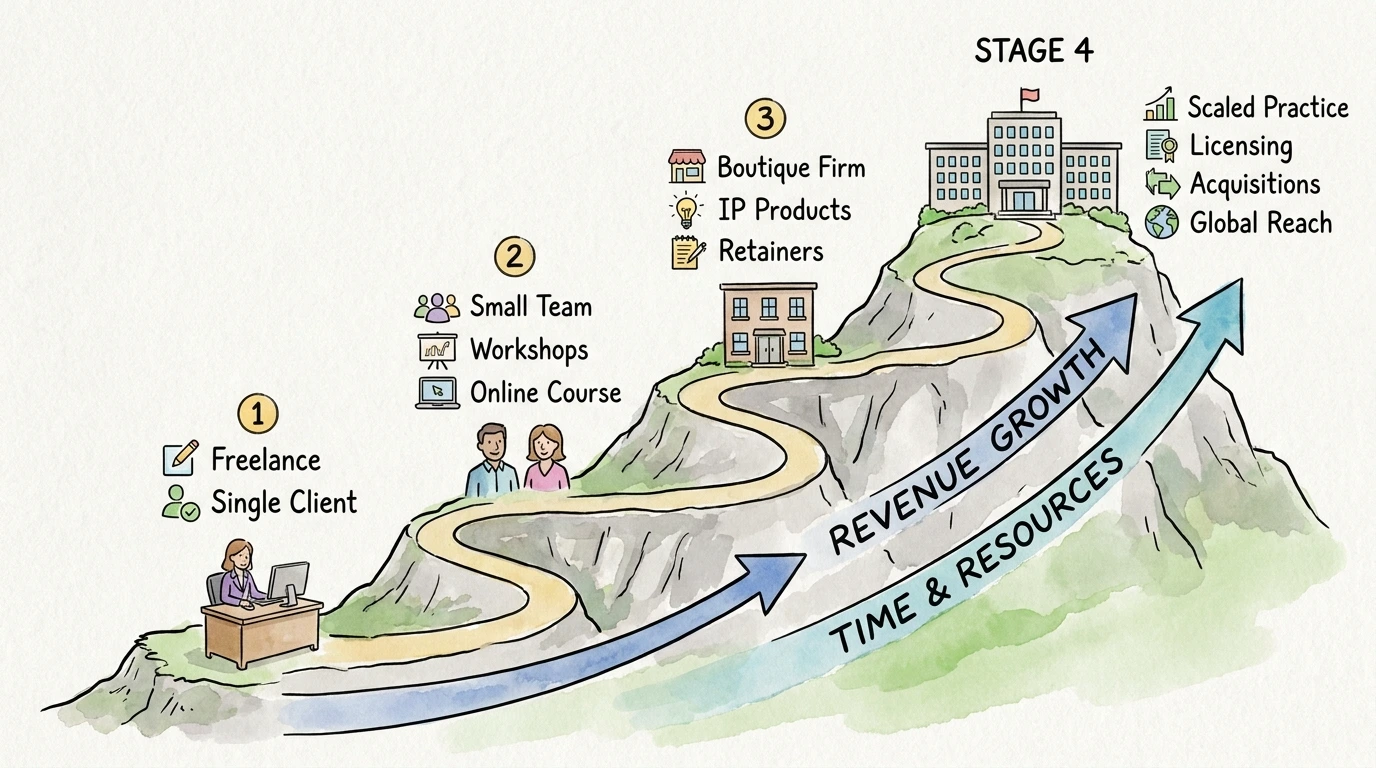
That ceiling is not inevitable. It is a structural challenge with a practical solution. Scaling a consulting business means creating systems, refining your service delivery, building a team when needed, and developing recurring revenue opportunities that allow your business to grow without requiring proportional increases in your workload.
This guide explains how to scale your consulting business by covering the most effective growth strategies, how to determine which approach fits your current stage, and how to expand your consulting practice while maintaining the quality, client experience, and reputation that made your business successful in the first place.
When You Are Ready to Scale
Not every consulting business is ready to scale immediately. Attempting to scale before the foundation is solid creates more problems than it solves.
You are ready to think seriously about scaling when several conditions are consistently true. Your pipeline is reliably full, and you are regularly turning away work or referring clients elsewhere because you do not have capacity. Your revenue has been stable for at least six to twelve months and is not dependent on one or two clients. Your service delivery is systematic enough that someone else could follow your process with clear guidance. Your reputation in your niche is established and generates referrals without active effort.
If those conditions are not yet in place, the most effective use of your energy is building toward them rather than adding operational complexity before the foundation supports it.
Strategy 1: Raise Your Rates
The simplest and most overlooked scaling strategy is raising your consulting rates. Most established consultants are charging significantly less than the market would bear, particularly consultants who set their initial rates conservatively and have not revisited them in years.
Raising rates increases revenue without adding clients, without hiring anyone, and without building new products or systems. It is the highest-leverage move available to most consulting businesses at the scale-ready stage.
If your pipeline is consistently full, if you are winning proposals without pricing pushback, and if referrals are coming in faster than you can accommodate them, all of those signals indicate that your rates are below market. Raise them for new clients first, then for existing clients on renewal.
A consultant who raises their effective hourly rate from $150 to $225 while maintaining the same number of billable hours increases annual revenue by 50 percent without changing anything else about their business.
Strategy 2: Shift to Higher-Value Clients
Another form of scaling that does not require hiring or product development is moving upmarket to clients with larger budgets and more complex problems.
Larger clients typically have larger budgets, longer engagement timelines, and more sophisticated procurement processes. Getting in front of them requires stronger positioning, better case studies, and more developed referral relationships than smaller clients do. But the revenue per engagement is substantially higher.
Moving upmarket usually means niching down further, not broader. The clients with the largest budgets are buying highly specialized expertise, not generalist advice. A consultant who serves mid-size healthcare organizations with revenue cycle optimization is more attractive to a large health system than a consultant who helps businesses of all kinds improve their finances.
Identify what the next tier of client looks like for your practice. What size, type, and sophistication level? What would you need to demonstrate to be credible to them? Build toward that systematically.
Strategy 3: Build a Retainer-First Practice
If your current revenue comes primarily from projects, transitioning toward retainer-based revenue is one of the most effective scaling moves available to a solo consultant.
Project revenue is unpredictable. It requires continuous sales activity to replace engagements as they complete. Retainer revenue is predictable, requires less sales effort per dollar earned, and compounds as client relationships deepen.
A practice with eight retainer clients at $3,000 per month produces $24,000 per month in recurring revenue. That same revenue from project work requires continuously closing new engagements, which is far more time and energy intensive.
Build toward retainers by designing your service offerings to naturally transition from project engagements to ongoing relationships. After completing a successful project, offer a maintenance, advisory, or implementation retainer that continues the relationship in a more structured form.
Not every client will convert to a retainer. Some organizations only have episodic needs. But for clients with ongoing challenges in your area of expertise, a retainer is often the right structure for both parties once trust is established.
Strategy 4: Productize Part of Your Expertise
Productized consulting takes your repeatable processes and packages them into standardized offerings with fixed scope, fixed price, and a defined delivery process. Unlike custom consulting, productized services are designed to be delivered consistently without reinventing the process for each client.
Examples of productized consulting services include a fixed-scope cybersecurity assessment delivered in two weeks for a set price, a one-day brand clarity workshop with a defined agenda and output, a four-week content audit and strategy package with standard deliverables, or a monthly fractional HR retainer with clearly defined included services.
Productization makes your services easier to sell because clients understand exactly what they are buying. It makes delivery more efficient because the process is standardized. And it creates the foundation for further leverage, because a standardized process is something you can eventually delegate to associates or document for other delivery mechanisms.
Strategy 5: Create Digital Products and Courses
The knowledge that makes you an effective consultant can also be packaged into digital products that generate income independent of your time. Online courses, workshops, templates, frameworks, and guides can all produce revenue while you are working on client engagements, sleeping, or on vacation.
This is often called passive income in online business circles, though in practice it requires significant upfront effort to create quality products and ongoing effort to market them. A more accurate description is leveraged income: you invest time once and earn from that investment repeatedly.
Digital products work best when they address a clearly defined problem that your target clients face consistently, when they are specific enough to be genuinely useful rather than generic, and when you already have a platform or audience that will discover them.
Building an audience through LinkedIn content, a newsletter, or a podcast before launching digital products dramatically improves the commercial viability of those products. Without an existing audience, selling digital products requires substantial marketing effort.
Strategy 6: Bring in Subcontractors
Bringing subcontractors into your consulting practice allows you to take on more client work than you can deliver alone without the cost and complexity of hiring full-time employees.
Subcontractors are independent professionals who you engage on a project basis to deliver specific components of client work under your direction. You maintain the client relationship and overall engagement management. They deliver the work they are specifically contracted for.
This model scales your capacity without scaling your fixed costs. When work is slow, you are not carrying payroll. When work is busy, you can bring in additional subcontractors to match demand.
Finding good subcontractors is the central challenge. The best sources are professionals you have worked with previously and trust, referrals from your professional network, and consultants in adjacent niches who complement your primary expertise.
Subcontractor arrangements must be documented clearly. Define the scope of their work, their compensation, confidentiality obligations, intellectual property ownership, and the client relationship boundaries. Work with an attorney to develop a standard subcontractor agreement before you begin using them.
Strategy 7: Build a Small Team and Transition to an Agency Model
For consultants who want to build a larger organization, transitioning from a solo practice to a small consulting firm or boutique agency is the natural next step.
This transition involves hiring staff or associates who deliver client work under the firm’s brand, building operational infrastructure to support multiple engagements simultaneously, and developing a sales and marketing function that generates more leads than you need for your own capacity.
The agency model produces higher revenue ceilings than solo consulting but introduces significantly more operational complexity. You take on management responsibilities, payroll obligations, and the challenge of maintaining quality control across work you are not personally delivering.
Many consultants who transition to this model discover that they prefer the work of solo consulting to the work of running an agency. That is a legitimate and important realization. Scaling through leverage does not require building a team. The other strategies in this article produce substantial growth without the operational demands of managing employees.
Building the Systems That Make Scaling Possible
Regardless of which scaling path you choose, systems are what make growth sustainable. A consulting business that runs entirely on the founder’s personal attention for every task cannot scale because every growth initiative creates more demands on the same bottleneck.
Document your processes. Write down how you onboard new clients, how you manage project delivery, how you handle invoicing and contract management, and how you conduct business development. Documented processes can be delegated, improved, and systematized.
Automate administrative tasks. Use scheduling tools like Calendly to eliminate back-and-forth in booking. Use accounting software to automate invoicing and expense tracking. Use project management tools like Notion or Asana to keep engagements organized without relying on memory.
Establish clear client communication standards. Define response time expectations, preferred communication channels, and update cadences. Consistent communication reduces client anxiety and reduces the time you spend managing relationship uncertainty.
Build a CRM habit. Track every prospect conversation, proposal, and follow-up. Even a simple spreadsheet is better than relying on memory. As your pipeline grows, a proper CRM becomes essential for managing relationships without things falling through the cracks.
Common Scaling Mistakes to Avoid
Several patterns consistently derail consulting business growth.
Scaling before the foundation is stable creates fragility. Adding subcontractors, new service lines, or digital products before your core offering is reliable and your client relationships are strong spreads your attention too thin.
Neglecting existing clients while chasing growth damages the referral base that most consulting businesses depend on. Your current clients are your best source of future revenue through renewals, expanded engagements, and referrals.
Hiring too quickly before you have consistent revenue to support payroll adds financial pressure that forces poor business decisions. Add capacity incrementally and only when demand consistently exceeds supply.
Losing touch with the work that made you successful is a subtle risk of scaling. As you delegate more, your direct involvement in client work decreases. If quality suffers as a result, your reputation suffers with it. Maintain involvement in quality assurance even as your role shifts toward management.
At what revenue level should I start thinking about scaling?
There is no universal threshold, but most consultants begin seriously exploring scaling strategies when they have achieved consistent monthly revenue for six or more months and are regularly turning away work due to capacity constraints. The specific revenue level is less important than the stability and consistency of what you have built.
Is it possible to scale a consulting business without hiring anyone?
Yes. Raising rates, productizing services, building retainer revenue, and creating digital products all increase revenue without requiring staff. Many solo consultants build highly profitable practices by optimizing these levers rather than building a team. The right approach depends on your goals and what you enjoy about your work.
How do I find good subcontractors for my consulting business?
Your professional network is the best starting point. Former colleagues, professionals you have collaborated with on past projects, and referrals from trusted contacts produce the most reliable subcontractor relationships. Platforms like LinkedIn and niche professional communities are secondary sources. Always work on a small, defined project with a new subcontractor before committing to a larger engagement.
How do I maintain quality when subcontractors deliver client work?
Clear documentation of your process, defined quality standards, and direct review of subcontractor work before it reaches clients are the primary quality control mechanisms. Do not hand off client work to a subcontractor without reviewing their output against your standards. Your reputation is attached to that work regardless of who produced it.
Should I build a course or digital product before or after scaling my client base?
Build your client base first. Digital products require marketing to generate sales, and your consulting client base is your most accessible initial audience. A newsletter, LinkedIn following, or community built around your consulting expertise also creates a natural launch audience for digital products when you are ready to develop them.
Do consultants get paid well?
The post does not give a general pay figure, but its examples show the levers: raising your effective hourly rate from $150 to $225 increases revenue without adding clients, eight retainer clients at $3,000 per month produce $24,000 per month in recurring revenue, and the agency model produces higher revenue ceilings than solo consulting. Pay ultimately depends on rates, client tier, and the scaling path you choose.
Conclusion
Scaling a consulting business does not require adding complexity, hiring a team, or reinventing how you work. It requires making deliberate choices about how you use your time, what you charge, how you structure your services, and how you build systems that let you grow without burning out.
Start with the highest-leverage moves available to you right now. For most established consultants, that means raising rates and building retainer revenue before anything else. Add complexity only when simpler approaches have been fully explored.
For the complete foundation that makes all of this scaling possible, including how to choose your niche, validate your idea, set your pricing, and land your first clients, the full guide on How to Launch a Consulting Business with No Experience covers every step in one place.