
How to Start a Consulting Business in UK (A Complete Beginner’s Guide)

Introduction
The UK has one of the most active consulting markets in the world. Thousands of people start consulting businesses here every year, some fresh out of corporate jobs, some with years of specialist experience, and some with just a strong skill and the desire to work independently.
If you’ve been thinking about starting a consulting business in the UK, you’re probably wondering where to actually begin. What do you register for? What does it cost? Do you need an office? What about taxes?
This guide answers all of that. It walks you through how to start a consulting business in UK from scratch, covering the full picture, from your first decisions to your first clients. By the end, you’ll have a clear roadmap and know exactly what to do next.
Why UK Is Good for Consulting Business
The UK is genuinely one of the better places in the world to run a consulting business, and that’s not just a cheerful opening statement it’s backed by practical reality.
The UK economy is heavily service-based. Finance, law, technology, healthcare, property, and professional services all have strong consulting needs. London alone is home to more professional services firms than almost any other city in Europe. But it’s not just London, Manchester, Birmingham, Leeds, and Edinburgh all have active business communities with real demand for specialist advice.
Setting up a business in the UK is also straightforward compared to many countries. You can register a limited company online in a single day for £12. The legal framework for self-employment is clear, and there are well-established structures for running a small consulting practice.
The UK also has a strong freelance culture. Businesses here are genuinely comfortable hiring independent consultants, which means less resistance from potential clients than you might face in markets where outsourcing expertise is less common.
Can Beginners Start a Consulting Business in UK?
Yes, and more successfully than most people expect.
The biggest myth about consulting is that you need decades of experience and a long list of prestigious employers to attract clients. In reality, most consulting businesses in the UK are built around specific, useful knowledge, not credentials.
If you know how to solve a problem that a business faces regularly, that’s the foundation of a consulting practice. You don’t need a fancy office, a large team, or even a formal qualification in most fields. What you need is clarity about what you offer, who you help, and why your approach works.
Many people who successfully start a consulting business in UK do it while still working another job. They take on small projects, build a client base, and transition fully once their consulting income is reliable. That’s a smart, low-risk way to begin.
Types of Consulting Businesses in UK
Consulting covers a very wide range of work. It’s worth knowing the main categories so you can identify where you fit.
Management consulting is the broadest category, helping businesses with strategy, operations, efficiency, and organizational challenges. This tends to attract people with corporate backgrounds.
IT and technology consulting are one of the fastest-growing areas in the UK. It includes cybersecurity, software implementation, digital transformation, and systems integration.
Financial consulting covers everything from bookkeeping and financial planning to investment advice and risk management. Some areas require FCA authorization.
HR and people consulting help businesses with hiring, organizational culture, employment law compliance, and workforce planning.
Marketing consulting covers brand strategy, digital marketing, content, SEO, paid advertising, and growth planning.
Legal consulting is practiced by qualified solicitors working independently, often on contract or advisory bases.
Specialist niche consulting is where many successful small practices live, things like sustainability consulting, supply chain consulting, education consulting, or healthcare operations. The more specific the niche, the less competition and often the more willingness clients have to pay premium rates.
Choosing a Consulting Niche
Before you register a business or design a website, the most important decision is figuring out what you’re actually going to consult on.
A consulting niche is the specific problem you solve for a specific type of client. The more precisely you can define it, the easier everything else becomes: your marketing, your pricing, your client conversations, all of it.
Start by asking yourself two questions. What do I know well enough to advise others on? And who would pay to get that advice?
The sweet spot is where your expertise meets a genuine business problem. If you’ve spent ten years managing retail operations, retail operations consulting is an obvious niche. If you’ve built marketing campaigns for fintech companies, fintech marketing consulting might be yours.
Don’t try to be everything to everyone, especially when you’re starting out. A narrower focus feels counterintuitive but almost always leads to faster growth.
Step-by-Step Process: How to Set Up a Consulting Business in the UK
Here’s the practical sequence most consultants follow:
Step 1 Define your niche and target client: Get specific about what you do and who it’s for.
Step 2 Choose your business structure: Most UK consultants operate as either a sole trader or a limited company. This decision affects your taxes, liability, and how clients perceive you.
Step 3 Register your business: Sole traders register with HMRC for self-assessment. Limited companies register with Companies House.
Step 4 Set up your finances: Open a separate business bank account. This is non-negotiable for keeping your records clean.
Step 5 Sort your contracts and insurance: You need a basic client contract before you start any paid work. Professional indemnity insurance is strongly recommended and sometimes required.
Step 6 Set your rates: Research what similar consultants charge. Consider your costs, your target income, and the value you deliver to clients.
Step 7 Get your first clients: Start with your existing network. Tell people what you’re doing. Take on smaller projects to build case studies and references.
Step 8 Deliver excellent work and ask for referrals: Referrals are the primary growth engine for most consulting businesses, especially in the early years.
That’s the core of it. The specifics of each step depend on your situation, but this sequence holds for almost everyone.
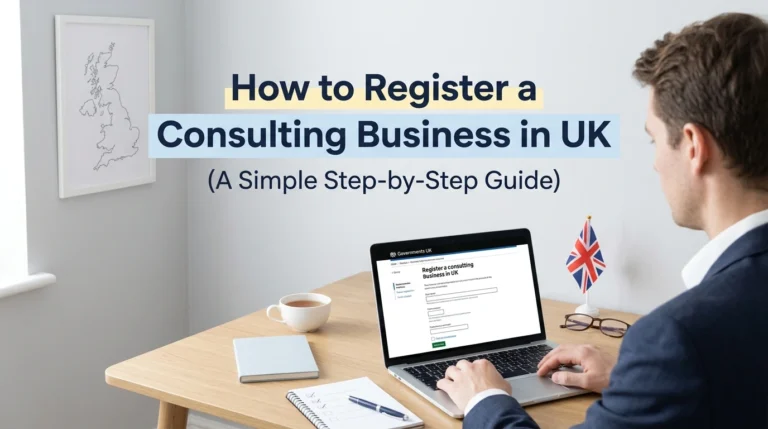
Business Registration in UK
When setting up a consulting business in the UK, every consultant needs to make a basic decision: operate as a sole trader or form a limited company.
As a sole trader, you register with HMRC and file a Self Assessment tax return each year. It’s the simplest option: no Companies House filing, no annual accounts, and minimal administration. Your business and your personal finances are legally the same thing, which means you’re personally liable if something goes wrong.
As a limited company, you register with Companies House and operate as a separate legal entity. Your personal assets are protected from business liabilities. Many clients, especially large companies and public sector organizations, prefer or require suppliers to operate as limited companies. The administrative requirements are higher, but the structure is more professional and often more tax-efficient at higher income levels.
Most consultants who are just starting out begin as sole traders for simplicity, then move to a limited company once their income justifies it. Others start as a limited company from day one if they’re targeting corporate clients.
For the full registration process, step-by-step instructions, and what to do after you’ve registered, read our detailed guide on how to register a consulting business in UK.
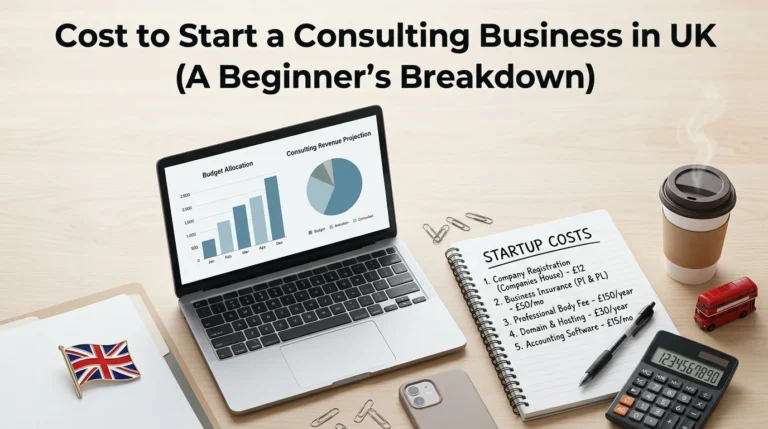
Cost to Start a Consulting Business in UK
The honest answer is that a consulting business can be started for very little money. Unlike product businesses, you’re not buying inventory, manufacturing anything, or leasing warehouse space.
If you start as a sole trader, your registration is free. If you form a limited company, Companies House charges £12 to register online. Beyond that, your core startup costs depend on the choices you make.
A basic professional website costs between £300 and £1,500 if you hire someone to build it, or close to nothing if you use a platform like Squarespace or Wix yourself. Business cards, a professional email address, and a simple contract template are minimal additional costs.
Professional indemnity insurance typically runs between £200 and £800 per year for a solo consultant, depending on the coverage level and your industry.
If you need software accounting tools, project management platforms, or video call systems, most have affordable plans, and many offer free tiers for small businesses.
Most consultants in the UK can start for between £500 and £2,000 in total, and many start for less. The bigger investment is your time, not your money.
For a detailed breakdown of startup costs by category, including what’s optional and what you genuinely need, read our full guide on the cost to start a consulting business in UK.
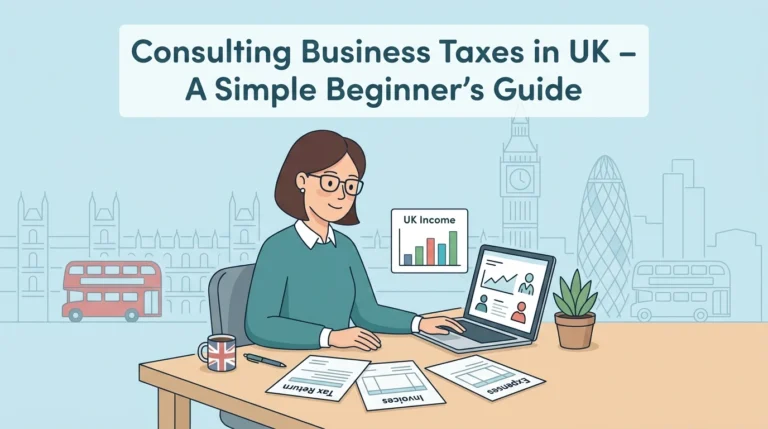
Consulting Business Taxes in UK
Tax is one of the areas that makes new consultants most nervous. It doesn’t need to be.
As a sole trader, you pay income tax on your profits through self-assessment, plus national insurance contributions. The tax year in the UK runs from 6 April to 5 April the following year, and your Self Assessment return is due by 31 January after that.
As a limited company director, the tax picture is more involved. Your company pays Corporation Tax on its profits. You typically take a combination of salary and dividends, which can be more tax-efficient at higher income levels.
All consultants should register for VAT once their taxable turnover exceeds £85,000 (the current threshold). Some consultants register voluntarily before that point, particularly if their clients are VAT-registered businesses that can reclaim it.
Whatever your structure, keeping clean records throughout the year makes tax time much less stressful. Track every invoice you send and every business expense you incur.
For a full explanation of what taxes apply to consultants in the UK, how to pay them, and what you can deduct, read our complete guide on consulting business taxes in UK.
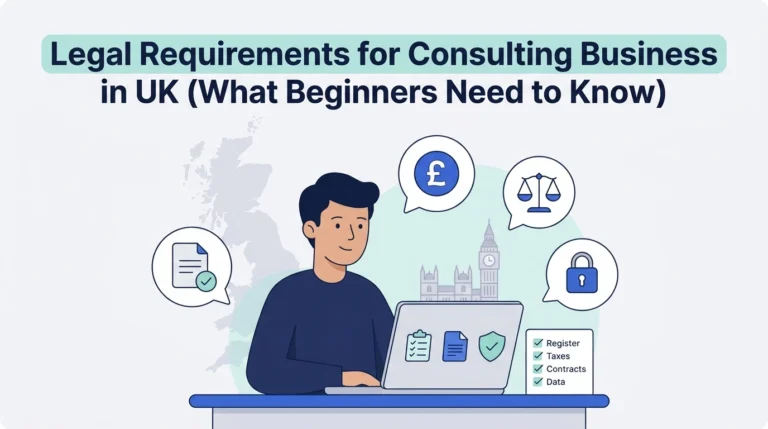
Legal Requirements for Consulting Business in UK
The legal side of consulting is manageable, but you do need to get the basics right.
The most important legal requirement for any consultant is a proper client contract. Before you start work for any client, you should have a written agreement that covers the scope of work, payment terms, deliverables, intellectual property ownership, confidentiality, and how the contract can be ended by either party.
Professional indemnity insurance is legally required in some consulting fields (particularly financial advice, legal advice, and some healthcare-adjacent work) and strongly recommended in most others. If your advice causes a client financial loss, professional indemnity insurance covers the legal costs of defending yourself and any compensation you have to pay.
Depending on your work, data protection under UK GDPR may also apply. If you handle any personal data from clients or their customers, you have legal obligations around how you store and process it. You may also need to register with the Information Commissioner’s Office (ICO), which costs £40 to £60 per year for most small businesses.
For a full explanation of every legal requirement that applies to UK consultants, including business structure, insurance, contracts, and data protection, read our detailed guide on the legal requirements for consulting business in UK.
Best Cities in UK for Consultants
Where you’re based matters, but perhaps less than you’d expect. Most UK consulting work today involves a mix of remote and in-person engagement, and many consultants serve clients nationally from wherever they live.
That said, certain cities offer natural advantages depending on your niche.
London
London is the undisputed center of the UK consulting market. It’s home to the headquarters of most major UK corporations, the largest financial services sector in Europe, and a dense concentration of professional services firms. If you’re targeting large corporate clients, financial institutions, or media companies, London puts you closest to that market.
The trade-off is the cost of living and working. Office space is expensive. Experienced talent is expensive. And the competition is intense. But for the right niche, London’s client density is unmatched.
Manchester
Manchester is the most significant consulting market outside London. It has a strong presence of financial services, technology, media, and healthcare companies. The BBC, major banks, and several significant tech employers are all based there. The cost of living is substantially lower than in London, which means a consulting practice can be profitable at lower revenue levels.
For consultants targeting the Northern powerhouse market, Manchester is the natural base.
Birmingham
Birmingham is the UK’s second largest city and has a diverse economy spanning manufacturing, professional services, retail, and an increasingly active technology scene. The cost of operating here is lower than in Manchester, and the market is less competitive.
The city also benefits from its central location. Consultants based in Birmingham can reach clients in London, Manchester, Bristol, and the Midlands without excessive travel time.
Leeds
Leeds has developed into a genuine financial services hub outside London. Several major banks, insurance companies, and professional services firms have significant Leeds operations. It also has strong legal and property sectors. For consultants in finance, law, or professional services, Leeds is worth serious consideration.
Common Mistakes Beginners Make
A few patterns come up repeatedly among consultants who struggle in their first year.
Trying to serve everyone. The desire to take any work that comes in is understandable when you’re starting out, but it makes it very hard to build a reputation. Pick a lane and stay in it, at least initially.
Undercharging. Most beginners set their rates too low. They’re worried about losing clients to price, but consulting is rarely chosen on price alone. Undercharging attracts difficult clients and signals low confidence in your own value.
Starting without a contract. Even with people you trust, always have a written agreement before you start any paid work. Disputes are rare, but when they happen without a contract, they’re extremely difficult to resolve.
Waiting until everything is perfect. A lot of people spend months building websites, designing logos, and writing service descriptions before approaching a single potential client. You can iterate all of that. You can’t get those months back.
Neglecting cash flow. Consulting income can be lumpy, with big payments followed by quiet periods. Keep track of what’s coming in and when, and maintain a financial buffer before you go full-time.
Tips for Long-Term Success
The consultants who build lasting businesses in the UK tend to do a few things consistently.
They focus on outcomes, not activities. Clients don’t buy your time they buy the results you help them achieve. Keep that perspective in your client conversations and your pricing.
They invest in relationships. Most consulting business comes from people who know you or have been referred by someone who does. Treat every client as a potential source of referrals and stay in touch even when a project ends.
They keep their skills current. Markets change, and so does best practice in most industries. Consultants who stop learning gradually become less valuable.
They manage their finances carefully. This means tracking income and expenses monthly, setting aside money for taxes, and not confusing revenue with profit.
And they know when to get professional help, whether that’s an accountant to handle their tax returns, a lawyer to review a contract, or a business mentor to help them through a difficult decision.
Conclusion
Starting a consulting business in the UK is genuinely achievable for beginners as well as experienced professionals. The market is receptive, the setup process is straightforward, and the earning potential for a well-positioned consultant is real.
The key is to start with clarity. Know what you offer, who you help, and what result you deliver. Get the basics in place registration, a contract, and a bank account. Then focus your energy on finding your first clients and doing excellent work for them.
Everything else grows from there.
Whether you’re ready to start a consulting business tomorrow or still weighing your options, the most important step is simply deciding to move forward.
FAQs
Do I need a qualification to start a consulting business in UK?
In most areas, no. Consulting isn’t a legally regulated profession in the UK (unlike law or medicine). What matters is your knowledge, your track record, and the results you can deliver for clients. Some specialist areas, financial advice, legal advice, and certain healthcare roles do require specific qualifications or FCA authorization.
How long does it take to start getting clients?
It varies, but most consultants land their first client within one to three months of actively looking, particularly when they start with people they already know. Building a reliable client base typically takes six months to a year.
Should I start as a sole trader or limited company?
Most beginners start as sole traders for simplicity and switch to a limited company once their income is consistent and the tax benefits become meaningful. If you’re targeting large corporate clients from day one, starting as a limited company can make a better impression.
How much should I charge as a consultant in UK?
Day rates for consultants in the UK typically range from £250 to over £1,500, depending on the specialism and client type. Hourly rates run from around £75 to £400 or more. Research what others in your niche charge and position yourself based on your experience and the value you deliver.
Do I need an office to run a consulting business in UK?
No. The vast majority of UK consultants work from home and meet clients at their offices or remotely. A home office setup, a good desk, reliable internet, and a professional video call background are almost all consultants need to start.
What’s the quickest way to set up a consulting business in the UK?
The fastest route is registering as a sole trader with HMRC, which you can do online in under an hour at no cost. From there, setting up a consulting business in the UK requires a few essentials: a separate bank account, a basic client contract, and a clear offer. Many consultants are operational within a week of making the decision. Speed matters less than getting those fundamentals right before you approach your first client.