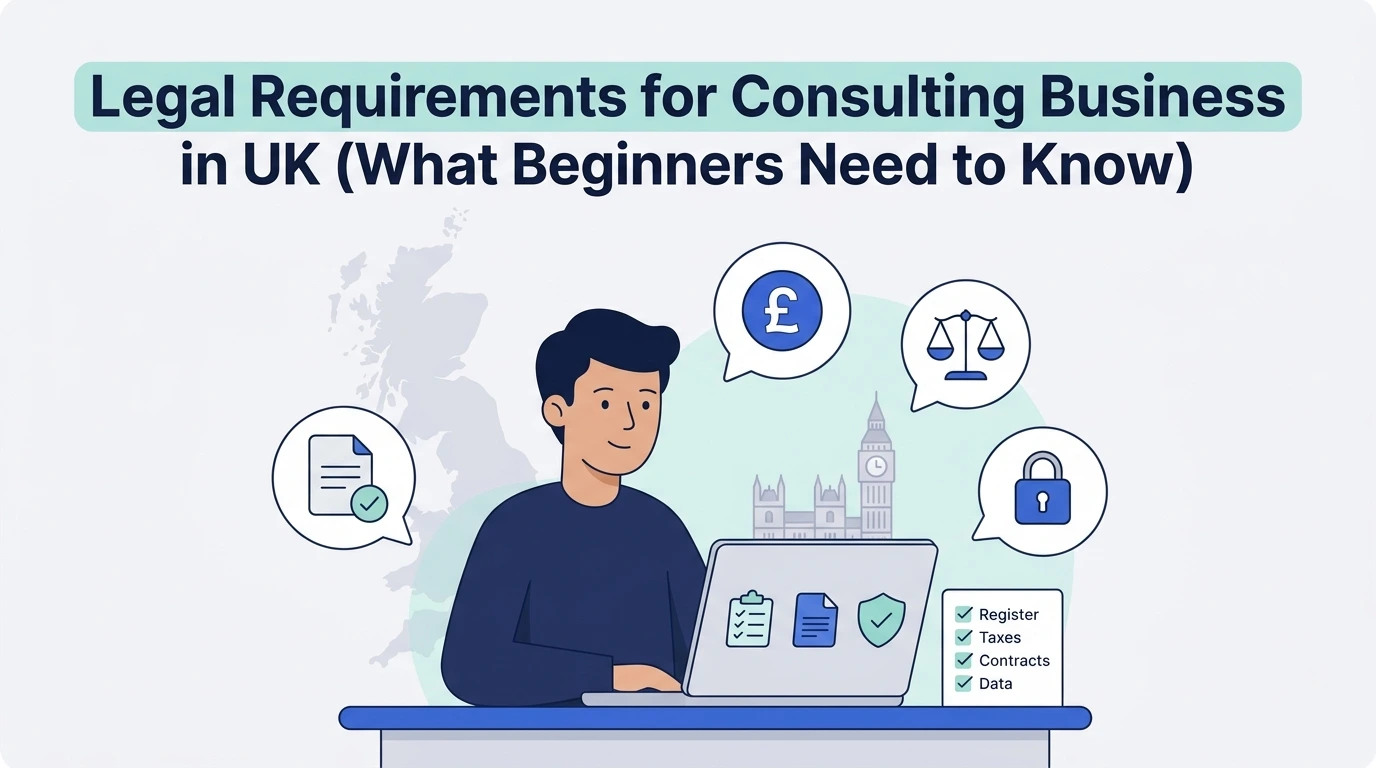
Legal Requirements for Consulting Business in UK (What Beginners Need to Know)

Introduction
The legal side of starting a consulting business can feel like the most confusing part. Most beginners either ignore it completely and hope for the best, or they get so overwhelmed they delay starting altogether. Neither approach is great.
The truth is, understanding the legal requirements for consulting business in UK doesn’t require a law degree. The basics are clear, and most of what you need to do is straightforward once someone explains it properly.
This guide covers everything a new consultant needs to know, from registering your business and writing contracts to insurance and data protection. Take it one step at a time, and you’ll have a solid legal foundation before you land your first client.
Do Consultants Need Legal Registration in UK?
Yes, but the process is simpler than most people expect.
If you’re starting out as a sole trader, you don’t need to register with Companies House. You simply register with HMRC as self-employed, which you can do online in about 10 minutes. There’s no fee, and once it’s done, you’re legally operating as a business.
If you choose to set up a limited company, you register through Companies House. The online process costs £12 and typically takes 24 hours. Once approved, your company exists as a separate legal entity distinct from you personally.
Neither structure requires a formal business license to consult in most industries. The main legal obligation for both is registering with HMRC and keeping proper financial records.
The one important deadline to remember: if you’re a sole trader, you need to register with HMRC by 5 October following the end of the tax year in which you started working. Missing this can result in a penalty, so don’t leave it late.
Business Licenses and Permits in UK
Most consultants don’t need a specific license to operate. The UK doesn’t require a general consulting license, unlike some industries such as financial advice, healthcare, or legal services, which have their own regulatory requirements.
That said, the sector you’re consulting in matters. If your work involves financial advisory services, you may need to be authorized by the Financial Conduct Authority (FCA). If you consult in healthcare, there may be professional registration requirements with relevant bodies.
For the majority of consultants working in marketing, HR, management, IT, strategy, or operations, no specific license is needed. You register with HMRC, comply with tax obligations, and trade legally.
If you’re ever unsure whether your specific area of consulting requires a license or professional authorization, the government’s official business license finder at gov.uk is a reliable starting point.
Sole Trader vs Limited Company Legal Differences
Choosing your business structure is one of the most important early legal decisions you’ll make. It affects your personal liability, your tax obligations, and how you’re seen by clients.
As a sole trader, you and your business are legally the same person. This is simple and cheap to set up, but it means you’re personally responsible for any business debts or legal claims. If a client sues you, your personal assets, including savings and property, could be at risk.
A limited company is a separate legal entity. The company owns its assets, enters contracts, and is liable for its debts. Your personal liability is generally limited to the amount you’ve invested in the company. This offers meaningful protection, especially as your consulting work grows and involves larger contracts.
Many consultants start as sole traders and later switch to a limited company once their income justifies it. From a purely legal standpoint, both are fully legitimate ways to consult in the UK. The choice mainly depends on your risk exposure, income level, and the preferences of your clients. Some larger organizations prefer to contract with limited companies.
Contracts and Client Agreements
A written contract is one of the most important legal protections you have as a consultant. Without one, disputes about scope, payment, and deliverables become very difficult to resolve.
A basic consulting agreement should cover what services you’re providing, the timeline, how much you’re being paid and when, what happens if either party wants to cancel, who owns the intellectual property created during the project, and a clause limiting your liability if something goes wrong.
You don’t need a lawyer to draft your first contract there are solid templates available from reputable sources. But if you’re working on a high-value project or with a large organization, having a solicitor review your contract is worth the cost.
Always get the contract signed before work begins. Verbal agreements happen, but they’re almost impossible to enforce if something goes wrong.
One thing many beginners miss: your client may send you their own contract rather than accepting yours. Read it carefully before signing. Pay attention to intellectual property clauses, payment terms, and any clauses about exclusivity or non-competition.
Business Insurance for Consultants
Insurance isn’t always legally required, but for most consultants, it’s practically essential.
Professional indemnity insurance is the most important policy for consultants. It protects you if a client claims your advice or work caused them financial loss. Even if you’re confident in your work, mistakes happen, and one claim without insurance could be financially devastating.
Public liability insurance matters if you ever meet clients in person, visit their offices, or host events. It covers claims of injury or property damage related to your business activities.
If you’re operating as a sole trader, insurance is particularly important because you have no limited liability protection. As a limited company director, the company structure offers some protection, but professional indemnity insurance is still strongly recommended, and many clients will require proof of it before signing a contract.
Basic professional indemnity cover starts at around £150 to £300 per year for most consultants. The exact cost depends on your industry, income level, and the size of contracts you handle.
GDPR and Client Data Protection
If you store or process any personal information, client names, email addresses, or contact details, then GDPR (General Data Protection Regulation) applies to you. This isn’t optional. It’s UK law.
The key principles are simple. You must only collect data you actually need, store it securely, not share it without consent, and delete it when it’s no longer needed.
As a consultant, you should have a basic privacy policy if you have a website that collects visitor information. You should also have a clear process for handling client data responsibly.
You may also need to register with the Information Commissioner’s Office (ICO). Most small businesses that handle personal data are required to pay an annual data protection fee, which starts at £40 per year. The ICO website has a self-assessment tool to tell you whether you need to register.
This sounds like a lot, but for most solo consultants, the practical requirements are minimal. Secure your email, use strong passwords, don’t store sensitive client information longer than you need to, and have a simple privacy policy. That covers most of it.
HMRC and Companies House Compliance Basics
Your ongoing legal obligations will depend on your business structure, but a few things apply to almost every UK consultant.
For sole traders, the main responsibilities are registering with HMRC as self-employed, filing an annual Self Assessment tax return by 31 January, paying income tax and National Insurance on your profits, and keeping financial records for at least five years.
For limited companies, the obligations are broader. You must file a Confirmation Statement with Companies House every year (currently £13 online), file annual accounts, submit a Corporation Tax return to HMRC, and maintain up-to-date records of company directors and shareholders.
If your consulting income exceeds the VAT registration threshold, currently £90,000 per year you’re legally required to register for VAT and file quarterly returns.
Missing any of these deadlines can result in penalties. HMRC and Companies House are both clear about their requirements, and the deadlines are consistent year to year, so once you know them, they’re easy to plan for.
Common Legal Mistakes Beginners Make
Starting work without a written contract is probably the most common and most costly mistake. Even informal projects can turn into disputes, and without a signed agreement, you have almost no legal ground to stand on.
Operating without professional indemnity insurance, especially when client contracts are large or the stakes are high, is another serious risk many beginners take without realizing it.
Missing the HMRC registration deadline is easier to do than you’d think, especially if you start consulting informally before you’ve thought through the admin side.
Ignoring GDPR because it sounds complex is a mistake that can come back to bite you. The basic requirements for a solo consultant are genuinely simple don’t let the jargon put you off.
Using a client’s contract without reading it properly is also surprisingly common. Pay close attention to payment terms, IP ownership, and any clause that limits what other clients you can work with.
Tips to Stay Legally Safe as a Consultant in UK
Always use written contracts, even for small projects or clients you know personally. Relationships change, memories fade, and a clear document protects both sides.
Keep your business and personal finances completely separate. Open a dedicated business bank account and never mix personal spending with business transactions. This protects you legally and makes tax time significantly easier.
Keep your company records up to date. If you’re a limited company director, missing a Confirmation Statement filing is a simple mistake that can cause real problems.
Review your insurance policy annually. As your business grows, your level of cover should grow with it.
Stay on top of HMRC deadlines. Put the key dates in your calendar every year 5 October for new self-employment registration, 31 January for Self Assessment, and quarterly VAT deadlines if relevant.
If you’re still putting together the full picture of how to set up your consulting business legally and practically, the main guide on how to start a consulting business in UK walks through the whole process from the beginning.
When Should You Speak With a Lawyer or Accountant?
You don’t need professional legal advice before sending your first invoice. But there are moments when getting expert input is genuinely worth the cost.
Speak to a solicitor if you’re reviewing a high-value or complex client contract, if a client is threatening legal action, if you’re creating a shareholders’ agreement for a limited company, or if you’re unsure whether your sector requires specific professional authorization.
Speak to an accountant before deciding between sole trader and limited company structures when your income grows to the point where tax planning genuinely matters and when you’re setting up payroll or bringing in employees.
Early on, many of these needs simply don’t arise. But knowing when to get help and not waiting too long when you do need it is a mark of a well-run business.
Conclusion
The legal requirements for consulting business in UK are genuinely manageable for any beginner who takes the time to understand them. Register correctly, use written contracts, get the right insurance, handle client data responsibly, and keep up with your HMRC and Companies House obligations.
None of these steps are difficult. They just require a bit of attention upfront. Get the basics right from the start, and the legal side of your consulting business will run quietly in the background exactly where it should be.
Frequently Asked Questions
Do I need a business license to start a consulting business in UK?
Most consultants don’t need a specific license. Unless you’re working in a regulated field like financial advice or healthcare, you simply register with HMRC as self-employed or set up a limited company through Companies House. That’s your legal basis for trading.
What is professional indemnity insurance and do I need it?
Professional indemnity insurance protects you if a client claims your advice or work caused them financial loss. It’s not legally required in most fields, but it’s strongly recommended, especially for consultants handling significant projects. Many clients will ask for proof of cover before signing a contract.
Do I need to register for GDPR as a consultant?
If you handle any personal data such as client contact details or employee records, GDPR applies to you. You may also need to pay the annual data protection fee to the ICO, which starts at £40. The ICO website has a simple tool to check whether registration is required.
What should a consulting contract include?
At a minimum, your contract should cover the scope of work, payment terms and amounts, the timeline, cancellation terms, who owns the intellectual property created, and a liability limitation clause. Getting this in writing before starting any project protects both you and your client.
Is a limited company legally safer than being a sole trader?
Generally, yes. A limited company provides limited liability, meaning your personal assets are usually protected if the company faces legal claims or debts. As a sole trader, you’re personally liable, which means your personal savings and property could be at risk in a serious dispute. However, professional indemnity insurance provides significant protection for sole traders too.