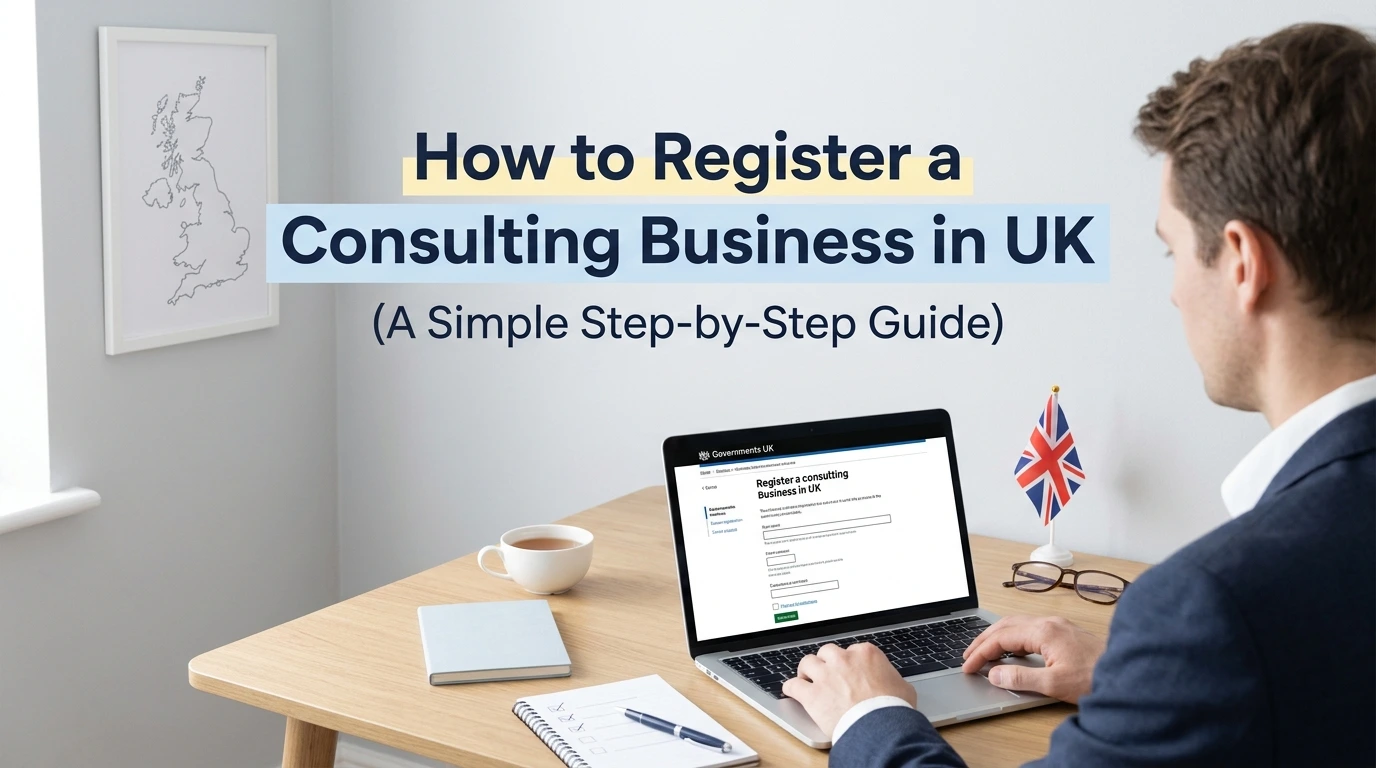
How to Register a Consulting Business in UK (A Simple Step-by-Step Guide)

Introduction
Getting your consulting business officially registered is one of those tasks that sounds more complicated than it actually is. Most people put it off because they’re not sure where to start or which rules apply to them. But once you understand the basics, the whole process is fairly quick, and in many cases, you can complete it in a single afternoon.
This guide walks you through how to register a consulting business in UK from scratch, in plain language. No jargon, no confusion, just a clear explanation of your options and what to do at each step.
Do You Need to Register a Consulting Business in UK?
Yes. If you’re charging clients for your services even on a part-time or occasional basis, you’re legally required to tell HMRC you’re self-employed. Operating without registering is not a gray area. HMRC expects to know about your income, and penalties apply if you don’t declare it on time.
The good news is that registration in the UK is genuinely simple compared to many other countries. You don’t need a lawyer, a large budget, or weeks of preparation. What you do need is a clear understanding of which business structure suits your situation.
Types of Business Structures in UK
Before you can register anything, you need to decide how your business will be structured. This is the most important early decision because it affects your taxes, your personal liability, and how clients perceive you.
Sole Trader
A sole trader is the simplest structure. You register with HMRC as self-employed, file a Self Assessment tax return each year, and pay income tax and National Insurance on your profits. There’s no separation between you and your business legally; they’re the same thing.
This means if your business owes money or faces a legal claim, your personal assets (including your savings and home) could be at risk. For most solo consultants starting out with low-risk work and no employees, this isn’t a practical concern. But it’s worth understanding.
The sole trader route suits consultants who want to start quickly, keep administration minimal, and aren’t targeting large corporate clients who may require a more formal structure.
Partnership
A partnership is used when two or more people run a business together. Each partner registers with HMRC individually and is responsible for their share of the profits and the debts. Like sole traders, partners have personal liability for the business.
A limited liability partnership (LLP) is a variation that gives partners some protection from personal liability. LLPs are less common for small consulting practices but relevant if you’re starting with a co-founder and want some structural protection.
Limited Company
A limited company is a separate legal entity from you personally. It has its own name, its own bank account, and its own tax obligations. You are a director (and usually a shareholder) of the company, not the company itself.
This separation means your personal assets are generally protected if the business runs into trouble. It also means the business pays corporation tax on its profits rather than income tax, which can be more efficient at higher income levels.
Many consultants start as sole traders and switch to a limited company once their income grows. Others go straight to a limited company if they’re targeting corporate clients or want the professional credibility that comes with “Ltd.” in the business name.
Choosing a Business Name in UK
Your business name matters for practical and professional reasons. A few rules apply.
As a sole trader, you can trade under your own name with no registration needed. If you want to trade under a different name, say, “Northfield Consulting,” instead of your personal name, you can do so, but you need to display your real name on business documents.
For a limited company, your name must be unique and is checked against the Companies House register when you apply. You can’t use a name that’s identical or too similar to an existing registered company. You also can’t use certain restricted words without approval (words like “Royal,” “Bank,” or “Institute”).
A few practical tips: keep the name professional and easy to spell. Avoid names that are too narrow if you might expand your services later. And before you get attached to a name, check that the domain name and social media handles are available too.
Step-by-Step Process to Register a Consulting Business in UK
Here’s the practical sequence depending on which structure you choose.
If you’re registering as a sole trader:
Go to the HMRC website and register for Self Assessment. You’ll need your National Insurance number and basic personal details. HMRC will send you a Unique Taxpayer Reference (UTR) number, usually within 10 working days. Keep this safe you’ll use it every year when you file your tax return.
That’s genuinely it for the registration itself. Simple.
If you’re registering a limited company:
Go to Companies House at companieshouse.gov.uk and use their online registration service. You’ll need to provide your company name; a registered office address (this must be a physical UK address, and it can be your home) the details of all directors and shareholders; and a memorandum and articles of association (Companies House provides a standard template you can use).
The fee is £12 if you register online. Companies House usually approves registrations within 24 hours, sometimes the same day.
Once your company is registered, you’ll also need to register with HMRC for corporation tax within three months of starting to trade. You’ll do this through HMRC’s online services using your company’s unique taxpayer reference.
If your turnover will exceed the VAT threshold (currently £85,000), you’ll also need to register for VAT, but this is rarely relevant when you’re just starting out.
HMRC and Companies House Basics
These are the two main government bodies you’ll deal with when registering and running your consulting business in the UK.
HMRC (His Majesty’s Revenue and Customs) handles all things tax-related. Your Income Tax, National Insurance, Corporation Tax, VAT, and PAYE (if you ever hire employees) all flow through HMRC. You’ll create a Government Gateway account to manage most of this online.
Companies House handles business registration. If you form a limited company, you’ll file your annual accounts and confirmation statement through Companies House every year. These filings are public anyone can look up your company’s details on the Companies House register.
For sole traders, you only deal with HMRC. Companies House isn’t relevant unless you later decide to incorporate.
Business Licenses and Permits in UK
Most consultants don’t need a special license to operate. General business consulting, management consulting, marketing consulting, IT consulting, and similar fields have no specific license requirement in the UK.
However, some areas do require authorization or registration with a regulatory body. Financial consultants who give regulated financial advice need to be authorized by the Financial Conduct Authority (FCA). Healthcare consultants in certain roles may need CQC registration or professional body membership. Legal consultants practicing law must be regulated by the Solicitors Regulation Authority (SRA) or another approved body.
If your consulting work touches a regulated industry, take 30 minutes to check whether your specific activities require any authorization. In most general consulting fields, they won’t.
One additional registration worth knowing about: if you handle personal data from clients or third parties, you may need to register with the Information Commissioner’s Office (ICO) under UK GDPR. The fee is £40 to £60 per year for most small businesses. It’s quick to do online and often overlooked by beginners.
Registration Costs in UK
One of the appealing things about starting a consulting business in the UK is how affordable the registration process is.
Registering as a sole trader with HMRC is completely free. There’s no charge.
Registering a limited company through Companies House costs £12 online. Third-party immigration agents charge more, typically £20 to £50, for the same service with some added assistance. For most straightforward registrations, the Companies House website is all you need.
If you use an accountant to handle your company formation, expect to pay between £50 and £200 as part of a broader setup package. Many accountants offer company formation as part of their ongoing service.
ICO registration, if needed, is £40 to £60 per year depending on your organization’s size and turnover.
That covers the required costs. Any other expenses, accounting software, a business bank account, and professional insurance are separate from registration itself.
Online Registration vs Hiring an Accountant
For most consultants, online registration is perfectly manageable without professional help.
The HMRC Self Assessment registration for sole traders is a short online form. The Companies House online incorporation service is clear and walks you through each step. Both are designed to be used by ordinary people, not just accountants.
That said, there are situations where having an accountant involved from the start makes sense.
If you’re unsure which business structure is right for your situation, particularly around the tax implications of a sole trader vs a limited company, an accountant can model out the numbers for you. Getting this decision right from day one can save meaningful money over time.
If your situation is anything other than straightforward, you’re coming from a previous business, you have existing income from other sources, or you’re registering from overseas, professional advice is worth the cost.
Many accountants who work with small businesses offer an initial consultation for free or a fixed low fee. It’s worth a conversation before you commit to a structure you might want to change later.
Common Registration Mistakes Beginners Make
A few mistakes come up repeatedly among people registering for the first time.
Registering too late. You must register as self-employed with HMRC by 5 October following the end of the tax year in which you started trading. Missing this deadline results in a penalty. Don’t put it off.
Using a business name that causes problems later. Choosing a name that’s too similar to an existing company, hard to spell, or impossible to find online creates unnecessary friction. Do your checks before you commit.
Forgetting to open a separate business bank account. This isn’t technically a registration step, but it’s one of the first things you should do after registering. Mixing personal and business finances makes your accounting much harder and looks unprofessional to clients.
Not understanding the ongoing filing requirements. Registration isn’t a one-time event. Sole traders file a self-assessment return every year. Limited companies file annual accounts and a confirmation statement with Companies House. Missing these has real consequences, including fines and company dissolution.
Assuming registration covers everything legal. Registration gets you started, but it doesn’t replace a proper client contract or professional insurance. Those are separate steps that matter just as much.
Tips Before Registering Your Consulting Business
Take a little time before registering to think through a few things.
Decide on your structure before you start. The choice between a sole trader and a limited company has real tax implications. If you’re earning less than around £30,000 to £35,000 in profit, being a sole trader is often simpler and no less tax-efficient. Above that, the numbers shift.
Have your registered address sorted out. For a limited company, you need a physical UK address for Companies House. This can be your home, a coworking space, or a registered office service.
Check if your name is available. Search Companies House and do a quick domain name search before you fall in love with a business name.
Think about VAT from the start. Even if you’re well below the threshold now, understanding how VAT works will help you price correctly and avoid surprises as you grow.
If you’re working through all the foundations of your consulting practice at the same time your services, your pricing, how to find clients the main guide on how to start a consulting business in UK covers all of that in full and is worth reading alongside this one.
Conclusion
Registering a consulting business in the UK is much simpler than most people expect. For sole traders, it’s a short online form with HMRC and costs nothing. For limited companies, it’s a £12 online application to Companies House that typically completes within 24 hours.
The more important decisions, which structure to choose, what name to use, and whether to involve an accountant, take a bit more thought. But the mechanics of registration itself are straightforward.
Get registered early, keep your records clean from day one, and don’t let the paperwork side of things slow you down from getting to work.
FAQs
How long does it take to register a consulting business in UK?
Sole trader registration with HMRC typically takes 10 working days to receive your UTR number, though the form itself takes minutes. Limited company registration through Companies House online usually completes within 24 hours.
Can I start consulting before I register?
Technically you should register before you start trading or as soon as possible after. HMRC requires you to register by 5 October after the end of the tax year in which you started earning. Don’t leave it too long.
Do I need a business bank account to register?
No, a business bank account isn’t required for registration. But you should open one immediately after registering. Mixing personal and business finances creates accounting headaches and looks unprofessional.
What’s the difference between HMRC and Companies House?
HMRC handles your taxes: income tax, corporation tax, VAT, and national insurance. Companies House handles business registration and maintains the public register of UK companies. Sole traders only deal with HMRC. Limited companies deal with both.
Can someone outside the UK register a consulting company in the UK?
Yes. Non-UK residents can register a limited company in the UK, but they’ll need a UK-registered office address and must meet Companies House requirements. It’s worth speaking with an accountant familiar with international setups if this applies to you.