
Business Consulting: A Complete Guide to How It Works and Why It Matters
Business consulting is one of the most widely used professional services in the world, yet many business owners and executives have only a vague understanding of what it actually involves and whether it would benefit their organization.
At its core, business consulting means bringing outside expertise into an organization to solve a specific problem, improve a specific function, or guide a significant decision. A consultant analyzes the situation, develops recommendations, and often helps implement those recommendations in a way that produces measurable results.
This guide covers everything you need to understand about business consulting: what it is, what consultants actually do, what types of consulting exist, how the engagement process works, and how to determine whether hiring a consultant makes sense for your specific situation.
What Business Consulting Is
Business consulting is a professional service in which an individual or firm provides expert analysis, strategic advice, and practical guidance to organizations seeking to solve problems, improve performance, or navigate significant change.
The relationship between a consultant and a client is built on knowledge asymmetry. The client has deep familiarity with their own organization but may lack expertise in a specific domain, an outside perspective on a familiar problem, or the bandwidth to address a challenge while managing day-to-day operations. The consultant brings the expertise, the fresh perspective, or the focused capacity that the client lacks.
Consulting engagements range from short diagnostic assessments lasting a few days to multi-year transformation programs involving large consulting teams. The scope, structure, and cost vary enormously depending on the complexity of the problem and the size of the organization involved. For a focused explanation of the definition and core concepts, see the article on What is business consulting?.
What Business Consultants Do
Business consultants analyze organizational problems, develop solutions, and guide implementation. The specific work varies by engagement type and industry, but most consulting work involves some combination of diagnosis, analysis, recommendation, and support.
In the diagnostic phase, consultants gather information about the client’s situation through interviews, data analysis, process observation, and document review. The goal is to understand the problem accurately rather than accepting the client’s initial description of it at face value. Clients often present a symptom when the underlying issue is something different.
In the analysis phase, consultants apply their expertise and analytical frameworks to interpret what the diagnostic work revealed. They identify patterns, compare the client’s situation to relevant benchmarks, and develop a clear understanding of root causes and contributing factors. In the recommendation phase, consultants present their findings and propose specific actions. Recommendations are typically prioritized by impact and feasibility, with clear rationale for each suggestion.
In the implementation phase, consultants may support the client in executing recommended changes. Some engagements end at the recommendation stage. Others involve ongoing consultant involvement through the implementation process. The supporting article on [what does a business consultant do] covers the full scope of consultant responsibilities in more detail.
Types of Business Consulting
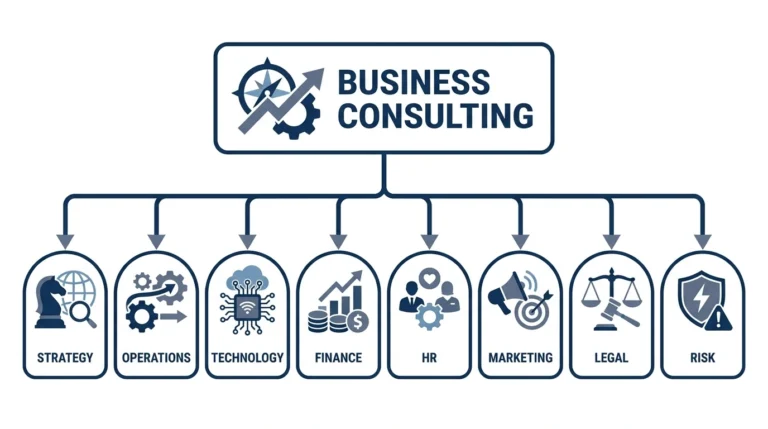
Business consulting spans a wide range of specializations. Organizations engage different types of consultants depending on where their needs are greatest.
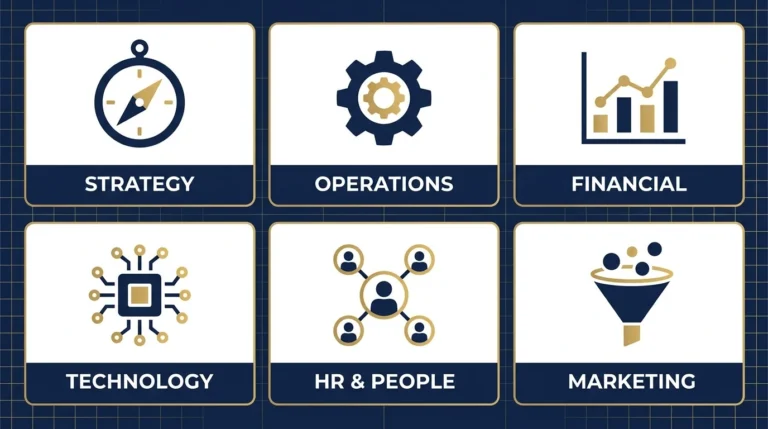
Strategy consulting addresses the highest-level business questions: market positioning, competitive strategy, growth planning, business model design, and major investment decisions. Strategy consultants typically work with senior leadership and produce analysis that shapes organizational direction. Operations consulting focuses on how businesses run internally. Process efficiency, supply chain management, cost reduction, quality improvement, and workflow design are the primary concerns. Operations consultants often work closely with functional teams rather than executive leadership.
Financial consulting covers financial planning, cash flow management, cost structure analysis, M&A advisory, and financial reporting improvement. Financial consultants serve businesses that need expertise beyond their internal finance team’s capacity. Technology consulting helps organizations make better decisions about technology: infrastructure planning, software selection, systems integration, cybersecurity, and digital transformation. Technology consultants work across industries wherever technology complexity exceeds internal expertise.
Human resources consulting addresses workforce strategy, talent acquisition, compensation design, organizational structure, and culture development. HR consultants serve organizations that lack internal people operations expertise or need an outside perspective on workforce challenges. Marketing consulting covers brand strategy, digital marketing, content strategy, market research, and customer acquisition. Marketing consultants help businesses improve how they reach and convert their target audience.
For a comprehensive breakdown of every major consulting category, the article on types of business consulting covers each in detail.
Business Consulting Services
The services that consulting firms and independent consultants offer vary by specialization, but several categories of service are common across most consulting practices. Diagnostic assessments evaluate a specific function, process, or strategic situation and produce a structured analysis of current state, identified gaps, and prioritized recommendations. These are typically fixed-scope engagements with a defined deliverable.
Strategic planning facilitation helps leadership teams develop organizational strategy through structured processes. The consultant designs and leads the process rather than producing the strategy independently. Process improvement consulting maps current workflows, identifies inefficiencies, and designs improved processes using methodologies such as Lean or Six Sigma.
Change management consulting helps organizations implement significant changes, such as technology implementations, restructuring, or culture shifts, by managing the human side of the transition. Training and capability building transfers specific knowledge or skills to client teams so that the organization retains capability after the engagement ends.
Ongoing advisory retainers provide clients with regular access to consulting expertise on a monthly basis, typically for organizations that need consistent outside guidance rather than a single defined project. The article on business consulting services provides a detailed breakdown of each service category with guidance on when each is most appropriate.
How Business Consulting Works
The typical consulting engagement follows a structured process regardless of the specific service being delivered. Understanding this process helps clients set appropriate expectations and get more value from their engagement.
The engagement begins with a scoping conversation in which the consultant and client define the problem to be addressed, the expected outcome, the timeline, the deliverables, and the fee structure. A well-scoped engagement is the foundation of a successful outcome. Vague scoping leads to misaligned expectations and difficult conversations later.
A formal proposal documents the agreed scope and serves as the basis for the client contract. The contract covers scope, deliverables, payment terms, confidentiality obligations, and intellectual property ownership. The discovery phase follows contract signing. The consultant gathers information through interviews, data collection, process observation, and document review. This phase typically takes one to four weeks depending on engagement complexity.
Analysis and synthesis happen as the consultant interprets the discovery findings against their expertise and relevant frameworks. This phase produces the insights that drive recommendations. Recommendations are presented through a formal deliverable, typically a written report and a presentation to relevant stakeholders. Effective consultants present findings in business terms that non-specialists can act on, not just technical analysis.
Implementation support varies by engagement. Some consultants move directly into supporting implementation after the recommendation phase. Others conclude the engagement at the recommendation stage and remain available for questions. The supporting article on [how business consulting works] covers the engagement lifecycle in complete detail.
Why Businesses Hire Consultants
Organizations hire consultants for several distinct reasons, and understanding those reasons helps both clients and consultants frame engagements more effectively. The most common reason is expertise gaps. The organization needs knowledge or skills that do not exist internally, and hiring a full-time specialist is either too expensive or not warranted by the volume of need.
The second common reason is outside perspective. Internal teams develop blind spots over time. People who have worked in the same organization for years may be too close to familiar problems to see them clearly. A consultant brings fresh eyes and pattern recognition from working across multiple organizations. Capacity constraints drive consulting demand when organizations have capable internal teams that are simply too occupied with current responsibilities to take on significant new initiatives.
Credibility is another reason organizations bring in consultants. A recommendation from an outside expert carries political weight that the same recommendation from an internal employee may not. Consultants are sometimes engaged specifically to validate or communicate a direction that leadership already intends to pursue. The supporting article on [why businesses hire consultants] examines each of these motivations in detail.
Business Consulting Examples
Abstract descriptions of consulting are less useful than concrete examples of what consulting actually looks like in practice.
A regional manufacturing company experiencing declining margins hires an operations consultant who maps the production workflow, identifies three specific inefficiencies contributing to cost overruns, and implements process changes that reduce production costs by 18 percent over six months.
A professional services firm that has plateaued in revenue engages a strategy consultant who analyzes the competitive landscape, identifies an underserved client segment, and develops a go-to-market plan for entering that segment. Revenue grows 30 percent over the following year.
A healthcare practice struggling with billing inefficiencies and denied insurance claims hires a revenue cycle consultant who restructures the billing process, trains the administrative team, and reduces the denial rate from 22 percent to 7 percent within three months.
A technology startup preparing for a Series B funding round engages a financial consultant who restructures the company’s financial reporting, develops a credible financial model, and prepares management for investor due diligence questions.
The supporting article on [business consulting examples] covers a wider range of real-world scenarios across industries and consulting specializations.
Business Consultant vs Business Coach
Business consultants and business coaches are both external advisors, but they serve different purposes and operate through different models. Understanding the distinction helps organizations choose the right type of support.
A business consultant diagnoses problems, develops recommendations, and often implements solutions. The consultant is the expert delivering analysis and guidance based on their specialized knowledge. The engagement is typically project-based and outcome-focused.
A business coach develops the client’s own thinking, decision-making capability, and leadership effectiveness through guided conversation and structured reflection. The coach typically does not provide direct answers or implement solutions. The value is in the development of the client’s own capability.
The right choice depends on what the organization actually needs. A business that needs a specific operational problem solved benefits from a consultant. A founder or executive who wants to improve their decision-making, leadership, or strategic thinking benefits from a coach. Many professionals use both at different stages.
The supporting article on [business consultant vs business coach] explores the differences in detail with guidance on how to choose between the two.
How to Get the Most From a Business Consulting Engagement
Organizations that benefit most from consulting engagements share certain behaviors that distinguish them from clients who invest in consulting without seeing meaningful results.
They define the problem clearly before engaging a consultant. Vague problems produce vague engagements. The more precisely an organization can describe what they need, the more effectively a consultant can scope and deliver a solution.
They provide honest access to information. Consultants can only analyze what they can see. Organizations that withhold data, restrict access to key personnel, or present an artificially positive picture of their situation limit the consultant’s ability to identify real problems and develop accurate recommendations.
They engage internal stakeholders in the process. Consulting recommendations that land on a leadership team with no prior awareness or buy-in face implementation resistance regardless of how technically sound they are. Involving key internal voices during the engagement process builds the organizational readiness to act on findings.
They measure outcomes. The value of a consulting engagement should be measurable. Define upfront what success looks like, how it will be measured, and over what timeframe. This creates accountability on both sides and makes it possible to evaluate whether the investment delivered what it was supposed to.
Frequently Asked Questions
How much does business consulting cost?
Business consulting fees vary widely by specialization, consultant experience, and engagement scope. Independent consultants typically charge $75 to $300 per hour or equivalent project rates. Boutique consulting firms charge $150 to $500 per hour. Large consulting firms charge $300 to over $1,000 per hour for senior consultants. Project fees and retainer arrangements are common alternatives to hourly billing.
How do I know if my business needs a consultant?
Consider consulting when you face a problem that exceeds your internal expertise, when you need an outside perspective on a decision with significant consequences, when your team lacks the bandwidth to address an important challenge alongside current responsibilities, or when previous internal attempts to solve a problem have not produced results.
How long does a typical consulting engagement last?
Engagement length varies by scope and complexity. Diagnostic assessments typically last two to four weeks. Project-based engagements commonly run one to three months. Transformation programs and ongoing retainer relationships can last one to three years or longer. Scope and timeline should be defined clearly in the engagement proposal.
What is the difference between a consulting firm and an independent consultant?
A consulting firm is an organization that employs multiple consultants and serves clients under the firm’s brand. An independent consultant is an individual who operates their own practice. Firms offer deeper bench strength and can staff larger engagements. Independent consultants often offer more focused expertise, more direct principal involvement, and lower fees.
How do I choose the right business consultant?
Evaluate consultants based on relevant experience in your specific industry or problem type, demonstrated results from comparable engagements, communication style and cultural fit with your organization, and clarity of their engagement process. Ask for references from clients with similar challenges and engage in a diagnostic conversation before signing a contract.
Conclusion
Business consulting is a practical tool available to organizations of every size. When used well, it accelerates problem-solving, improves decision quality, and produces measurable business results that would have taken significantly longer to achieve internally.
The key is approaching consulting with clarity: clear problem definition, realistic expectations, honest information sharing, and a commitment to acting on findings rather than filing away a report.