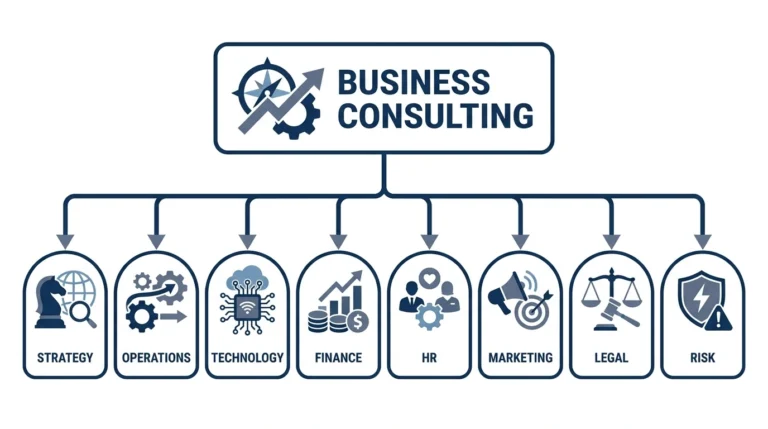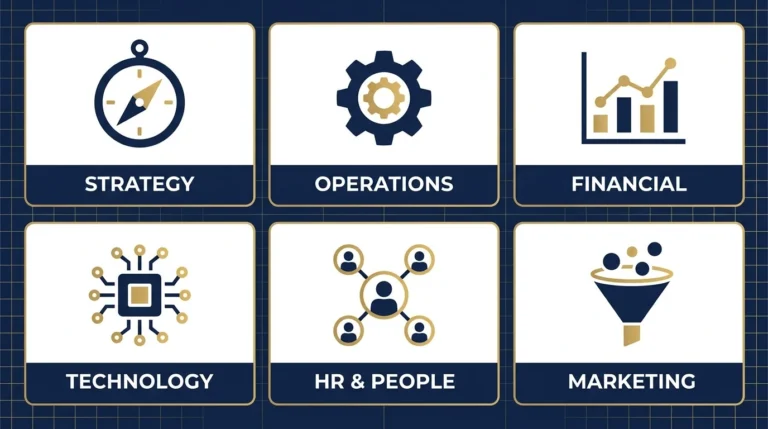

What Is Business Consulting? A Clear and Complete Explanation
What is business consulting, and why do organizations of every size rely on it to solve their most important problems?…
What is business consulting, and why do organizations of every size rely on it to solve their most important problems? The short answer is that business consulting is a professional service in which an outside expert helps an organization analyze a problem, develop solutions, and improve performance in a specific area.
But that definition, while accurate, only scratches the surface of what consulting actually involves in practice. Understanding business consulting fully means understanding why it exists, what consultants actually do during an engagement, what clients can realistically expect, and where consulting tends to produce the most value.
This article provides a clear, complete explanation of what business consulting is and how it works.
The Core Definition of Business Consulting
Business consulting is the professional practice of providing expert advice, analysis, and guidance to organizations in exchange for a fee. A business consultant is an outside specialist who brings knowledge, experience, or analytical capability that the client organization does not have internally or cannot deploy effectively on its own.
The consultant’s job is to help the client understand their situation more clearly, make better decisions, and implement changes that produce better outcomes. The specific form that help takes varies significantly depending on the type of consulting, the nature of the problem, and the structure of the engagement.
What stays consistent across all forms of business consulting is the fundamental value proposition: the consultant knows something the client needs to know, or can do something the client cannot efficiently do alone, and the client pays for access to that knowledge and capability.
Why Business Consulting Exists
Business consulting exists because of a fundamental reality in organizational life: every organization has gaps between what it knows how to do and what it needs to do.
Those gaps arise from several sources. Businesses encounter problems that fall outside the expertise of their current team. They face decisions that require specialized knowledge not available internally. They need to move faster on a priority initiative than their internal capacity allows. They want a perspective on their situation that is not filtered through years of organizational familiarity and internal politics.
Hiring a full-time specialist for every gap is often impractical. A small business cannot afford a full-time CFO, a full-time IT director, and a full-time HR manager simultaneously. Even large enterprises face situations where the specific expertise needed for a particular challenge does not exist on their current team.
Business consulting fills those gaps on demand, without the long-term cost commitment of permanent hiring. The organization gets the expertise it needs for as long as it needs it, and the consultant moves on to the next client when the engagement is complete.
The Different Forms Business Consulting Takes
Business consulting is not a single uniform practice. It takes different forms depending on what the client needs.
Advisory consulting is the most traditional form. The consultant provides analysis, perspective, and recommendations. The client retains responsibility for decision-making and implementation. Advisory consulting is appropriate for strategic questions, major decisions, and situations where the client wants informed guidance rather than direct implementation support.
Implementation consulting: goes beyond recommendations to active involvement in executing the changes being recommended. The consultant works alongside client teams to deploy new processes, systems, or structures. Implementation consulting is appropriate for complex changes where the client needs both the design and the build support.
Fractional consulting embeds a consultant in the organization on a part-time basis, typically through a monthly retainer. The consultant functions like a part-time member of the leadership team, providing ongoing expertise across multiple engagements over an extended period. This model is common for functions where small businesses need consistent expertise but cannot justify a full-time hire.
Project consulting delivers a specific, defined outcome within a fixed timeframe and fee structure. The engagement begins, the deliverable is produced, and the engagement concludes. Project consulting is appropriate for well-defined needs such as a market analysis, a process redesign, or a technology selection.
What Business Consulting Is Not
Understanding what business consulting is also requires clarity on what it is not.
Business consulting is not the same as business coaching. A coach develops the client’s own thinking and decision-making capability through guided conversation. A consultant diagnoses problems and provides expert recommendations. The difference is in where the expertise sits: with the coach who facilitates the client’s thinking or with the consultant who provides their own analysis.
Business consulting is not outsourcing. Outsourcing transfers a business function to an outside provider on an ongoing basis. Consulting is typically a defined engagement with a specific problem-solving objective, not a permanent transfer of operational responsibility.
Business consulting is not staffing. Staffing agencies provide personnel to fill operational roles. Consultants provide expertise to solve specific problems or improve specific functions. The relationship is fundamentally different in purpose and structure.
Who Uses Business Consulting
Business consulting serves organizations across every sector, size, and stage of development. The range is wider than many people assume.
Large enterprises use major consulting firms for strategic transformation programs, large-scale technology implementations, and regulatory compliance initiatives. These engagements can involve hundreds of consultants and run for years.
Mid-size companies use boutique consulting firms and independent specialists for operational improvement, functional expertise gaps, and strategic planning support. Engagements at this level are typically smaller in scope and more focused in objective.
Small businesses and startups use independent consultants for specific challenges: financial modeling, marketing strategy, HR policy development, technology selection, or operational efficiency improvement. Engagements at this level are often short, focused, and priced to match smaller budgets.
Nonprofits use consultants for fundraising strategy, program evaluation, governance improvement, and organizational assessment. The consulting relationship is similar in structure to for-profit engagements, though the business objectives and budget realities differ.
Government agencies engage consulting firms and independent advisors for policy analysis, program evaluation, technology implementation, and process improvement. Public sector consulting has its own procurement requirements and political dynamics.
What Makes a Business Consulting Engagement Successful
Not all consulting engagements produce good outcomes. The difference between consulting that delivers measurable value and consulting that produces an expensive report that no one acts on usually comes down to a few key factors.
Problem clarity. The most important determinant of a successful engagement is how clearly the problem is defined before the engagement begins. Vague problems produce vague analysis and vague recommendations. A precisely defined problem makes everything else in the engagement more effective.
Honest information sharing. Consultants can only work with what they can see. If clients withhold data, restrict access to key personnel, or present an artificially optimistic picture of their situation, the consultant’s analysis will be built on incomplete information. The result will be recommendations that miss the real problem.
Client engagement throughout. Consulting is not a passive experience. Clients who participate actively in the process, challenge consultant thinking, share context that the consultant cannot gather independently, and engage stakeholders in preparation for implementation get significantly better results than clients who hand over a problem and wait for a report.
Commitment to implementation. The value of consulting recommendations is realized only when they are implemented. Organizations that treat a consulting report as the end of the process rather than the beginning of an implementation phase extract a fraction of the potential value from their consulting investment.
The Business Consulting Industry
Business consulting is a large and growing global industry. Major strategy consulting firms such as McKinsey, Boston Consulting Group, and Bain serve the world’s largest organizations. The major professional services networks, including Deloitte, PwC, KPMG, and Accenture, offer consulting alongside audit and tax services at global scale.
Below the top tier, thousands of boutique consulting firms serve mid-market organizations across specific industries and functional specializations. And the independent consultant market, individuals operating their own consulting practices, has grown substantially as professionals with deep expertise choose to serve multiple clients rather than work for a single employer.
The diversity of the industry means that organizations of every size and budget can find consulting expertise appropriate to their needs and resources.
Is business consulting the same as management consulting?
The terms are often used interchangeably, but management consulting typically refers specifically to consulting on organizational strategy, structure, and management practices. Business consulting is a broader term that encompasses management consulting as well as functional consulting in areas like finance, technology, marketing, and HR.
Do small businesses benefit from business consulting?
Yes. Small businesses often benefit significantly from consulting because they face complex challenges without the internal specialist resources that larger organizations have. A small business owner working with the right consultant can access expertise that would otherwise require a full-time hire, at a fraction of the cost.
How is a business consultant paid?
Business consultants are paid through several structures. Hourly rates are common for advisory and fractional arrangements. Project fees are common for defined deliverables. Monthly retainers are common for ongoing advisory relationships. Some consultants also use value-based pricing, where fees are tied to the measurable outcome the engagement produces.
Can business consulting guarantee results?
No ethical consultant guarantees specific outcomes, because outcomes depend on implementation decisions made by the client, market conditions, and other factors outside the consultant’s control. What consultants can commit to is the quality of their analysis, the soundness of their recommendations, and the expertise they bring to implementation support.
What credentials should a business consultant have?
Credentials vary by specialization. Some consulting niches, such as financial consulting and legal consulting, have licensing requirements. Most consulting niches rely on demonstrated expertise, professional reputation, and relevant experience rather than formal credentials. Client references, case studies, and track record of results are more reliable indicators of consultant quality than certifications alone.
What does a business consultant do?
A business consultant provides expert advice, analysis, and guidance to organizations facing specific challenges or seeking improvement. The consultant’s job is to help the client understand their situation more clearly, make better decisions, and implement changes that improve performance. Depending on the form of engagement, this ranges from advisory recommendations to active involvement in executing the changes.
Conclusion
Business consulting is a professional service built on a simple premise: organizations perform better when they have access to the right expertise at the right time. Whether the need is strategic direction, operational improvement, technical implementation, or functional expertise, consulting provides a structured way to bring that expertise into the organization on demand.
Understanding what business consulting is and what it is not helps organizations make better decisions about when and how to engage outside expertise.
For a complete overview of how consulting works, what services are available, and how to evaluate whether consulting is right for your organization, visit the full guide on business consulting.