Types of Business Consulting: A Complete Overview of Every Major Consulting Category
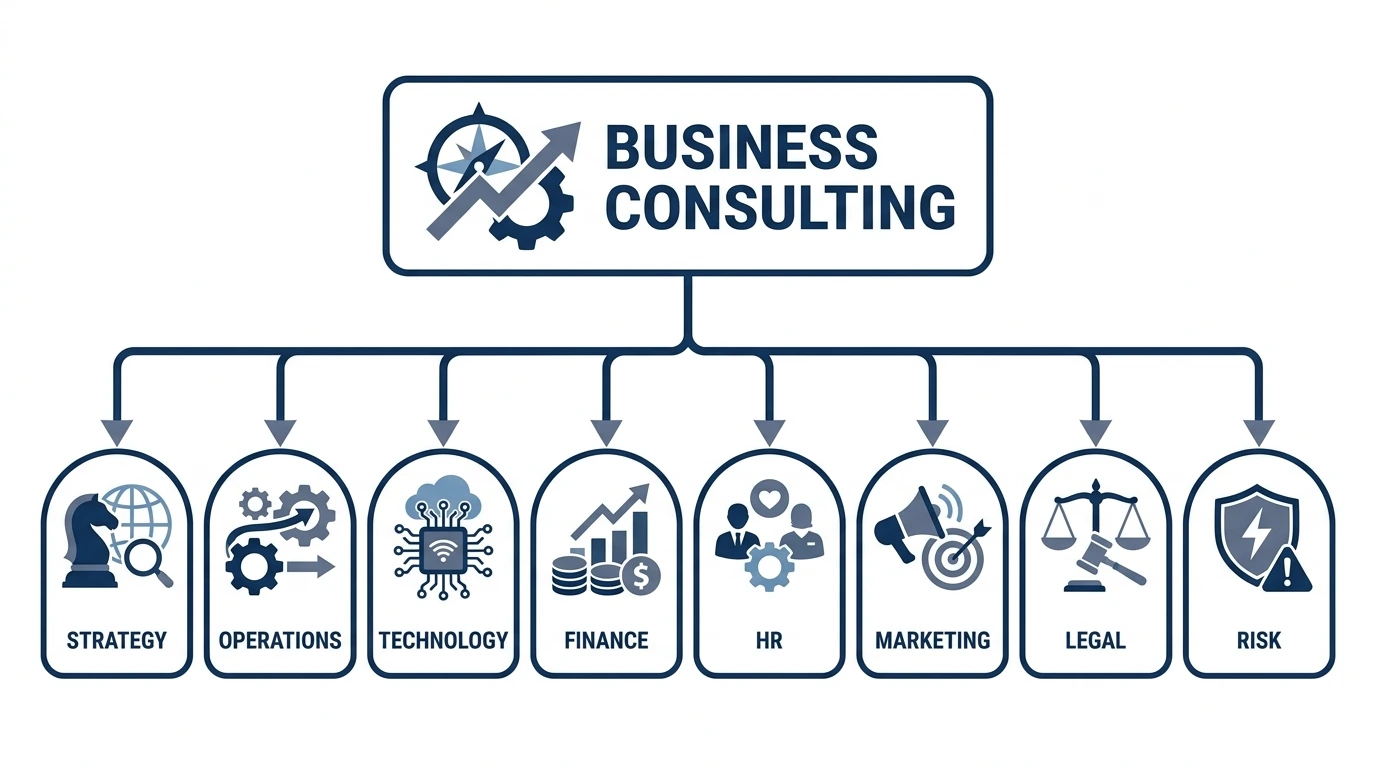
The types of business consulting available to organizations today span nearly every functional area and industry sector. What looks from the outside like a single profession is, in practice, a collection of distinct specializations with different methodologies, different client types, and different value propositions.
Understanding the different types of business consulting helps organizations identify exactly which kind of expertise they need, rather than searching generically for a consultant and hoping for a match.
This article covers every major consulting category, what each involves, who benefits most, and how each type creates value.
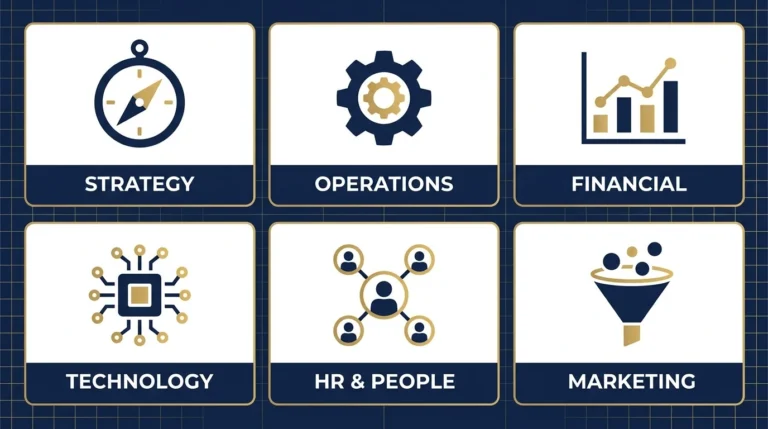
Strategy Consulting
Strategy consulting addresses the highest-level business questions. What markets should we compete in? How should we position against competitors? What business model best serves our growth objectives? Where should we invest our resources over the next three to five years?
Strategy consultants analyze markets, competitive dynamics, customer behavior, and organizational capability to help leadership teams make better long-term decisions. Engagements typically produce a structured analysis of the current situation, a set of strategic options, and a recommended direction with supporting rationale.
Major strategy consulting firms such as McKinsey, Bain, and Boston Consulting Group built their reputations on this category. The work requires strong analytical frameworks, industry research capability, and the ability to synthesize complex information into clear, actionable recommendations for senior leadership.
Strategy consulting is most valuable when an organization is facing a major directional decision, entering a new market, considering a significant investment, or needs to revisit its fundamental business model.
Management Consulting
Management consulting is often used interchangeably with strategy consulting, but the term more accurately refers to a broader category that includes organizational effectiveness, leadership development, governance improvement, and management system design alongside strategy.
Management consultants help organizations improve how they are led, structured, and governed. Engagements in this category might address reporting structure redesign, decision-making process improvement, board governance, executive team effectiveness, or the alignment between organizational structure and strategic objectives.
This is a broad category with significant overlap with both strategy consulting and HR consulting. The distinguishing characteristic is the focus on management systems and organizational effectiveness rather than functional expertise in a specific domain.
Operations Consulting
Operations consulting focuses on how organizations execute their core activities. The primary objective is improving efficiency, reducing costs, increasing output quality, and building operational systems that can scale with business growth.
Operations consultants use methodologies such as Lean, Six Sigma, and process mapping to analyze current workflows, identify waste and inefficiency, and design improved operational systems. Engagements typically produce a detailed process assessment, a redesigned workflow or operational model, and an implementation plan.
This category is particularly valuable for manufacturing companies, logistics organizations, retail chains, and service businesses with complex, repeatable operational processes where incremental efficiency improvements produce significant financial impact.
Financial Consulting
Financial consulting helps organizations manage, analyze, and improve their financial performance. This category spans a wide range from operational cash flow management to strategic M&A advisory.
Financial consultants serve organizations that need financial expertise beyond their internal team’s capacity. Common engagements include financial model development, CFO advisory services on a fractional basis, cost structure analysis, fundraising preparation, investor relations support, and financial due diligence for acquisitions.
This category is relevant across all organization types and sizes. Startups use financial consultants to build credible financial models for investors. Mid-market companies use fractional CFO services for strategic financial leadership. Large organizations use financial consulting firms for complex transactions and regulatory matters.
Technology Consulting
Technology consulting helps organizations make better decisions about technology selection, implementation, security, and optimization. As technology becomes central to operations in every industry, the demand for outside technology expertise has grown substantially.
Technology consultants work in several subspecialties. IT infrastructure consulting focuses on network design, server architecture, and technology infrastructure planning. Software consulting focuses on application selection, custom development, and systems integration. Cybersecurity consulting focuses on risk assessment, security architecture, and compliance with security frameworks. Digital transformation consulting focuses on using technology to fundamentally change how an organization operates.
The common thread across these subspecialties is expertise in technology decisions that the client organization cannot make effectively with internal resources alone.
Human Resources Consulting
Human resources consulting covers workforce strategy, talent management, organizational design, compensation, and the policies and systems that govern how people work within an organization.
HR consultants serve organizations at every stage. Early-stage companies need help building foundational HR infrastructure: job descriptions, offer letter templates, employee handbooks, and basic HR policies. Growing companies need help with talent acquisition systems, compensation benchmarking, and performance management. Mature organizations need help with complex organizational design, succession planning, and culture management.
This category has grown significantly as employment law complexity has increased and as workforce management has become a more strategic organizational priority across industries.
Marketing Consulting
Marketing consulting helps organizations improve how they attract, engage, and convert their target audience. The category spans brand strategy at the conceptual level and tactical campaign execution at the implementation level.
Marketing consultants specialize in several subspecialties. Brand consulting focuses on positioning, messaging, and visual identity. Digital marketing consulting focuses on SEO, paid advertising, social media, and content strategy. Market research consulting focuses on customer insight, competitive intelligence, and market sizing. Go-to-market consulting focuses on product launch strategy and new market entry.
Marketing consulting is relevant for organizations of every size. Small businesses use marketing consultants to build effective marketing programs without hiring a full marketing team. Large organizations use marketing consulting firms for brand repositioning, major campaign development, and market expansion strategy.
Legal Consulting
Legal consulting provides advisory services related to compliance, contract management, regulatory navigation, and legal risk management without the formal legal representation structure of a law firm engagement.
Legal consultants are often practicing or former attorneys who prefer advisory work to litigation or firm practice. They help organizations understand their legal obligations, design compliance programs, review contracts, navigate regulatory requirements in specific industries, and prepare for legal risk scenarios.
This category is particularly valuable in heavily regulated industries such as healthcare, financial services, and government contracting, where the legal and regulatory landscape is complex enough to require ongoing expert attention.
Environmental and Sustainability Consulting
Environmental consulting helps organizations navigate environmental regulations, manage environmental risk, and develop sustainability strategies. Growing pressure from regulators, investors, and customers around ESG performance has significantly expanded demand for this category.
Environmental consultants work with industrial companies on regulatory compliance and remediation. Sustainability consultants help organizations of all types develop environmental strategies, measure and reduce their carbon footprint, and meet ESG reporting requirements.
This category has evolved from a narrow industrial compliance specialty to a broad sustainability advisory function as ESG considerations have become central to investment, supply chain, and reputational management for organizations across sectors.
Risk and Compliance Consulting
Risk and compliance consulting helps organizations identify, assess, and manage risk across operational, regulatory, financial, and reputational dimensions. This category is particularly important in regulated industries where compliance failures carry significant financial penalties.
Risk consultants conduct enterprise risk assessments, develop risk management frameworks, and help organizations build the monitoring systems needed to identify and respond to emerging risks. Compliance consultants focus specifically on regulatory requirements, helping organizations understand what is required, assess their current state, and remediate gaps.
Healthcare Consulting
Healthcare consulting serves providers, payers, and healthcare technology companies navigating the complex operational, regulatory, and financial environment of the healthcare industry.
Healthcare consultants specialize in areas including clinical workflow optimization, revenue cycle management, regulatory compliance (particularly HIPAA and CMS requirements), electronic health record implementation, practice management, and healthcare technology selection.
This is a specialized category that typically requires either clinical background or deep healthcare administration experience. The regulatory complexity and the direct connection between operational quality and patient outcomes make healthcare consulting a distinct specialty rather than simply an application of general management consulting.
Education Consulting
Education consulting serves K-12 schools, higher education institutions, early childhood programs, and education technology companies. Services range from curriculum development and accreditation support to enrollment management and institutional strategy.
Education consultants understand the specific regulatory environment, funding structures, and operational realities of their sector, which differ significantly from for-profit business contexts. Higher education consulting and K-12 consulting are substantially different subspecialties with different client types, different decision-making structures, and different service needs.
Nonprofit Consulting
Nonprofit consulting serves charitable organizations, foundations, and advocacy groups. Services include fundraising strategy, grant development, board governance, program evaluation, organizational assessment, and strategic planning.
Nonprofit consulting requires understanding the specific constraints and motivations that shape nonprofit decision-making: mission alignment, donor relationships, board governance dynamics, grant compliance requirements, and the balance between program impact and operational sustainability.
Frequently Asked Questions
Which type of business consulting is most in demand?
Technology consulting and strategy consulting consistently rank among the most in-demand categories globally. HR consulting, financial consulting, and cybersecurity consulting have also seen sustained demand growth. At the local and regional level, demand patterns vary by industry concentration and economic activity.
Can one consultant cover multiple consulting types?
Some consultants operate across adjacent categories effectively, particularly when the intersection between categories is genuine. An operations consultant with strong technology knowledge can credibly serve clients at the intersection of operations and technology. A financial consultant with M&A experience can move across financial strategy and transaction advisory. Be cautious of consultants who claim expertise across fundamentally different domains without a coherent underlying specialization.
What is the difference between a consulting firm and a solo consultant by type?
Both consulting firms and independent consultants operate across all major consulting categories. Firms offer more staffing depth for large engagements. Independent consultants often offer more focused expertise and direct principal involvement. The right choice between firm and independent depends on engagement scale and complexity rather than consulting type.
Are some consulting types better for small businesses than others?
Operations, marketing, financial, and HR consulting are all highly relevant for small businesses and typically available from independent consultants at price points appropriate for smaller budgets. Strategy consulting at the major firm level is generally not cost-accessible for small businesses, though independent strategy consultants with boutique practices serve mid-market and smaller organizations effectively.
How do I know which type of consulting my business needs?
Start by defining the problem or gap you are trying to address as specifically as possible. The problem description usually points naturally toward the relevant consulting category. A revenue growth challenge points toward strategy or marketing consulting. An operational efficiency problem points toward operations consulting. A compliance requirement points toward legal or risk consulting. If the problem spans multiple categories, a generalist assessment engagement can help clarify where focused intervention will produce the most value.
Conclusion
The types of business consulting available today cover virtually every area where organizations need outside expertise. Understanding the landscape of consulting categories helps organizations move from a vague awareness that outside help might be useful to a specific, informed decision about what type of expertise they actually need.
For a complete overview of business consulting, including how consulting engagements work, what consultants do, and how to evaluate whether consulting is right for your organization, visit the full guide on business consulting.