Business Consulting Services: What Consultants Offer and How to Choose the Right One
Business consulting services cover a wide spectrum of professional support, from high-level strategic analysis to hands-on operational implementation. Understanding what services are available, what each one involves, and when each is most appropriate helps organizations make informed decisions about the type of consulting support they need.
The term “business consulting services” is broad by design. It encompasses everything an outside expert might provide to help an organization perform better, solve a specific problem, or navigate a significant transition. This article breaks down the major service categories, explains what each delivers, and provides guidance on choosing the right service for your specific situation.
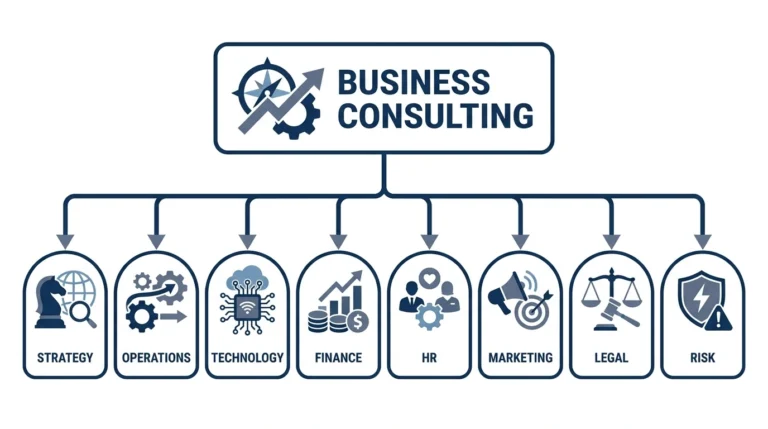
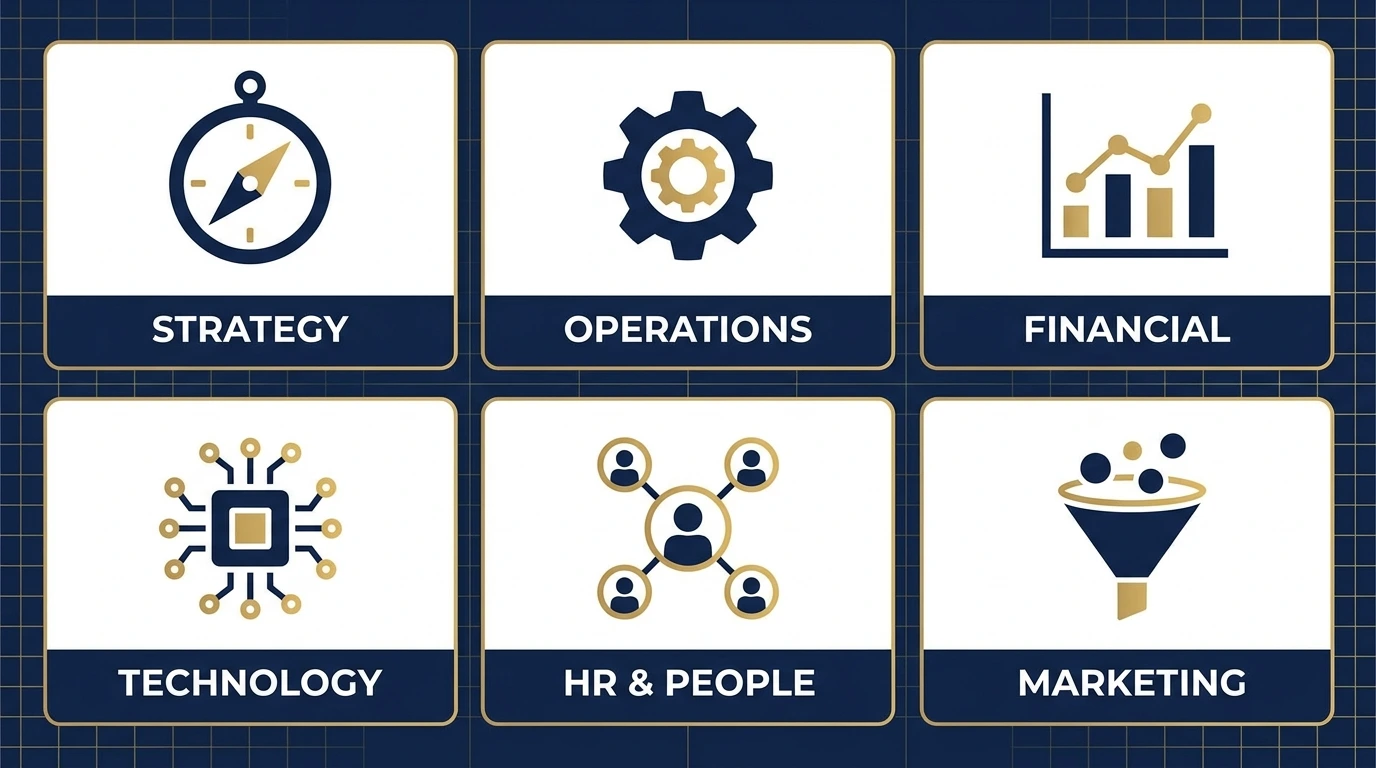
Strategic Consulting Services
Strategic consulting addresses the most consequential questions an organization faces about its direction, competitive position, and long-term priorities.
Services in this category include market entry analysis, competitive landscape assessment, business model evaluation, growth strategy development, merger and acquisition advisory, and organizational restructuring planning. The deliverable is typically a structured analysis combined with a set of strategic recommendations that senior leadership can act on.
Strategic consulting is most appropriate when an organization is facing a decision with major long-term consequences and wants independent analysis to inform that decision. It is also appropriate when leadership is considering a significant shift in direction and wants to pressure-test assumptions before committing resources.
The engagement typically involves the senior leadership team and produces insights that shape organizational priorities over months or years. Strategy consultants are generalists at the strategic level but often bring deep expertise in specific industries or market contexts.
Operations Consulting Services
Operations consulting focuses on how an organization executes its core activities. The objective is to improve efficiency, reduce waste, increase quality, and build operational capacity that supports business growth.
Services in this category include process mapping and redesign, supply chain optimization, quality management system development, cost reduction analysis, procurement strategy, and lean operations implementation. The deliverable varies by service but typically includes a current-state assessment, gap analysis, and a prioritized improvement roadmap.
Operations consulting is most appropriate when an organization is experiencing growth-related friction, declining margins, quality problems, delivery delays, or any other symptom of operational inefficiency. It is also valuable when an organization is scaling rapidly and needs its operational infrastructure to keep pace.
Financial Consulting Services
Financial consulting helps organizations understand and improve their financial performance. This ranges from short-term cash flow management to long-term financial strategy and capital structure optimization.
Services in this category include financial modeling and forecasting, CFO advisory on a fractional basis, cost structure analysis, working capital management, financial reporting improvement, investor presentation preparation, and M&A financial due diligence. The deliverable depends on the specific service but generally includes analysis and recommendations alongside whatever financial models or documents the engagement produces.
Financial consulting is most appropriate for organizations facing significant financial decisions, experiencing financial stress, preparing for fundraising or exit, or needing financial leadership that exceeds the capacity of their current team.
Technology Consulting Services
Technology consulting helps organizations make better decisions about technology: what to use, how to implement it, how to secure it, and how to extract maximum value from existing technology investments.
Services in this category include technology needs assessment, software selection advisory, ERP and CRM implementation management, cybersecurity assessment and remediation, cloud strategy and migration planning, IT infrastructure design, and digital transformation planning. The deliverable is typically a combination of analysis, recommendations, and implementation support.
Technology consulting is most appropriate when an organization is evaluating a significant technology investment, struggling with an existing system, facing cybersecurity exposure, or trying to modernize infrastructure that has not kept pace with business growth.
Human Resources Consulting Services
Human resources consulting addresses workforce strategy, talent management, organizational design, and the policies and systems that govern how people work within an organization.
Services in this category include HR function assessment, talent acquisition process design, compensation and benefits benchmarking, employee handbook development, performance management system design, HR technology selection, organizational restructuring support, and culture assessment. The deliverable varies by service but typically includes a combination of recommendations, designed deliverables such as policy documents or process designs, and implementation guidance.
HR consulting is most appropriate for organizations that lack an internal HR specialist, are growing rapidly and need to build people operations infrastructure, are experiencing workforce challenges such as high turnover or recruiting difficulty, or are facing employment compliance requirements that exceed current internal knowledge.
Marketing Consulting Services
Marketing consulting helps organizations improve how they reach, engage, and convert their target audience. This ranges from strategic brand development to tactical campaign management.
Services in this category include brand strategy development, market research and customer insights, digital marketing strategy, content strategy and planning, SEO and website optimization advisory, paid advertising strategy, email marketing program development, and marketing technology selection. The deliverable varies by service and typically includes strategic recommendations, detailed implementation plans, or both.
Marketing consulting is most appropriate for organizations that are not generating sufficient leads or revenue from their marketing activity, are entering new markets or launching new products, are rebranding or repositioning, or need to build marketing capability that does not currently exist internally.
Change Management Consulting Services
Change management consulting helps organizations implement significant internal changes by managing the human dimension of the transition. Major changes in strategy, technology, structure, or culture create employee uncertainty and resistance that, if unmanaged, undermine implementation success.
Services in this category include change readiness assessment, stakeholder communication planning, training program design, organizational adoption support, and change effectiveness measurement. The deliverable typically includes a structured change management plan alongside implementation support throughout the transition.
Change management consulting is most appropriate when an organization is implementing a major technology system, restructuring teams or leadership, merging with or acquiring another organization, or shifting culture or operating model in ways that significantly affect how employees work.
Training and Development Consulting Services
Training and development consulting transfers specific knowledge, skills, or capabilities to client teams. The goal is to build organizational capacity that persists after the consulting engagement ends.
Services in this category include custom training program design, workshop facilitation, leadership development program development, onboarding program design, skills gap assessment, and coaching program development. The deliverable is typically a combination of content, facilitated experiences, and materials that the client organization can use independently after the engagement.
Training and development consulting is most appropriate when an organization needs to build specific capability quickly, when a new system or process requires structured knowledge transfer, or when leadership development is a strategic priority.
Interim and Fractional Consulting Services
Interim and fractional consulting provides organizations with experienced executive or specialist capacity on a part-time or temporary basis.
An interim consultant steps into a role, typically a functional leadership role such as CFO, COO, or CHRO, on a full-time basis for a defined period while the organization searches for a permanent hire or navigates a transition. A fractional consultant serves in a similar capacity but on a part-time basis, typically through a monthly retainer.
These arrangements are most appropriate for organizations that need experienced leadership in a specific function but are not ready for or cannot afford a full-time senior hire, or for organizations in transition that need immediate leadership capacity while permanent staffing decisions are made.
How to Choose the Right Business Consulting Service
Selecting the right consulting service starts with an honest diagnosis of what you actually need.
Define the problem specifically. The more precisely you can describe what is wrong or what outcome you want, the more accurately you can match that need to the right type of consulting service. A vague sense that “the business needs help” leads to vague engagements with vague results.
Identify where the gap lies. Is it a knowledge gap, a capacity gap, or a perspective gap? Knowledge gaps are best addressed by consultants with specific domain expertise. Capacity gaps may be best addressed by fractional or interim arrangements. Perspective gaps are best addressed by advisory consultants who specialize in the type of question you are facing.
Consider the timeline and budget. Different consulting services have different cost structures and engagement timelines. A diagnostic assessment delivers value quickly and at lower cost. A transformation program delivers deeper value over a longer period at higher cost. Match the service type to what your organization can realistically commit to.
Evaluate consultant fit, not just credentials. The best consulting credentials mean little if the consultant cannot communicate effectively with your team, does not understand your industry context, or takes an approach that does not fit your organizational culture. Spend time assessing fit before signing a contract.
Frequently Asked Questions
What is the most common type of business consulting service?
Strategy consulting and operations consulting are the most widely used categories, but the most common service type for any specific organization depends on where its most pressing needs lie. Financial consulting, HR consulting, and technology consulting are also consistently in high demand across most industries.
Can a single consultant provide multiple types of consulting services?
Yes, but with important caveats. Some consultants operate as genuine generalists with credible expertise across multiple domains. More commonly, a consultant has one or two areas of deep expertise and broader knowledge in adjacent areas. Be cautious of consultants who claim deep expertise in every domain. The most credible practitioners are specific about where their expertise is strongest.
How do I evaluate whether a consulting service delivered value?
Define success metrics before the engagement begins. Identify what measurable improvement you expect to see, in what timeframe, and through what indicators. Evaluate the engagement against those metrics at defined intervals. Value delivered should be measurable, not just felt.
Should I hire a consulting firm or an independent consultant?
Consulting firms offer more personnel depth, broader geographic reach, and institutional credibility. Independent consultants often offer more focused expertise, more direct access to senior talent, and lower fees. The right choice depends on engagement complexity, budget, and how much you value institutional brand versus individual expertise.
Are business consulting services tax deductible?
In most jurisdictions, consulting fees paid by a business for legitimate business purposes are deductible as a business expense. Consult with your accountant or tax advisor to confirm the specific treatment applicable to your situation.
Conclusion
Business consulting services span a wide range of professional support, each designed to address a different type of organizational need. Understanding the landscape of available services helps organizations make deliberate choices about what type of outside expertise to engage rather than defaulting to a vague “consulting” search.
Start with an honest assessment of where your organization’s most important gap lies, match that gap to the appropriate service category, and evaluate consultants based on their specific experience with the problem you are trying to solve.
For a complete overview of business consulting, including how it works, what consultants do, and how to evaluate whether consulting is right for your organization, visit the full guide on business consulting.