
Industry Consulting Ideas: How to Build a Niche Practice in Any Sector

The strongest consulting businesses are not built on generic expertise. They are built on deep knowledge of a specific industry, its language, its regulations, its operational rhythms, and its persistent problems.
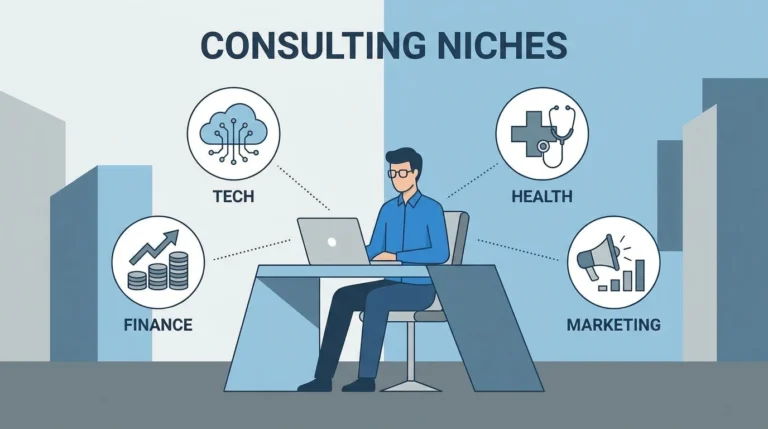
Industry-specific consulting is a different strategic choice from function-specific consulting. A function-specific consultant specializes in marketing, finance, or HR and serves clients across many industries. An industry consultant specializes in a single sector, construction, legal services, agriculture, or hospitality, and applies their expertise across multiple business functions within that vertical.
Both models work. But for professionals who have spent significant years inside a specific industry, vertical consulting typically produces faster client acquisition, stronger referral networks, and more defensible market positioning.
This article covers practical industry consulting ideas across multiple sectors, what each requires, and how to build a focused advisory practice.
Why Industry Specialization Builds Stronger Consulting Businesses
Generalist consulting is difficult to sell. A business owner facing a specific operational problem in their restaurant chain does not want a consultant who works with every type of business. They want someone who has solved that specific problem in the restaurant industry before.
Industry specialization reduces the cost of client acquisition because your expertise is self-evidently relevant. It reduces the onboarding cost of each engagement because you already understand the regulatory environment, the standard workflows, and the typical vendor landscape. It generates stronger referrals because satisfied clients introduce you to their industry peers who are exactly the clients you want.
The trade-off is a smaller total addressable market. Industry consultants accept a narrower potential client pool in exchange for stronger positioning and higher close rates within that pool. For most practitioners, this trade-off produces better long-term business outcomes.
Industry Consulting Business Ideas
Legal Industry Consulting
Law firms and legal departments face operational challenges that most attorneys are not trained to solve. Legal industry consultants help firms improve practice management, technology adoption, client experience, billing efficiency, and marketing strategy.
Law firm management consulting is a growing subspecialty. Clients include solo practitioners, boutique firms, mid-size regional firms, and in-house legal teams at corporations. Services include practice management system selection, legal technology implementation (document management, e-discovery, contract automation), pricing strategy, and business development program development.
Legal operations consulting serves corporate legal departments, specifically helping them manage outside counsel relationships, implement matter management systems, control legal spend, and build internal workflows that reduce reliance on expensive external attorneys.
This niche suits professionals with backgrounds in legal administration, law firm operations, or legal technology. It does not require a law degree, though some understanding of legal practice context is essential.
Construction and Contracting Consulting
Construction is a high-revenue, operationally complex industry where margin management, project coordination, subcontractor relationships, and regulatory compliance create persistent advisory needs.
Construction consultants help contractors improve project management systems, build estimating processes, manage contract risk, select construction management software, improve cash flow management, and develop safety programs. Specialty areas include green building consulting, dispute resolution, and public contract compliance.
This niche suits professionals with backgrounds in construction project management, construction finance, or general contracting. Industry certifications such as PMP (Project Management Professional) with a construction focus or LEED certification for sustainability-oriented work strengthen positioning.
Construction is a referral-driven industry. Building relationships with trade associations such as Associated General Contractors (AGC) or Associated Builders and Contractors (ABC) generates substantial business development opportunities.
Real Estate Industry Consulting
Real estate consulting covers a wide spectrum from individual investor advisory to corporate portfolio management. Consultants in this space help clients analyze investment opportunities, evaluate development feasibility, manage due diligence processes, and develop asset management strategies.
Property management consulting helps landlords and management companies improve operational systems, tenant communication processes, maintenance management, and financial reporting. This subspecialty is particularly strong for consultants who have managed multi-family or commercial portfolios and understand the operational realities of property management.
Real estate technology consulting, helping agencies, brokerages, and investment firms select and implement PropTech solutions, is a growing subspecialty that suits professionals at the intersection of real estate operations and technology adoption.
Restaurant and Hospitality Consulting
The restaurant and hospitality industry operates on thin margins with high operational complexity. “Consultancy” is a commonly used term in the sector; the fusion of hospitality values and business discipline, and consultants who understand this cultural dimension alongside operational reality, perform well.
Restaurant consultants help operators with concept development, menu engineering, kitchen workflow design, cost control, staff training, technology selection (point-of-sale systems, reservation management, inventory control), and marketing strategy.
Hotel and hospitality consultants assist properties with revenue management, guest experience design, operations standards, franchise relationship management, and pre-opening planning for new properties.
This niche suits professionals with direct experience in food and beverage or hotel operations. Clients in this industry are intensely practical they want consultants who have worked in the industry, not those who have only studied it.
Agriculture and Food Industry Consulting
Agriculture consulting covers farm operations management, crop production optimization, precision agriculture technology adoption, commodity marketing strategy, and rural business planning. The food industry side of this niche includes food production operations, supply chain management, food safety compliance, and organic or specialty certification support.
Agriculture consultants frequently work with individual farm operations, agricultural cooperatives, food processing companies, and agricultural lenders. USDA programs and rural development grants create additional consulting opportunities around government funding navigation.
This niche requires genuine domain expertise. Agricultural clients are knowledgeable and skeptical of advisors without practical farming or food industry backgrounds.
Retail Industry Consulting
Retail consulting helps brick-and-mortar and e-commerce businesses improve operations, merchandising, customer experience, inventory management, and omnichannel integration. The ongoing disruption of traditional retail by e-commerce and changing consumer behavior creates persistent demand for advisory support.
Retail consultants help independent retailers develop competitive strategies against large-format and online competitors. They assist multi-location retail chains with store operations standardization, inventory system selection, and customer loyalty program development.
E-commerce consulting within the retail niche focuses specifically on online store optimization, marketplace strategy (Amazon, Etsy, eBay), fulfillment operations, and digital marketing integration.
Education Industry Consulting
Education consulting serves K-12 schools, higher education institutions, early childhood programs, tutoring businesses, and education technology companies. The range of potential services is broad.
School improvement consulting helps public and private K-12 institutions develop curriculum, improve instructional quality, navigate accreditation processes, and strengthen administrative operations. These engagements often involve state education funding and require familiarity with public education regulatory frameworks.
Higher education consulting helps colleges and universities with enrollment management, student retention, technology implementation, and administrative efficiency. This is a sophisticated market that values consultants with direct higher education administration or academic affairs experience.
EdTech consulting helps education technology companies understand educator needs, product-market fit, go-to-market strategy, and pilot program design. This subspecialty suits professionals at the intersection of education expertise and startup advisory experience.
Nonprofit Industry Consulting
Nonprofit consulting encompasses fundraising strategy, grant management, board development, program evaluation, strategic planning, and organizational assessment. The nonprofit sector includes hundreds of thousands of organizations of varying sophistication, creating a wide range of potential clients.
Fundraising consultants specialize in campaign planning, major gift strategy, annual fund development, event fundraising, and planned giving programs. Grant consultants focus specifically on identifying funding opportunities and writing competitive applications.
Organizational effectiveness consultants help nonprofits clarify their theory of change, measure program impact, improve governance, and develop strategic plans that align resources with mission. This is a higher-level subspecialty that suits professionals with backgrounds in nonprofit management, foundation program work, or social sector research.
Manufacturing Consulting
Manufacturing consulting focuses on production efficiency, supply chain optimization, quality management systems, lean operations, and regulatory compliance. The manufacturing sector in the United States, United Kingdom, Canada, and Australia continues to face pressure to modernize, which creates persistent consulting demand.
Manufacturing consultants use frameworks such as Lean Manufacturing and Six Sigma to identify and eliminate waste in production processes. Quality management consultants help manufacturers achieve and maintain ISO 9001 certification and related quality standards.
Industry 4.0 consulting, helping manufacturers adopt connected technologies including IoT sensors, automation systems, and manufacturing analytics platforms, is an emerging high-value subspecialty as traditional manufacturers invest in digital operations.
Financial Services Industry Consulting
Financial services consulting serves banks, credit unions, investment firms, insurance companies, and fintech organizations. Regulatory compliance, risk management, digital transformation, and customer experience improvement are the dominant advisory themes.
Community bank consulting serving smaller banks and credit unions navigating competitive and regulatory pressure is a particularly active niche. Services include strategic planning facilitation, product development advisory, technology selection, and merger and acquisition preparation.
Insurance consulting helps carriers and agencies improve operations, select agency management systems, develop distribution strategies, and navigate regulatory requirements across multiple state jurisdictions.
Government and Public Sector Consulting
Government consulting serves federal, state, and local government agencies. Services include program evaluation, process improvement, technology implementation, strategic planning, and grant administration.
Public sector consulting is more complex than private sector work due to procurement processes, political considerations, and the involvement of public funds. However, government contracts can be substantial and long-term providing significant revenue stability.
State and local government consulting is more accessible to independent consultants than federal contracting. Many state agencies use simplified procurement processes for smaller contracts that individual consultants can pursue without the infrastructure required for federal RFP responses.
How to Choose Your Industry Niche
Choosing an industry niche for consulting should be grounded in honest self-assessment rather than market trend analysis alone.
Where have you spent your career? Industry expertise that took years to develop is your most defensible asset. Clients in specialized industries are sophisticated enough to recognize advisors who lack genuine sector experience.
Where do your professional relationships exist? Business development in consulting is relationship-driven. The industry where you already have a network is the industry where your first clients are most likely to come from.
What problems in this industry do you know how to solve? Identify specific, recurring problems in your target industry that you have direct experience addressing. Build your service offering around those specific problems rather than general advisory positioning. If you read 20+ consulting business ideas, then read our consulting business ideas.
Building a Sustainable Industry Consulting Practice
Industry consulting practices grow most effectively through three channels: referrals from satisfied clients, visibility within industry professional associations, and content that demonstrates sector expertise publicly.
Publishing practical insights on LinkedIn, speaking at industry conferences, contributing to trade publications, and participating actively in sector-specific associations positions you as a recognized authority within the vertical. That recognition generates inbound interest and strengthens referral credibility.
Industry certifications, association memberships, and regulatory training specific to your sector all reinforce expert positioning and build client confidence during the evaluation process.
Frequently Asked Questions
What is the difference between industry consulting and functional consulting?
Industry consulting specializes in a specific sector, construction, healthcare, legal, or retail, and serves clients across multiple functional needs within that sector. Functional consulting specializes in a specific business function, marketing, HR, or finance, and serves clients across multiple industries. Industry consultants typically have deeper contextual knowledge within their sector; functional consultants may have broader cross-industry pattern recognition.
Can I transition into industry consulting from a corporate career?
Yes. Most successful industry consultants come directly from corporate careers in their target sector. A background as a construction project manager, hospital administrator, restaurant operator, or financial services executive provides exactly the credential and experience base that industry consulting clients expect.
How long does it take to build a full-time industry consulting practice?
Most consultants reach consistent full-time income from consulting within 12 to 24 months of focused effort. The timeline depends on the strength of the existing professional network, the clarity of the service offering, and the consultant’s willingness to invest consistently in business development activity.
What should I charge as an industry consultant?
Rates vary significantly by industry and specialization depth. Entry-level industry consultants typically charge $75 to $125 per hour. Experienced consultants with strong sector reputations commonly charge $150 to $300 per hour. High-complexity subspecialties ERP, regulatory compliance, and financial services routinely exceed $300 per hour on specialized engagements.
Is it better to serve one industry deeply or multiple industries broadly?
For most solo consultants, deep industry specialization produces better long-term business outcomes. The referral network is more concentrated, the positioning is clearer, the sales cycle is shorter, and the work is more efficient because industry knowledge carries over from client to client. Expansion into adjacent industries becomes easier once a strong reputation is established in the primary niche.