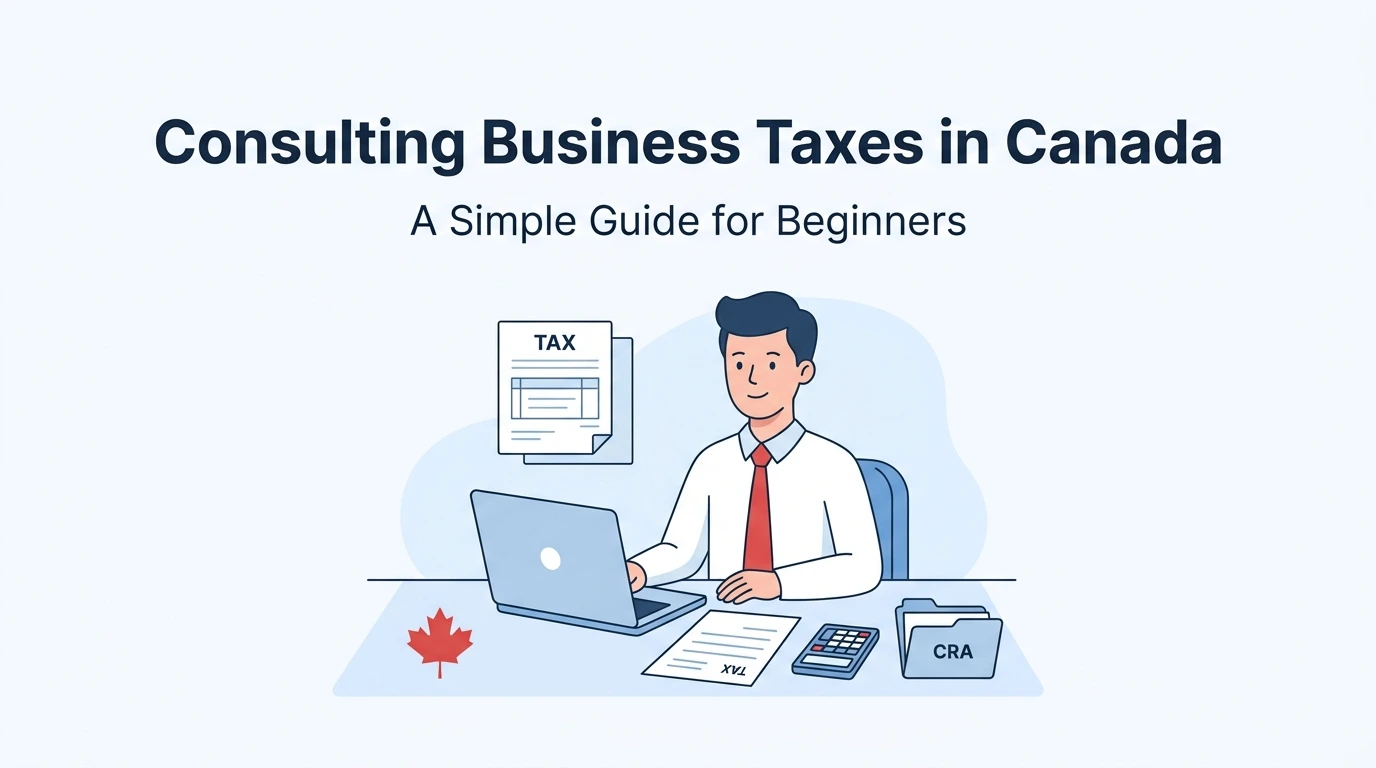
Consulting Business Taxes in Canada (A Simple Guide for Beginners)

Introduction
Understanding consulting business taxes in Canada is one of the most important things you’ll do when you start out on your own. The good news is that it’s not as complicated as it sounds. Once you understand the basic rules of what you owe, when you owe it, and what you can deduct, managing your taxes becomes a normal part of running your business rather than something to stress about.
This guide explains everything in plain language. No accounting jargon, no confusing tax code references, just a clear picture of what you need to know as a new consultant in Canada.
If you’re still working through the broader setup of your consulting practice, the full guide on how to start a consulting business in Canada covers everything from registration to finding clients alongside the tax side.
Do Consultants Pay Taxes in Canada?
Yes, and as a self-employed consultant, you’re responsible for handling your own taxes in a way that employees never have to think about.
When you work for an employer, they deduct income tax, CPP contributions, and EI premiums from your paycheck automatically. You never see that money. As a consultant, none of that happens automatically. You receive your full invoiced amount from clients, and it’s entirely your responsibility to set money aside and pay what you owe to the Canada Revenue Agency (CRA).
This is the part that catches a lot of new consultants off guard. They look at their bank account, see more money than they’ve ever had at once, and spend it as if it’s all theirs. Then tax season arrives, and the bill is larger than expected. Getting into the habit of setting aside a portion of every payment you receive from day one prevents that problem entirely.
Types of Taxes for Consulting Businesses in Canada
There are two main types of taxes most consultants deal with: income tax and GST/HST.
Income tax is what you pay on the money you earn. As a sole proprietor, your consulting income gets added to your personal income and taxed at your applicable federal and provincial rate. As an incorporated consultant, your corporation pays corporate tax on its profits, and you pay personal tax on any salary or dividends you pay yourself.
GST/HST is a consumption tax that you collect from clients on behalf of the government and then remit to the CRA. More on this below.
There’s also the Canada Pension Plan (CPP). As a self-employed person, you pay both the employee and employer portions of CPP contributions on your net self-employment income. For 2024, that combined rate is 11.9 percent up to the maximum earnings threshold. It’s a significant amount that many beginners don’t factor in when they’re calculating what they’ll owe.
Income Tax for Consultants
As a sole proprietor, you report your consulting income on your personal tax return each year using the T1 form. You’ll fill out a section called the T2125 Statement of Business or Professional Activities, which is where you report your revenue and claim your business expenses.
Your net income from consulting (revenue minus eligible expenses) gets added to any other income you have, and you’re taxed on the combined total using the federal and provincial tax brackets that apply to you.
Canada uses a progressive tax system, meaning the more you earn, the higher the rate on each additional dollar. The federal rates in 2024 start at 15 percent on the first $55,867 of taxable income and increase from there. Each province also applies its own rates on top of the federal rate.
Because no employer is withholding tax for you, the CRA may eventually ask you to pay your taxes in quarterly installments rather than all at once in April. This typically kicks in once you’ve owed more than $3,000 in taxes at the end of the year. Instalments are due in March, June, September, and December.
GST/HST Explained in Simple Words
GST stands for Goods and Services Tax. HST is the Harmonized Sales Tax, which is used in provinces that have combined their provincial sales tax with the federal GST. Which one applies to you depends on where you’re based.
Here’s the basic idea: once your consulting revenue reaches $30,000 in a calendar year, you’re required to register for a GST/HST account with the CRA. After that, you add GST or HST to your invoices, collect it from your clients, and then send that money to the CRA periodically.
For example, if you’re in Ontario and you invoice a client $2,000 for consulting services, you’d add 13 percent HST on top, making the total invoice $2,260. That extra $260 is not your money; it belongs to the CRA, and you’ll remit it when your filing period is due.
The good news is that you can also claim back the GST/HST you pay on your own business expenses. This is called an input tax credit. So if you paid HST on software or office supplies, you can subtract that from what you owe the CRA.
Some consultants choose to register voluntarily before hitting the $30,000 threshold. If your clients are businesses that are also GST/HST registered, they can claim back what they pay you anyway so it doesn’t cost them anything, and it allows you to claim input tax credits on your own expenses.
Do You Need a Business Number in Canada?
A Business Number (BN) is a nine-digit number the CRA assigns to your business. It’s used to identify your account for income tax, GST/HST, payroll, and other CRA programs.
You’ll get a business number automatically when you register for a GST/HST account. You may also get one when you incorporate your business. If you’re a sole proprietor who hasn’t hit the $30,000 threshold and isn’t hiring employees, you might not need one right away; your Social Insurance Number is used for filing your personal taxes.
That said, once your consulting income grows, a business number becomes a normal part of operating. If you ever register for GST/HST or hire a contractor or employee, you’ll need one.
Tax Deductions Consultants Can Claim
This is one of the real advantages of being self-employed. As a consultant in Canada, many of your business expenses are tax-deductible, which means they reduce your taxable income and lower your overall tax bill.
Common deductions include your home office expenses. If you work from home, you can deduct a portion of your rent or mortgage interest, hydro, internet, and heat based on the percentage of your home used for work. The CRA has specific rules around this, so make sure the space is used regularly and exclusively for work.
Your phone and internet bills are partially deductible. Software subscriptions you use for work are deductible. Professional development courses, books, and industry memberships are deductible. Travel expenses for client meetings, your professional liability insurance premiums, and any advertising or marketing costs you pay are all eligible.
Even accounting fees are deductible. So the money you spend on an accountant to help file your taxes reduces the income those taxes are calculated on.
The key to claiming deductions properly is keeping records. Every deductible expense needs a receipt or proof of purchase. More on that below.
Record Keeping and Invoices
Good recordkeeping is what makes consulting business taxes in Canada manageable rather than stressful. The CRA requires self-employed individuals to keep records for a minimum of six years.
At a practical level, this means saving all receipts related to your business expenses, whether physical or digital. It means issuing proper invoices to every client, tracking every payment you receive, and reconciling your income and expenses regularly rather than waiting until the end of the year.
A simple accounting tool makes this much easier. Wave is free and works well for solo consultants. FreshBooks and QuickBooks are popular paid options that add features like automatic expense categorization and invoicing tools.
Your invoices should include your name and address, your client’s name and address, a description of the services provided, the amount charged, the date, and your GST/HST number if you’re registered. Keeping a clean record of all invoices issued means you always know exactly what your revenue looks like.
Common Tax Mistakes Beginners Make
Not setting money aside is the most common and most painful mistake. A reasonable rule of thumb is to set aside 25 to 30 percent of every payment you receive into a separate savings account. This covers income tax, CPP, and potentially GST/HST. The exact amount you’ll owe depends on your total income, but being conservative early on protects you from surprises.
Forgetting about CPP is another one. Many new consultants focus on income tax and completely overlook the CPP contribution, which, as mentioned, is nearly 12 percent of net self-employment income. It adds up quickly.
Missing the GST/HST registration deadline is also common. Once you’ve crossed $30,000 in revenue, you’re required to register and start charging GST/HST. Some people cross that line without noticing and then owe the CRA for amounts they didn’t collect from clients.
Mixing personal and business expenses creates problems too. If your personal and business spending runs through the same account, separating them at tax time is tedious, and you’re more likely to miss legitimate deductions. A dedicated business bank account solves this completely.
Tips to Manage Consulting Business Taxes in Canada
The single best thing you can do is treat tax management as an ongoing task, not a once-a-year panic. Spend 30 minutes each week updating your books, logging expenses, and categorizing transactions. Doing it consistently takes far less time overall than catching up on months of backlog in March.
Open a separate business bank account and, if possible, a separate savings account specifically for tax money. Every time client payment comes in, move 25 to 30 percent into the tax savings account immediately. Treat it as money that was never yours to spend.
Keep digital copies of all receipts. Apps like Dext or even just a dedicated folder in Google Drive make it easy to store and find receipts without keeping a shoebox of paper.
Stay on top of the CRA’s installment deadlines if they apply to you. Missing installment payments results in interest charges that are completely avoidable.
When Should You Hire an Accountant?
Not every consultant needs an accountant from day one, but most benefit from at least one conversation with one early on.
At a minimum, working with an accountant at tax time each year is worthwhile. A good accountant who understands self-employment will often find deductions you missed and ensure your return is filed correctly. For most sole proprietors, this costs $300 to $700, and the deductions they identify typically cover the fee and then some.
If your income grows quickly, you’re considering incorporation, or you start receiving income from multiple sources, getting professional guidance becomes more important. An accountant can also help you decide whether incorporating makes financial sense for your situation, which is a question most consultants eventually ask.
Conclusion
Consulting business taxes in Canada don’t have to be complicated. The fundamentals are manageable once you understand them: report your income, claim your deductions, collect and remit GST/HST once you’re over the threshold, and set aside money regularly so the bill is never a shock.
The habits you build early, keeping good records, separating your finances, and staying organized, make every tax year easier than the last.
If you’re still working through the full setup of your consulting business, the complete guide on how to start a consulting business in Canada covers registration, legal requirements, costs, and everything else alongside the tax side of things.
FAQs
Do self-employed consultants in Canada pay more tax than employees?
The total tax burden is similar, but self-employed consultants pay both the employee and employer portions of CPP, which employees don’t. The tradeoff is access to business deductions that employees can’t claim.
When do I need to register for GST/HST in Canada?
Once your consulting revenue reaches $30,000 in a calendar year, GST/HST registration is required. You can also register voluntarily before that threshold if it makes sense for your situation.
What percentage of my consulting income should I set aside for taxes?
A common starting point is 25 to 30 percent. The exact amount depends on your total income and province, but being on the conservative side protects you from owing more than you’ve saved.
Can I deduct my home office as a consultant in Canada?
Yes. If you work from home and have a dedicated workspace, you can deduct a portion of your housing costs (rent, utilities, internet) based on the percentage of your home used for work.
What is the T2125 form in Canada?
The T2125 is the CRA form Statement of Business or Professional Activities that sole proprietors use to report consulting income and claim business expenses when filing their personal tax returns.
Do I need an accountant as a new consultant in Canada?
Not necessarily from day one, but working with an accountant at tax time each year is worth it for most people. They help ensure your return is filed correctly and often identify deductions that cover their fee.