How to Register a Consulting Business in Canada (A Simple Beginner’s Guide)
Introduction If you’re trying to figure out how to register a consulting business in Canada, you’re in the right place….
Introduction
If you’re trying to figure out how to register a consulting business in Canada, you’re in the right place. The process is simpler than most people expect. You’ll choose a business structure, pick a name, fill out a form, and pay a small fee. This guide covers every step clearly, including what documents you need, how much it costs, and the common mistakes to avoid before you get started.
If you want the full picture of setting up and running a consulting business, not just the registration part, the complete guide on how to start a consulting business in Canada is worth reading alongside this one.
Do You Need to Register a Consulting Business in Canada?
This is the first question most beginners ask, and the honest answer is it depends.
If you’re operating as a sole proprietor and using only your legal name as your business name, many provinces in Canada don’t require you to formally register. You could technically start consulting tomorrow, send invoices under your own name, and be operating completely legally.
But the moment you want to use a business name other than your own legal name, you need to register that name with your provincial government. Something like “True North Consulting” or “Maple Advisory Group” needs to be officially registered before you use it.
Beyond the legal requirement, there are practical reasons to register even when it’s not strictly required. A registered business name helps you open a business bank account, sign contracts more professionally, and build credibility with clients. Most consultants find it worth doing from day one.
If you plan to incorporate, that’s an entirely separate process with its own steps and costs, and we’ll cover that below.
Types of Business Structures in Canada
Before you register anything, you need to choose a business structure. This decision affects how you’re taxed, how much personal liability you carry, and how much administrative work you’ll deal with on an ongoing basis.
Sole Proprietorship
Sole proprietorship is the most popular starting point for new consultants in Canada, and for good reason. It’s the simplest structure available. You and the business are considered the same legal entity, so there’s no separation between your personal finances and your business finances.
You report your consulting income directly on your personal tax return, and registration is quick and inexpensive. The main drawback is that you’re personally responsible if a client takes legal action against you. Your personal savings, car, or home could technically be at risk in a serious dispute.
Most beginners start here and move to incorporation later if and when it makes financial sense.
Partnership
A partnership works similarly to sole proprietorship but involves two or more people. Each partner shares in the profits, the losses, and the legal responsibilities of the business.
If you’re starting a consulting business with someone else, a formal written partnership agreement is essential even between close friends or family members. It should spell out how profits are divided, what happens if one partner wants to leave, and who makes decisions if you disagree. Without one, you’re relying on provincial partnership laws to sort things out, which rarely works in anyone’s favor.
Corporation
A corporation is a separate legal entity from you personally. It can own assets, sign contracts, and be sued all independently of you as an individual. That separation is what makes incorporation attractive to many consultants once their income grows.
The Canadian small business tax rate is considerably lower than personal income tax rates, which means incorporated consultants can often keep more money inside the business and pay themselves strategically to reduce their overall tax burden.
The tradeoff is that corporations come with more paperwork. You’ll need to file separate corporate tax returns, keep proper books, and in most cases work with an accountant. It’s not complicated once you have the right help in place, but it is more involved than running as a sole proprietor.
Most people starting out don’t need to incorporate immediately. Start simple, build income, and then revisit the decision with an accountant when the numbers justify it.
Choosing a Business Name in Canada
If you’re going to register a business name, the name needs to pass a few basic checks before you can use it.
The first thing to do is search whether the name is already taken. Every province has an online registry where you can check this. In Ontario, you’d search through the Ontario Business Registry or run a NUANS search. In British Columbia, you’d use BC Registries. Alberta, Manitoba, and Nova Scotia all have searchable databases available online at no cost.
Your name also can’t be deceptively similar to an existing registered business. If there’s already a “Summit Business Consulting” operating in your province, you can’t register “Summit Business Consultants” and hope no one notices.
Beyond the legal checks, think practically. A good business name is easy to spell, easy to say out loud, and gives some sense of what you do or who you serve. Before you get attached to a name, also check whether the matching domain name is available. You don’t have to build a website right away, but owning the domain is cheap and worth doing early.
Step-by-Step Process to Register a Consulting Business in Canada
Here’s how the process works for most new consultants registering as a sole proprietor or registering a business name at the provincial level.
Step 1: Decide on your business structure: sole proprietorship, partnership, or corporation. This determines which registration path you follow and which government body handles your registration.
Step 2: Search and confirm your business name: Use your province’s online registry to check that your chosen name is available. Have a backup name ready in case your first choice is taken.
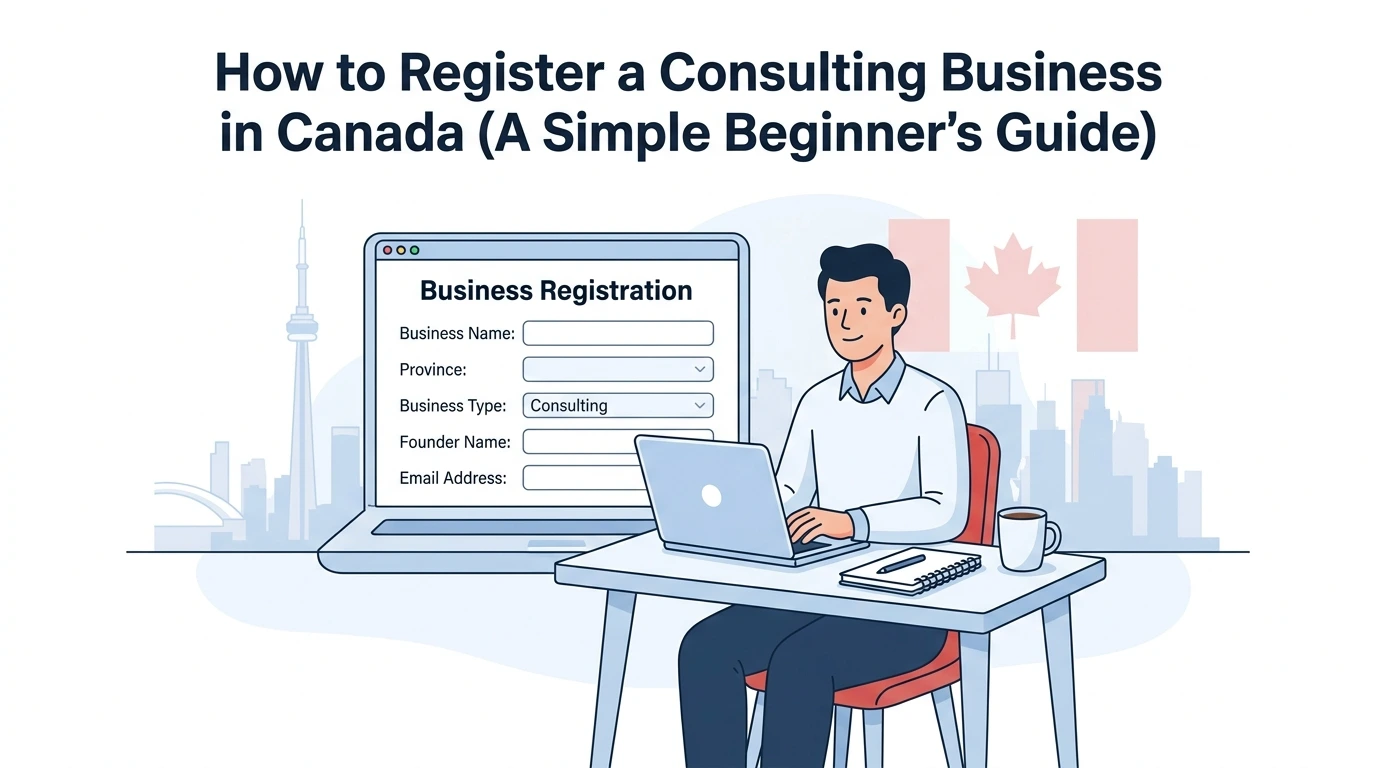
Step 3: Fill out the registration form: Most provinces let you do this entirely online. You’ll provide your legal name, your business name, your business address, and a brief description of what your business does.
Step 4: Pay the registration fee: Fees vary by province and structure. For a sole proprietorship or business name registration, expect to pay between $40 and $80 in most provinces.
Step 5: Receive your registration certificate: After your application is processed, you’ll receive a business registration number and a certificate. This document is what you’ll use to open a business bank account and may be required when signing certain client contracts.
Step 6: Register with the CRA if needed: Once you’re registered provincially, you may also need to set up a business number with the Canada Revenue Agency. This is required if you plan to hire employees and also becomes necessary if your annual revenue is going to reach $30,000; at that point you’re required to register for a GST/HST account.
For most sole proprietors, the whole process from start to finish can be completed online in under an hour.
Documents Required for Registration
One of the reasons registration is so manageable for new consultants is that the document requirements are minimal for a basic sole proprietorship.
Most provinces ask for your full legal name, your home or business address, your chosen business name, and a description of your business activity. Something general like “management consulting” or “marketing consulting” is perfectly acceptable. You don’t need to describe every service you plan to offer.
If you’re incorporating, the requirements are more involved. You’ll need articles of incorporation, which describe the structure of the corporation and the rights of any shareholders. Incorporating federally through Corporations Canada or provincially through your province’s registry both require this document. Many people use a lawyer or an online incorporation service to prepare it correctly.
Registration Costs in Canada
The cost to register a consulting business in Canada is quite low at the sole proprietor level.
Ontario charges around $60 to register a business name online. British Columbia sits at roughly $40 for a sole proprietorship registration. Alberta and Manitoba are in a similar range. Quebec handles registration through the Registraire des entreprises, and fees are comparable to other provinces.
If you incorporate federally through Corporations Canada, the online fee is $200. Provincial incorporation costs vary. Ontario is around $300, while other provinces range between $250 and $450 depending on the method.
Keep in mind that business name registrations in most provinces need to be renewed every few years. The renewal fees are typically lower than the initial registration cost.
Online vs Offline Registration
For the vast majority of people registering a consulting business in Canada today, online is the way to go.
Provincial government websites have made the process straightforward. You fill in your information, upload any required documents, pay by credit card, and receive your certificate digitally. For a sole proprietorship, this can happen within minutes of submitting your application.
In-person registration at a government service office is still an option in most provinces, but it usually takes longer and offers no real advantage for a simple registration. Unless you have a complicated situation or specific questions you want answered in person, online is faster and easier.
If you’re incorporating and find the process confusing, there are third-party services that guide you through it for a fee. They’re not the cheapest option, but they can save time and reduce the chance of errors in your incorporation documents.
Common Mistakes Beginners Make During Registration
A few patterns show up regularly among new consultants registering for the first time.
The most common mistake is choosing a business name before searching whether it’s available. It’s easy to get attached to a name, build a logo around it, and then find out it’s already registered. Always run the search before you commit to anything.
Another mistake is using a home address without thinking through the privacy implications. Your registered business address is typically part of the public record. If you work from home and don’t want your residential address publicly listed, look into virtual office addresses or registered agent services in your province.
Choosing the wrong structure is also common. Some new consultants incorporate before their income warrants it, adding administrative complexity and cost without getting the full benefit. Others stay as sole proprietors too long and miss out on tax savings. If you’re unsure, a one-hour conversation with an accountant before you register can save you a lot of headaches.
Finally, forgetting to renew. Most people register and then forget that registrations expire. Mark the renewal date in your calendar when you register so it doesn’t catch you off guard a few years down the line.
Tips Before Registering Your Consulting Business
A few things worth sorting out before you submit your registration application.
Have two or three name options ready when you start your name search. Your first choice might be taken, and having alternatives in mind means you don’t have to stop and start over.
Decide on your business address ahead of time. If your home address is fine to use publicly, great. If you prefer privacy, research virtual office options in your city before you fill out the form.
Plan to open a business bank account as soon as your certificate arrives. Keeping your business income and personal money separate from day one makes your bookkeeping cleaner and your tax filing much simpler. It also looks more professional to clients when invoices come from a business account.
And if you’re on the fence about incorporating, don’t let the decision delay you from getting started. Register as a sole proprietor, start working with clients, and revisit incorporation with an accountant once you have a clearer picture of your income.
Conclusion
Knowing how to register a consulting business in Canada doesn’t require legal expertise or weeks of preparation. For most new consultants, it’s a straightforward process that takes a few hours at most.
The key decisions, your business structure, and your business name are worth thinking through carefully before you start filling out forms. Get those right, and the rest follows naturally.
Once your business is registered, the next step is understanding everything else involved in building and running your consulting practice. The full guide on how to start a consulting business in Canada covers the complete picture, from choosing a niche to finding clients and managing your taxes.
Do I have to register my consulting business in Canada if I work under my own name?
Not always. Many provinces allow sole proprietors to operate under their legal name without formal registration. But if you use any other business name, registration is required.
How long does it take to register a consulting business in Canada?
A sole proprietorship or business name registration done online typically takes anywhere from a few minutes to a few hours. Incorporation can take several days to a few weeks depending on the province and whether you use a lawyer or service.
Can I register my consulting business online in Canada?
Yes. Almost every province offers online registration through their official government registry. It’s the simplest and fastest option for most people.
What is the difference between registering a business name and incorporating?
Registering a business name lets you operate under a chosen name as a sole proprietor. Incorporating creates a separate legal company with its own tax obligations and liability protections.
Do I need to hire a lawyer to register a consulting business in Canada?
For a basic sole proprietorship registration, no. The process is simple enough to handle yourself. For incorporation, working with a lawyer or a reputable incorporation service helps ensure the documents are prepared correctly.
What happens if my business name registration expires?
Your registration lapses, and you’re technically operating without a valid registration. Most provinces send renewal notices, but it’s worth tracking the expiry date yourself so you can renew on time.