Consulting Business Logos: How to Get a Logo That Represents Your Brand Professionally
Your consulting business logos is not your entire brand. But it is one of the first things potential clients notice,…
Your consulting business logos is not your entire brand. But it is one of the first things potential clients notice, and it appears across every touchpoint where your business is represented. A well-designed logo builds credibility, reinforces professionalism, and creates a consistent visual identity. A poorly designed logo, on the other hand, can weaken trust regardless of how valuable your expertise actually is.
The good news is that creating effective consulting business logos does not require a large budget or an overly complex design. What matters most is that your logo is clean, memorable, scalable, and aligned with the expectations of your target audience. It should represent your consulting business consistently across your website, proposals, presentations, social media profiles, and other marketing materials.
This guide explains everything you need to know about consulting business logos, including the principles of effective logo design, affordable design options, common mistakes to avoid, and how to work with a professional designer or create a strong visual identity on a limited budget.
What a Consulting Logo Needs to Do
Before choosing a design approach or briefing a designer, it helps to understand what a consulting logo is actually supposed to accomplish.
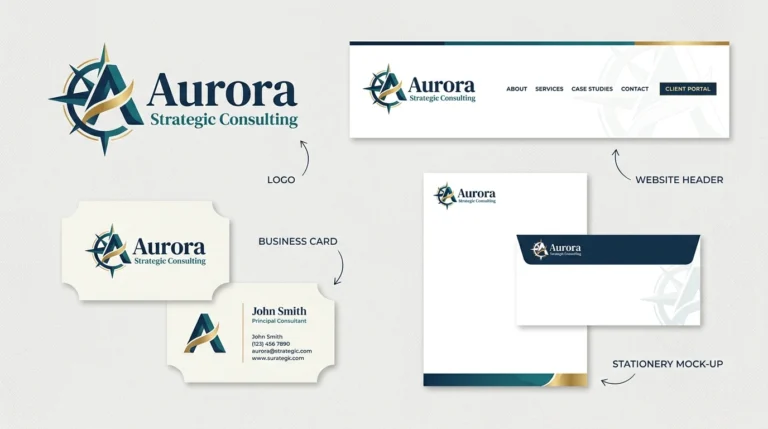
A consulting logo needs to be recognizable across different surfaces and sizes. It will appear on your website header, your business card, your email signature, your proposal documents, and potentially on presentation decks and branded merchandise. A logo that looks good at large sizes but becomes unreadable at small sizes is not fully functional.
It needs to communicate appropriate professionalism for your target clients. The visual tone of a logo for a management consulting firm serving Fortune 500 companies is different from the visual tone appropriate for a marketing consultant serving independent retailers. Both can be professionally designed. The difference is in what the design communicates.
It needs to work in both color and black and white. There will be situations where your logo appears without color: printed documents, faxed materials, and single-color print applications. A logo that loses its meaning or legibility without color has a functional limitation.
It needs to be distinctive enough to be recognizable but simple enough to be remembered. Overly complex logos are difficult to reproduce at small sizes and do not create strong memory impressions.
The Main Types of Consulting Logos
Consulting business logos generally fall into a few categories. Knowing the terminology helps when working with designers or evaluating options.
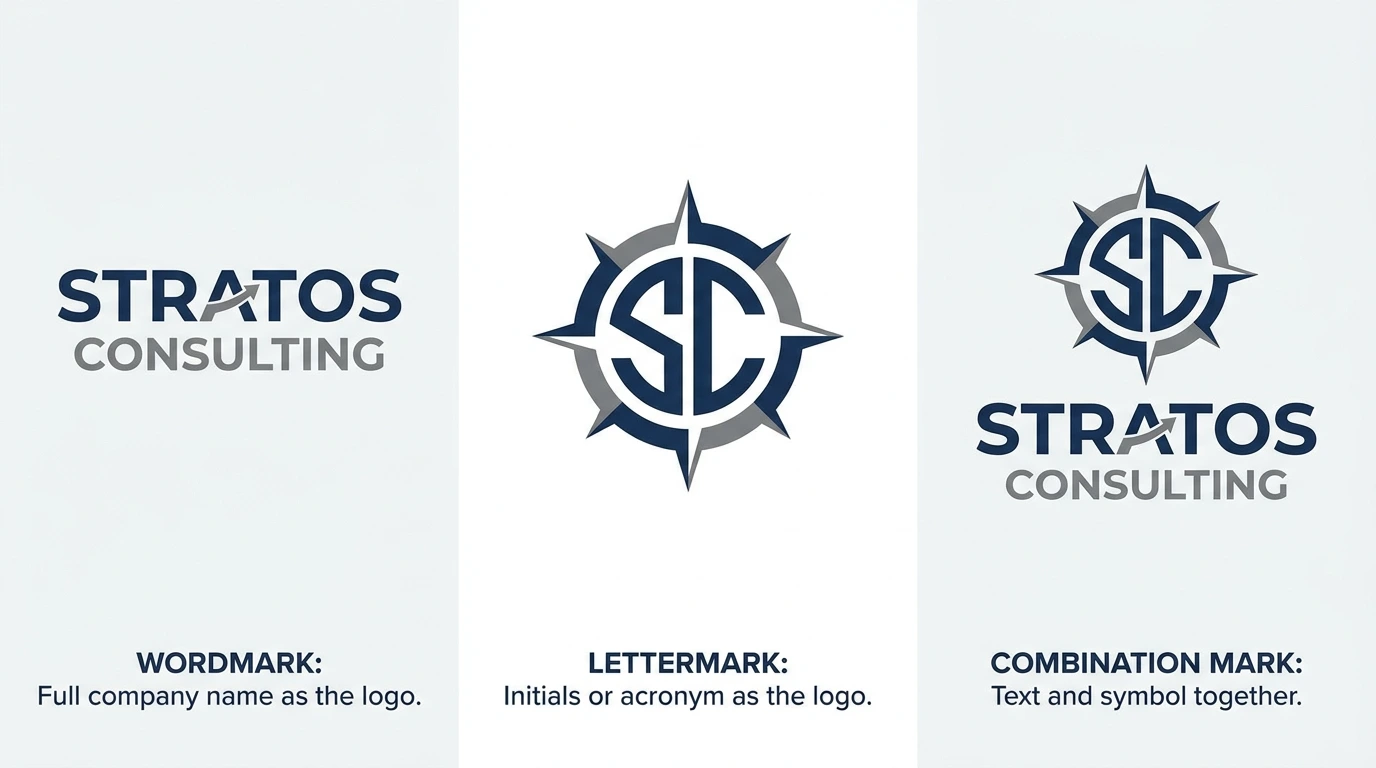
Wordmarks: use the business name set in a carefully chosen typeface as the entire logo. There is no icon or graphic element. The name itself, through its typography and spacing, creates the visual identity. Wordmarks are a strong choice for consulting businesses because the name is always visible, which supports brand recognition at the stage when clients are still learning who you are.
Lettermarks: use one or more initials from the business name rather than the full name. These work well for firms with longer names and are common in professional services. The challenge is that lettermarks require more time to build recognition because clients need to learn what the initials stand for before the mark is meaningful.
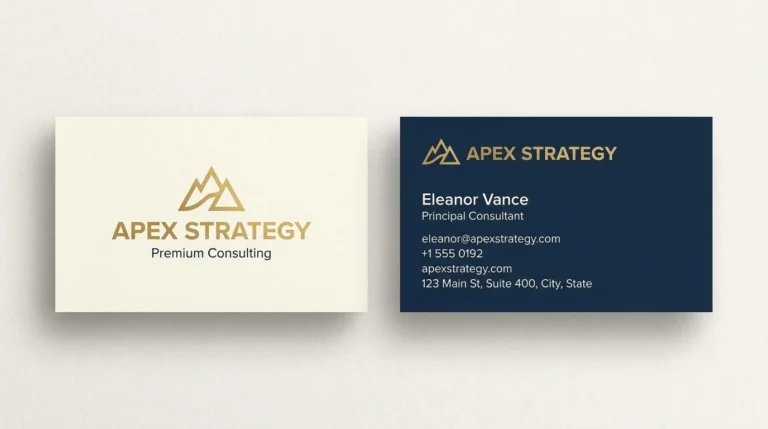
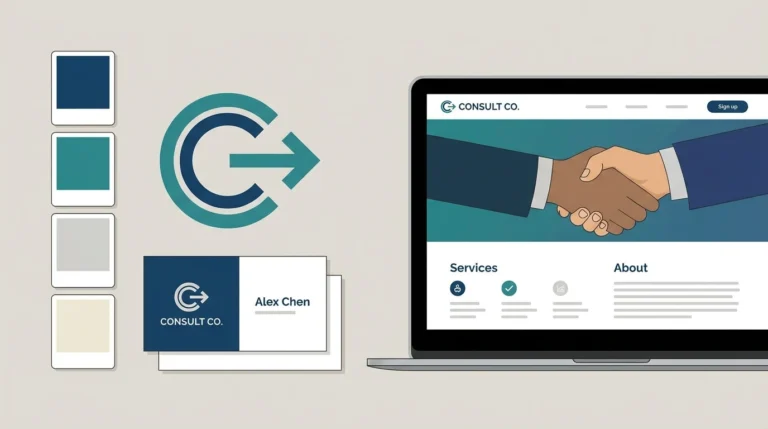
Combination marks: pair a graphic icon or symbol with the business name in text. This is the most versatile format because the icon and the wordmark can be used separately in different contexts. At small sizes, the icon alone works. On a business card, the full combination mark appears.
Abstract marks: use a non-representational graphic shape as the primary brand symbol. These require the most investment in brand building because nothing about the shape inherently communicates meaning. They are generally more appropriate for larger firms with substantial marketing budgets than for solo or small consulting practices.
For most independent consultants and small consulting firms, a wordmark or combination mark with a clean, simple icon is the most practical and effective choice.
Logo Design Options at Every Budget
The range of logo design options available today is wider than it has ever been. Here is an honest assessment of what each approach delivers.
DIY Design Platforms
Tools like Canva and Looka allow non-designers to create logos using templates and intuitive editing interfaces. The cost is minimal, often just the platform subscription or a one-time download fee.
The results from DIY platforms are highly variable. A consultant with a strong aesthetic sensibility who chooses templates carefully and makes deliberate design decisions can produce a credible result. A consultant who rushes through the process or picks the first option that looks acceptable will produce something generic that looks like every other logo from the same template library.
DIY design is appropriate for consultants at the earliest stage of their practice who need a functional visual identity quickly and cheaply, with the expectation of investing in professional design once revenue supports it.
Freelance Designers
Hiring a freelance designer through platforms like Fiverr or Upwork, or through direct referral, produces better results than DIY at a wide range of price points. Entry-level logo design from an experienced freelancer typically costs $200 to $500. Mid-tier professional designers charge $500 to $2,000 for logo and basic brand identity work.
The quality difference between the low and high ends of that range is significant. At the low end, you are getting execution of a relatively straightforward brief. At the higher end, you are getting strategic design thinking alongside execution, which means the designer is helping you make decisions that support your brand goals, not just producing visual output.
Freelance design is appropriate for most consulting practices that have generated some initial revenue and are ready to invest in a professional visual identity.
Design Contests
Platforms like 99designs offer design contest models where you write a brief, set a prize amount, and receive multiple design submissions from different designers. You choose the winner and pay only for the design you select.
Contests produce a wide range of quality and give you multiple creative directions to evaluate simultaneously. The limitation is that designers working on spec in a contest environment often produce safer, more generic work than designers engaged in a direct relationship where they invest in understanding your specific needs.
Boutique Brand Design Studios
For consultants at a more advanced stage who want a comprehensive brand identity developed strategically, working with a boutique brand design studio typically costs $3,000 to $10,000 or more. This engagement includes brand strategy discussions, multiple concept directions, refinement rounds, and a complete brand identity system delivered in all necessary formats.
This investment is appropriate for established consultants who are investing significantly in their practice growth and want a brand identity that will support that growth for many years without needing to be revisited.
How to Brief a Designer Effectively
The quality of your logo outcome is heavily influenced by the quality of the brief you give your designer. A vague or incomplete brief produces generic results. A specific, well-considered brief gives the designer the information they need to create something genuinely appropriate for your brand.
A useful logo design brief covers the following.
Your business name and what it does. Describe your consulting focus, your target clients, and the specific problem you solve. The designer needs to understand the context your logo will operate in.
Your brand positioning. Are you positioning yourself as a premium, sophisticated provider? An accessible, practical advisor? A technical specialist? A creative problem solver? The positioning should influence every design decision.
The tone you want the logo to communicate. List four to six adjectives that describe how you want the logo to feel: professional, warm, bold, precise, approachable, innovative, and trustworthy. These become design direction guides.
Examples you find effective. Share three to five logos from other consulting businesses or professional service firms that you find credible and appropriate. Explain specifically what you like about each. This is one of the most useful inputs you can give a designer because it communicates aesthetic preferences far more precisely than descriptive language alone.
Formats and applications. Tell the designer where the logo will appear. Business cards, website, email signature, proposal documents, and LinkedIn cover image. This determines what sizes and formats the final files need to be delivered in.
What to Look for in a Final Logo
When evaluating logo options, assess each option against practical criteria rather than personal preference alone.
Does it work at small sizes? Test the logo at business card size and email signature size. If key elements become unclear or the overall mark loses its character at small dimensions, that is a functional problem.
Does it work in black and white? Remove the color from the logo and evaluate whether it retains its legibility and character. A logo that depends entirely on color to communicate its meaning is not fully functional.
Does it feel appropriate for your target clients? Show the logo to two or three people who fit your target client profile and ask for their honest first impression. You are not asking whether they like it. You are asking what it communicates to them about the business.
Is it distinctive enough to be remembered? A logo that looks like it could belong to a dozen other consulting businesses does not build brand recognition effectively. Some level of distinctiveness, even if subtle, matters.
Logo File Formats You Need
When you receive your final logo files, confirm that you are getting the formats necessary to use the logo across all your applications.
SVG and EPS are vector formats that can be scaled to any size without loss of quality. These are the master files you need for professional printing and any application where size is not fixed. PNG with a transparent background is the format you will use most often for digital applications, including your website, email signature, and social media profiles.
PDF is useful for print applications and is often required by print vendors. JPEG is acceptable for some digital applications but does not support transparency, which limits its usefulness. Confirm that you receive files in all of these formats, along with both full-color and black and white versions of the logo.
How much should a consulting business logo cost?
A functional logo for a solo consulting practice can be produced for $200 to $500 through a competent freelance designer. More comprehensive brand identity work from a professional studio runs $2,000 to $10,000. DIY options cost less but require more of your time and design sensibility to produce an effective result.
Do I need a logo before I can start consulting?
No. You can begin consulting with a simple text-based email signature and a basic LinkedIn profile while your logo is being developed. Many consultants land their first clients without any formal visual identity. Do not let logo development delay client outreach.
Should my consulting logo include an icon or just use my business name?
Both approaches work. A wordmark using only your business name in distinctive typography is a clean and professional solution for most consulting businesses. A combination mark with a simple icon adds visual interest and creates a symbol that can stand alone in some contexts. The choice depends on your personal preference and the overall positioning of your brand.
Can I use a free logo maker for my consulting business?
Free logo makers produce functional results for consultants at the very beginning of their practice. The limitation is that template-based logos can look generic and are often similar to logos produced by other businesses using the same platform. As your practice grows, investing in a professionally designed logo that is uniquely yours produces a stronger brand asset.
What colors work well for consulting business logos?
Blue, navy, and dark green communicate trust, stability, and professionalism, which is why they are common in consulting and professional services. Deep charcoal and black communicate sophistication and authority. Warmer tones such as burgundy and forest green can communicate approachability alongside professionalism. Avoid very light colors or highly saturated bright colors for primary brand elements in most consulting contexts, as they tend to communicate informality.
Conclusion
A well-designed logo is a practical investment in your consulting brand. It does not need to be expensive or elaborate. It needs to be clean, appropriate, consistent with your positioning, and functional across the surfaces where it will appear.
Invest in the best logo you can afford at your current stage. Start with something credible and refine it as your practice grows. The goal is a mark you can represent confidently in every client interaction, not perfection at the expense of getting started.
To see the seen full picture of building a consulting brand that attracts the right clients, visit the complete guide on consulting business branding.