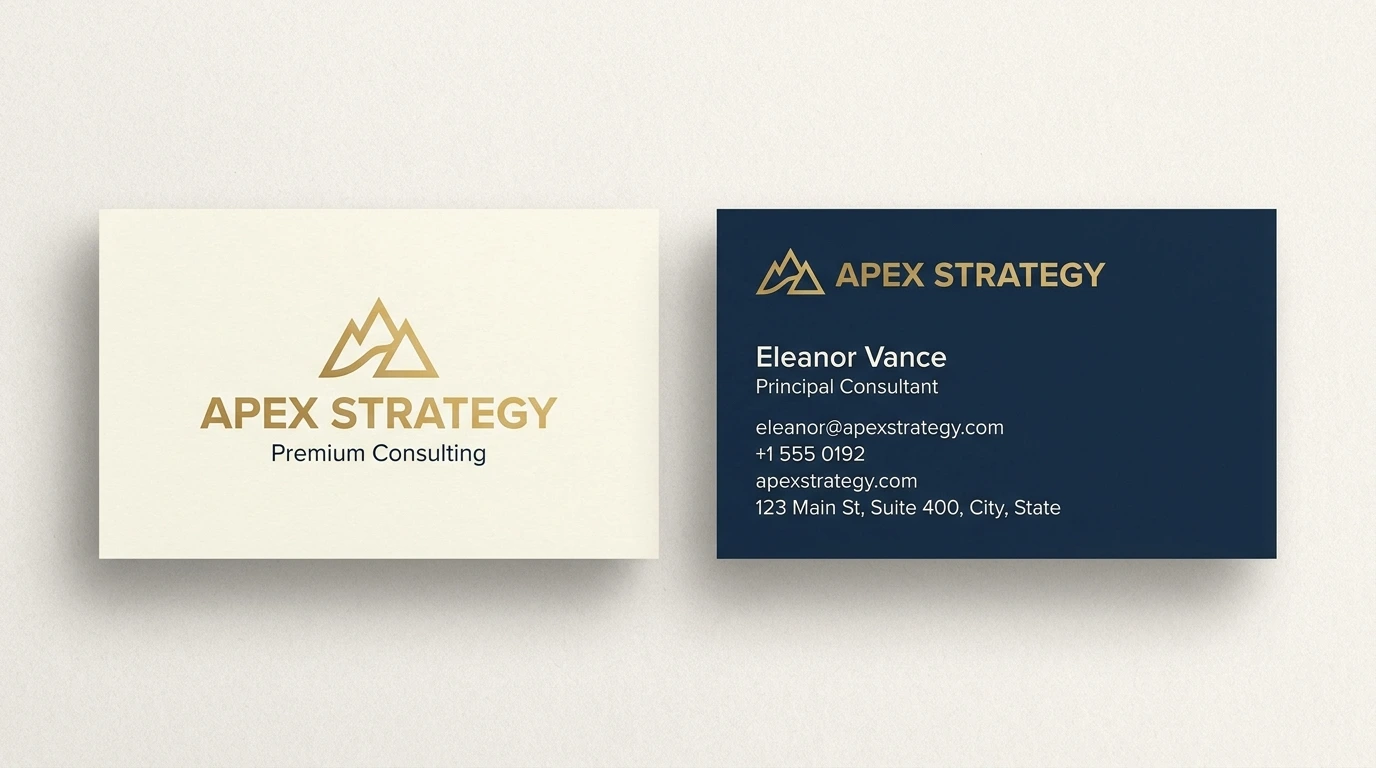
Consulting Business Cards: Design, Content, and How to Use Them Effectively
Business cards have survived the digital age for a simple reason. They work. A well-designed card exchanged at the right…
Business cards have survived the digital age for a simple reason. They work. A well-designed card exchanged at the right moment creates a physical brand touchpoint that no digital equivalent has fully replaced.
For consultants, business cards remain relevant in professional settings where first impressions matter most: industry conferences, association events, in-person client meetings, and networking dinners. The card you hand someone in that moment either reinforces your professional credibility or quietly undermines it.
This guide covers what belongs on a consulting business cards, how to design one that represents your brand effectively, what printing quality signals, and how to use cards strategically rather than distributing them indiscriminately.
Why Business Cards Still Matter for Consultants
Digital contact sharing tools exist, and many professionals use them. But a physical business card communicates something that a digital exchange does not: that you came prepared, that you take your professional identity seriously, and that you want this person to have something tangible to remember you by.
There is also a practical dimension. Not every environment is conducive to pulling out a phone and tapping cards digitally. A meal, a cocktail reception, a hallway conversation between sessions at a conference: these moments are often where meaningful professional introductions happen. A well-timed physical card exchange is more graceful in these contexts than asking someone to find you on LinkedIn while you are both standing with drinks in your hands.
For consultants specifically, the card is also a brand touchpoint. Every element of it, from the paper weight to the typography to the color choices, contributes to the impression your brand makes. A cheap, poorly designed card is not a neutral absence of signal. It is an active negative signal about how seriously you take your professional presentation.
What to Include on a Consulting Business Card
The most effective consulting business cards contain essential information without crowding every available surface. Restraint is a design principle, not a limitation.
Your name: This should be the most prominent text element on the card. Clients need to remember who you are before they remember anything else.
Your title or professional descriptor: This communicates what you do and who you serve without requiring a conversation. Options include your job title, your niche descriptor, or a short phrase that positions your expertise. Examples: Management Consultant, HR Strategy Advisor, Technology Implementation Consultant, Financial Operations Consultant.
Your business name and logo: Your business name and logo should appear on the card and be consistent with your other branded materials. This is a basic consistency requirement.
Your email address: Use a professional email address with your domain, not a generic Gmail or Yahoo address. Your email address is a branding element as well as a contact detail.
Your phone number: Include a professional phone number where clients can reach you. Many consultants use a separate business line or a VoIP service for this purpose to maintain the separation between personal and professional contact.
Your website. Your website URL should appear on the card. Keep it clean without the http://www.wordpress.com prefix if the URL reads clearly without them.
Your LinkedIn URL: A customized LinkedIn profile URL is worth including, particularly if your LinkedIn presence is a primary channel for demonstrating your expertise. Customize your LinkedIn URL to remove the default numbers and make it clean enough to print.
A QR code (optional): A QR code that links to your website or LinkedIn profile adds a useful digital bridge without cluttering the design. Modern card printing services can generate and print QR codes easily. Place the QR code in a position that does not compete visually with the core information.
What you should not include: your full street address unless physical location is relevant to your practice, social media handles beyond LinkedIn unless they are active and professional, a photograph unless you are in a field where face recognition adds meaningful value, and unnecessary decorative text.
Design Principles for Consulting Business Cards
A consulting business card should communicate professionalism through restraint and quality, not through complexity or decoration.
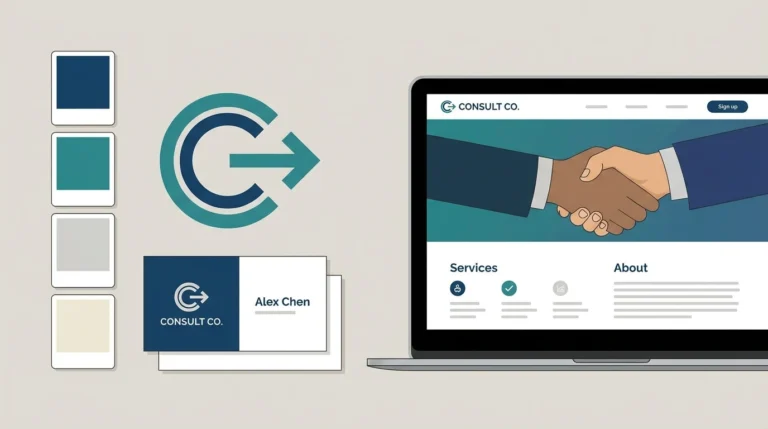
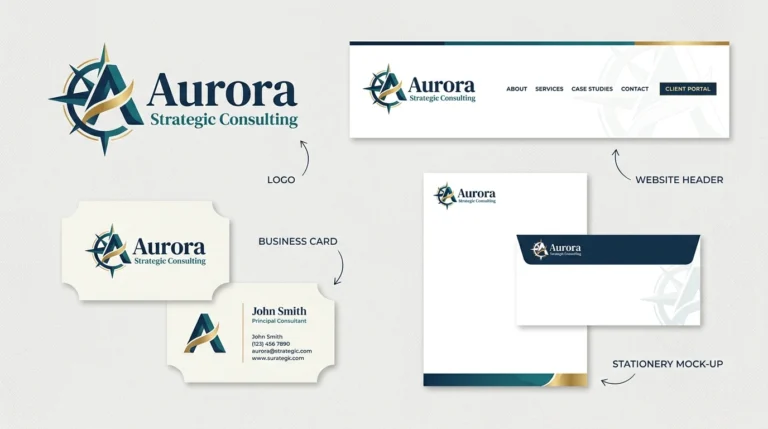
Consistency with your broader brand identity. Your card should use the same fonts, colors, and logo that appear across your other branded materials. A card that looks unrelated to your website signals disorganization. Consistency reinforces recognition.
Clear visual hierarchy. Your name should be the dominant element. Secondary information like your title and contact details should be clearly readable but visually subordinate. The hierarchy guides the reader’s eye in the order of importance.
Generous white space. Cramming every surface of the card with information looks desperate and is difficult to read. White space communicates confidence. Leave breathing room around text elements.
Readable typography. Use your brand fonts at sizes that are genuinely comfortable to read, not the minimum size that technically fits. Cards are often read in variable lighting conditions by people who may not be wearing their reading glasses.
Appropriate color usage. Use your brand colors intentionally. A card does not need to use every color in your palette. A clean card with one or two colors used thoughtfully is more effective than a multicolor design that competes with itself.
Back of the card. Many consultants leave the back of the card blank, which is a perfectly acceptable choice. Others use the back for a short positioning statement, a key service list, or a visual brand element. If you use the back, apply the same design discipline as the front: less is more.
Paper Quality and Print Finishing
The physical quality of your business card communicates as much as the visual design. A card printed on thin, flimsy stock contradicts a premium brand positioning regardless of how well the design is executed.
Paper weight. Standard business cards are typically 14-point or 16-point cardstock. Premium cards use 32-point or thicker stock. The difference in perceived quality is immediately apparent when you hold the cards. For a consulting business, a 16-point minimum is a reasonable baseline. 32-point or above positions the card as a premium item.
Finish options. Matte finishes communicate sophistication and are easier to write on, which is useful if you ever want to jot a note on the card before handing it over. Gloss finishes communicate polish and make colors more vibrant. Soft-touch or velvet finishes communicate premium quality through texture. Choose a finish that aligns with your overall brand positioning.
Specialty finishes. Spot UV coating, foil stamping, embossing, and letterpress printing all add tactile and visual distinction. These finishes increase cost substantially but can create a card that genuinely stands out. They are most appropriate for consultants at the premium end of their market whose card is part of a deliberate impression-making strategy.
Recommended printers. Moo is widely considered the standard for premium quality business cards at accessible prices. Vistaprint offers competitive pricing for standard quality. Local print shops can provide specialty finishes that online printers do not always offer and allow you to proof the physical card before full production.
How to Use Business Cards Effectively
Having professional business cards is only half the equation. How and when you use them determines whether they contribute to your business development.
Give cards at the right moments. The best time to offer a business card is when a conversation has produced genuine mutual interest. A card exchanged after a meaningful connection reinforces that connection. A card distributed to every person in a room regardless of conversation quality is a forgettable gesture.
Ask for the other person’s card. The card exchange is a two-way interaction. Asking for the other person’s card demonstrates genuine interest and gives you a way to follow up rather than waiting for them to contact you.
Write a note. After a meaningful conversation, write a brief note on the back of the card you give or add context on the spot: the specific topic you discussed, a resource you promised to share, or a follow-up action. This personalizes the exchange and makes your card more memorable.
Follow up promptly. The value of a business card exchange is realized in the follow-up. Send a LinkedIn connection request or a brief email within 24 to 48 hours of meeting someone. Reference the conversation specifically to demonstrate that you were genuinely engaged.
Keep cards fresh. Do not carry cards that are bent, marked, or smudged. The condition of the card you hand someone is a detail that registers subconsciously. Carry cards in a card holder that protects them and makes retrieval clean and professional.
Digital Alternatives and Complements
Several digital tools offer alternatives to physical business cards that are worth knowing even if they do not fully replace the physical card for most consulting contexts.
LinkedIn QR code. Your LinkedIn profile has a built-in QR code that can be shared from your phone. This is useful in casual digital exchanges and as a backup when you have run out of cards.
Digital business card apps. Tools like HiHello, Popl, and similar platforms allow you to create a digital card that recipients can save directly to their contacts. NFC-enabled cards and devices make this exchange near-instant in some contexts.
QR code on physical card. As noted in the design section, printing a QR code on your physical card bridges the physical and digital experience. Recipients can scan the code to save your information digitally without manual entry.
These tools complement physical cards for most consultants rather than replacing them. The physical card remains the most appropriate format for formal professional introduction settings.
How many business cards should I order?
For most consultants, starting with 250 to 500 cards is reasonable. This gives you enough supply for a year or more of professional networking at a moderate pace without over-investing before you have confirmed your design and contact information are stable. If your business name, email address, phone number, or website is likely to change in the near future, order a smaller quantity initially.
Should I include a photo on my consulting business card?
Photos on business cards are common in some fields, such as real estate and insurance, where face recognition aids client retention. For most consulting niches, a photo is not standard and may feel inconsistent with a professional services positioning. The exception would be consultants in personal coaching or executive advisory roles where the personal relationship is the primary product.
Is it worth spending more on premium business card printing?
For most consulting practices, yes. The difference in per-card cost between standard and premium printing is modest when spread across the lifetime of a card stock order. The difference in impression made is more significant. A consultant charging professional rates should have a business card that reflects that positioning.
Should I put my home address on my consulting business card?
No. Unless your consulting practice operates from a dedicated office that clients visit, including a home address on your business card is unnecessary and reduces privacy. A website URL and professional email address are sufficient for directing potential clients to the right places.
How often should I redesign my consulting business cards?
Redesign when your business name, contact information, or brand identity changes significantly. Incremental updates to services or positioning that do not change the core brand elements do not warrant a full card redesign. A well-designed card with stable brand elements can serve effectively for three to five years.
Conclusion
A consulting business card is a small but meaningful investment in your professional brand. It reinforces your credibility at the moments when first impressions are being formed, and it gives potential clients a tangible reminder of who you are and how to reach you.
Design it with the same care you bring to your proposals and your client work. Use quality printing that reflects your positioning. And use it strategically rather than distributing it indiscriminately.
For a complete approach to building every element of your consulting brand, including your logo, business name, personal brand, and overall positioning strategy, visit the full guide on consulting business branding.