Personal Branding for Consultants: How to Build a Reputation That Attracts Clients
In consulting, people do not hire firms. They hire people. Even when the engagement is formally with a business entity,…
In consulting, people do not hire firms. They hire people. Even when the engagement is formally with a business entity, the decision to hire is almost always based on how a specific person comes across: their expertise, communication style, professional reputation, and the trust they inspire.
That is why personal branding for consultants matters more than it does for almost any other profession. Your personal brand is one of the strongest assets influencing whether potential clients choose to work with you. A well-developed personal brand builds credibility, differentiates you from competitors, and makes it easier for prospective clients to view you as a trusted expert before the first conversation even takes place.
This guide explores every aspect of personal branding for consultants, including what a consultant’s personal brand really is, where it is built, how to establish authority across your website and professional platforms, and how to develop a consistent, authentic reputation that attracts high-quality clients over the long term.
What Personal Branding Actually Means for a Consultant
Personal branding is not a performance. It is not crafting a persona that is different from who you actually are or curating a feed of carefully staged professional content designed to look impressive.
For a consultant, personal branding is the deliberate, consistent communication of your expertise, your perspective, and your professional values in the channels where your potential clients spend their professional attention.
The goal is not fame. It is recognition within a specific professional community. You want the people who have problems you can solve to know that you exist, understand what you do, and have enough confidence in your expertise to reach out or respond positively when someone introduces you.
That is a narrow and achievable goal. It does not require a massive audience. It requires consistent visibility among the right people over a sustained period.
The Three Pillars of a Consultant’s Personal Brand
A strong consulting personal brand rests on three interconnected pillars.
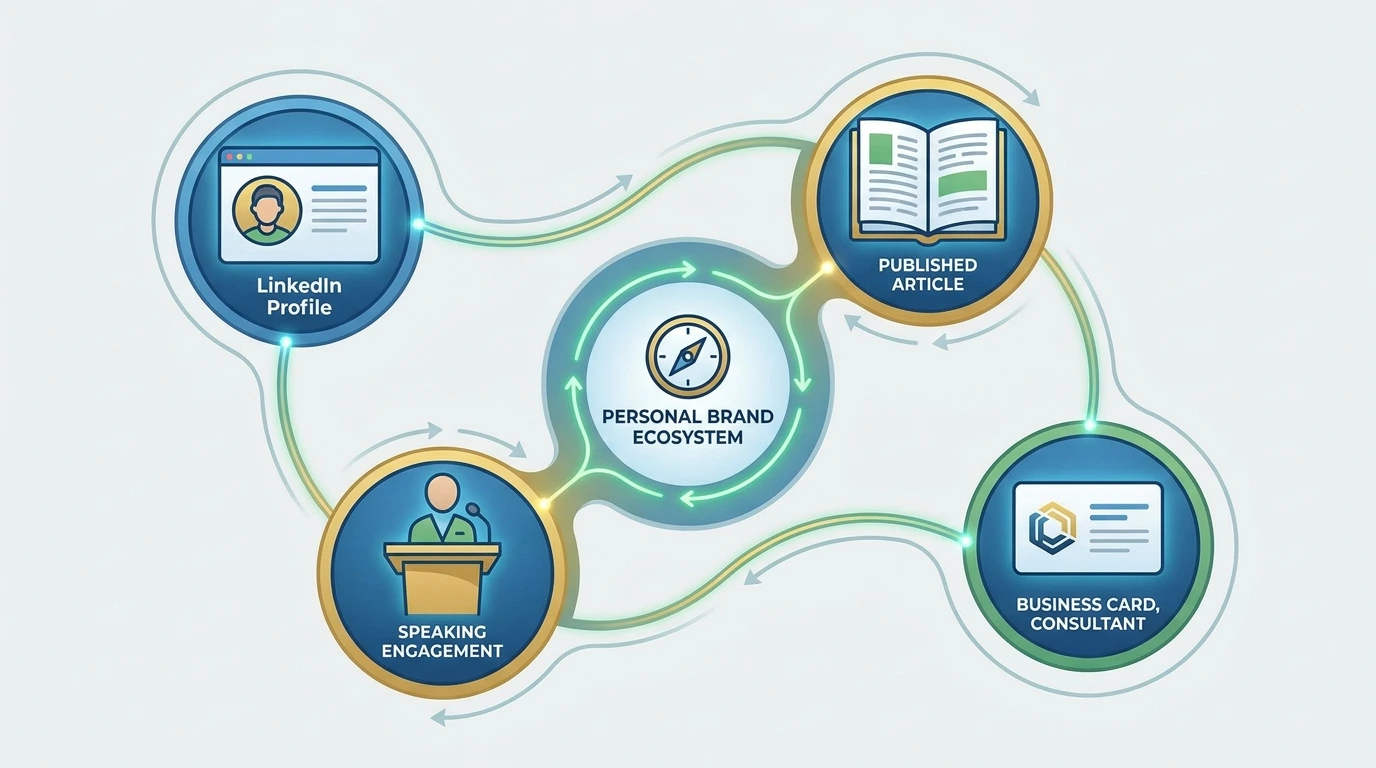
Expertise visibility: Potential clients need to see evidence of your knowledge before they are ready to trust you with their problems. This evidence comes through the content you publish, the positions you take on industry questions, the case studies you share, and the recommendations from people who have worked with you.
Consistent presence: Visibility that appears once and disappears creates no lasting impression. Personal brand development requires showing up in the same channels consistently enough that people in your target market begin to recognize you and associate you with your area of expertise.
Professional character: How you communicate, how you treat people in professional interactions, how you handle disagreement or criticism, and how you represent your values all contribute to your personal brand. Expertise without trustworthy character does not build the kind of reputation that generates consulting referrals.
LinkedIn: The Most Important Personal Branding Platform for Consultants
For the vast majority of consultants, LinkedIn is the single most important platform for personal brand development. It is where most business decision-makers spend professional attention online, where consulting introductions are researched and validated, and where content reaches the people most likely to hire you.
Investing in your LinkedIn presence before any other platform is the right priority for most consulting practices.
Optimizing Your LinkedIn Profile
Your LinkedIn profile is the foundation of your personal brand on the platform. Before any content strategy, the profile itself needs to be set up to communicate your positioning clearly to anyone who visits.
Your headline should describe what you do and who you serve, not just your job title. Instead of “Independent Consultant,” consider “Operations Consulting for Mid-Size Manufacturing Companies” or “HR Strategy Advisor for Fast-Growing Tech Startups.” The headline is the first thing anyone reads, and it determines whether they keep reading.
Your About section should communicate your positioning, your expertise, and your professional character in a few clear paragraphs. Write it in first person and in a tone that reflects how you actually communicate. This is not a resume summary. It is a professional introduction to potential clients.
Your Experience section should describe the outcomes you produced in each role, not just the responsibilities you held. Clients reviewing your profile want to understand what working with you produces, not just what activities you have been paid to do.
Recommendations from former clients and colleagues add significant credibility. A profile with five or more detailed, specific recommendations from credible professionals communicates social proof that no amount of self-description can replicate. Ask for recommendations from every satisfied client and collaborative colleague.
Your featured section allows you to pin specific content to the top of your profile. Use this to showcase your strongest case studies, published articles, or a brief video introduction. Give profile visitors the best possible first look at your expertise before they scroll further.
LinkedIn Content Strategy for Consultants
Publishing content on LinkedIn consistently is the most effective way to build personal brand visibility within your target client community. Content that demonstrates your expertise in relevant, practical terms is what builds the recognition that eventually generates inbound interest.
The best performing content for consultants on LinkedIn shares a common characteristic. It provides genuine value without requiring the reader to hire you to get that value. Practical insights, honest observations about challenges in your industry, lessons from real engagements (with appropriate confidentiality maintained), and clear explanations of complex topics all perform well.
What does not work is promotional content that exists primarily to tell people how good you are. Readers scroll past self-promotion quickly. They stop and engage with content that teaches them something, challenges their thinking, or articulates a problem they have been struggling to name.
Post with a frequency you can maintain indefinitely. Two to three times per week is a strong target for consultants who want to build meaningful visibility. Once a week is acceptable and still compounds over time. Posting intensively for two weeks and then going silent is worse than posting infrequently but consistently, because consistency is what builds recognition.
Engage genuinely with content from others in your professional community. Comment with substance rather than generic affirmations. Ask questions. Share perspectives. LinkedIn is a social platform. One-directional broadcasting without engagement is a less effective strategy than active participation in professional conversations.
Building Thought Leadership Beyond LinkedIn
LinkedIn is the priority, but personal brand development does not end there. Additional channels compound your visibility and reach potential clients who are active on different platforms.
Writing and publishing: Contributing articles to industry publications, trade journals, or well-read blogs in your niche builds credibility and reaches audiences beyond your existing LinkedIn network. Start with publications your target clients actually read. A single article in the right trade publication can produce more relevant visibility than dozens of LinkedIn posts.
Speaking: Speaking at industry conferences, association events, and professional gatherings is among the most effective personal branding activities available to consultants. A 20-minute presentation to 200 people who fit your target client profile produces more qualified exposure than almost any digital activity. Start with smaller local events and panel discussions before pursuing keynote opportunities.
Podcasting: Appearing as a guest on podcasts that your target clients listen to places you in front of existing audiences without requiring you to build an audience first. Research the podcasts most active in your niche, listen to several episodes to understand the format and audience, and reach out to hosts with a specific proposal for what you could contribute.
A newsletter: A regular email newsletter to a subscribed audience is one of the highest-value owned media assets a consultant can build. Unlike social media followers, an email subscriber list is an audience you own and control. Even a small, engaged subscriber list of 500 to 1,000 people who fit your target client profile is a meaningful business development asset.
Managing Your Online Reputation
Your personal brand also includes what appears when someone searches your name online. Most potential clients will search for you before or after an introduction. What they find shapes their confidence in moving forward.
Search your own name periodically and look at what appears. Is your LinkedIn profile among the first results? Do you have published articles or podcast appearances that reinforce your expertise? Are there any results that could create doubt or confusion?
Positive content you control, such as your LinkedIn profile, website, and published articles, will generally rank above third-party content. Publishing consistently creates a growing body of positive search results that reinforce your positioning for anyone who searches for you.
Consistency and the Long Game
Personal brand development is not a short-term tactic. Most consultants see meaningful results from sustained personal branding effort within 12 to 24 months. The consultants who stop because they do not see immediate results in the first few months are the ones who miss the compounding benefit.
The value of a personal brand compounds in the same way that financial investments compound. Early contributions seem to produce little visible return. Over time, the accumulated effort produces returns that dwarf the input. A consultant who has published consistently valuable content for two years has a searchable archive that introduces them to potential clients constantly, with no ongoing effort required for each individual piece.
Commit to the process long enough to see the compound effect. Be consistent enough to build recognition. Be genuine enough to build trust. The combination of those three qualities, over time, produces a personal brand that makes every other aspect of your consulting practice easier.
How long does it take to build a personal brand as a consultant?
Building a personal brand that generates consistent inbound interest typically takes 12 to 24 months of sustained effort. The timeline varies based on niche size, publishing frequency, the quality of the content, and the strength of existing professional relationships. Consistent effort compresses the timeline. Sporadic activity extends it significantly.
Do I need to be active on multiple social media platforms to build a consulting personal brand?
No. For most consultants, deep investment in one platform (almost always LinkedIn) produces better results than shallow presence across multiple platforms. Master one channel before considering expansion. Adding platforms before your primary channel is producing results spreads your effort too thin and reduces the quality of presence on every platform.
What should I write about to build my personal brand as a consultant?
Write about the specific problems your target clients face, practical lessons from your professional experience, clear explanations of concepts your clients find confusing, honest observations about challenges in your industry, and your perspective on questions clients frequently ask you. Your content should reflect the expertise you bring to client engagements, not generic business advice.
Is it necessary to have a personal brand website separate from my business website?
Not necessarily. Many solo consultants effectively use their business website as their personal brand home base, particularly when their personal name and business name are the same or closely related. A separate personal website makes more sense for consultants who maintain a distinct personal speaking or writing presence alongside their consulting practice.
How do I handle negative feedback or criticism of my public content?
Respond to substantive criticism professionally and without defensiveness. Genuine disagreement handled with grace reflects well on your character and often produces more positive brand impressions than the absence of any controversy. Ignore or calmly dismiss unconstructive or hostile commentary. Do not engage in extended public arguments. Your brand is demonstrated by how you handle these moments, not just by the content you proactively publish.
Conclusion
Your personal brand is the most durable asset in your consulting practice. Clients come and go. Market conditions change. Technology evolves. But a reputation built on demonstrated expertise, consistent presence, and genuine professional character continues to compound in value regardless of what changes around it.
Start building it now, even if imperfectly. Publish something useful this week. Optimize your LinkedIn profile today. Reach out to a podcast that your clients listen to. Every action builds toward a brand that will make your consulting practice significantly easier to grow in the years ahead.
For the complete guide to building a consulting brand that works across every touchpoint, including your business name, logo, business cards, and overall brand strategy, visit the full guide on consulting business branding.