Legal Requirements for Consulting Business in USA (What Every Beginner Needs to Know)

Introduction
When you decide to start consulting, the excitement is real. You have skills, you have potential clients, and you’re ready to get to work. But before you send your first proposal, there’s a side of the business that deserves your attention: the legal side.
Understanding the legal requirements for consulting business in USA doesn’t mean you need to become a lawyer. It means you need to know enough to protect yourself, operate properly, and avoid problems that catch a lot of beginners off guard. The good news is that for most solo consultants, the legal setup is straightforward. This guide walks you through all of it in plain language.
Do Consultants Need Legal Registration in USA?
Yes, in most cases. Whether or not you’re required to formally register depends on your business structure and your state, but operating as an unregistered business comes with real risks.
If you’re consulting under your own legal name, say you’re John Smith and you invoice clients as John Smith, you’re technically operating as a sole proprietor. In many states, you can do this without formal registration. But the moment you want to use a business name (like “Summit Strategy Consulting”), you’ll need to file a DBA (Doing Business As) registration with your county or state.
Most consultants eventually form an LLC (limited liability company). This is by far the most popular structure for independent consultants, and for good reason. It separates your personal assets from your business, meaning if something goes wrong with a client, your personal savings and property are generally protected.
The requirements for forming an LLC vary by state, but the process is similar everywhere: you file articles of organization with your state, pay a filing fee (usually between $50 and $500), and create an operating agreement. Some states require you to publish a notice in a local newspaper. Check your specific state’s Secretary of State website for the exact steps.
Business Licenses and Permits in USA
One of the more confusing parts of the legal requirements for consulting business in USA is figuring out which licenses and permits actually apply to you.
The federal government doesn’t require a general business license. But your state, county, or city might. Many local governments require a general business operating license just to do business in their jurisdiction. This is usually inexpensive and renewed annually.
Beyond general business licenses, certain types of consulting require specialized licenses. Financial consultants, healthcare consultants, and legal consultants typically need professional licenses tied to their specific field. If your consulting work touches a regulated industry, check whether your state requires you to hold any professional credentials or licenses before charging for advice.
Most management, marketing, IT, HR, or business strategy consultants don’t face heavy licensing requirements. But it’s always worth a 15-minute check with your local city or county clerk’s office to confirm what applies in your area.
LLC vs Corporation: Legal Differences Explained Simply
When consultants think about business structure, the choice usually comes down to LLC or corporation. Here’s how they differ in practical terms.
An LLC gives you personal liability protection without a lot of administrative complexity. You can choose to be taxed as a sole proprietor (pass-through taxation) or, once your income grows, elect S-corp tax treatment to potentially save on self-employment taxes. For most solo consultants, an LLC is the right starting point.
A corporation (specifically a C-corp) is a more formal legal structure with a board of directors, shareholders, and strict record-keeping requirements. It’s typically used by businesses planning to raise investment or eventually go public. For the average independent consultant, a C-Corp creates more overhead than it’s worth.
An S-Corp isn’t actually a separate business structure; it’s a tax election. A consultant with an LLC or corporation can elect S-Corp status with the IRS once their net income is high enough (usually $50,000 or more) to make the tax savings meaningful. This is something to discuss with an accountant as your income grows.
For someone just starting out and working through the fundamentals of how to structure and launch their business, the bigger guide on how to start a consulting business in USA covers business structure decisions in more detail.
Contracts and Client Agreements
This is one of the most important legal requirements for consulting business in USA, and it’s also one of the most overlooked by beginners.
A contract protects both you and your client. It sets clear expectations about what work you’ll do, when you’ll deliver it, what you’ll be paid, and what happens if either side doesn’t hold up their end.
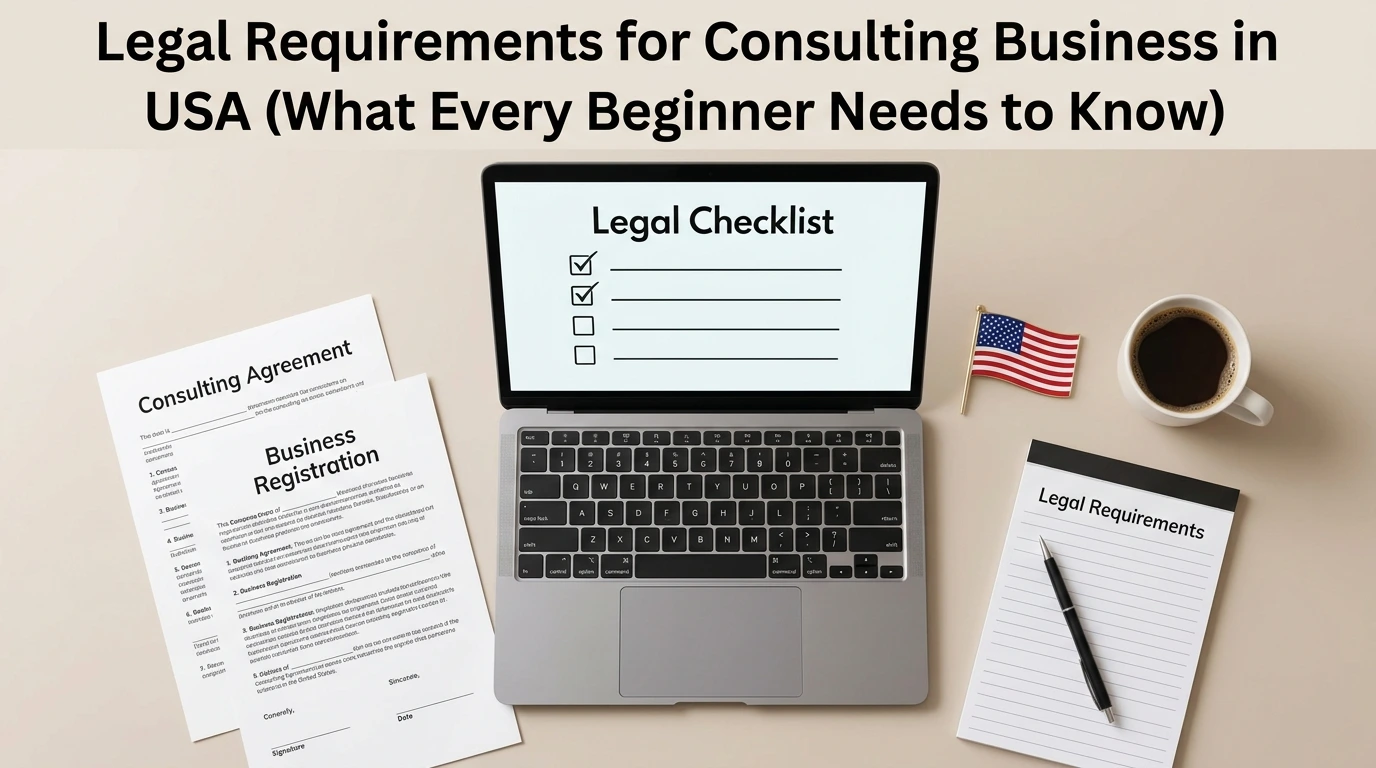
At minimum, your consulting contract should include the scope of work (exactly what services you’re providing), payment terms (how much and when), a timeline, intellectual property ownership, a confidentiality clause, and a termination clause that explains how either party can end the agreement.
Never start work on a project without a signed agreement. Even with clients you trust personally. Verbal agreements are extremely difficult to enforce, and misunderstandings over scope or payment are far more common than most people expect.
You don’t need to hire a lawyer to draft every contract from scratch. There are solid contract templates available from platforms like Bonsai, AND CO., or even through state bar association websites. Just make sure any template you use is reviewed for your specific situation, especially for larger projects.
Business Insurance for Consultants
Legal protection doesn’t end with your business structure and contracts. Insurance is a real and practical part of managing legal risk.
The most relevant type for consultants is Professional Liability Insurance, also called Errors and Omissions (E&O) Insurance. This covers you if a client claims your advice caused them financial harm. Even if the claim has no merit, defending yourself in court without insurance can be expensive.
General liability insurance is another type worth knowing about. It covers physical or property damage claims. If you ever meet with clients in person, whether at your office or theirs, it’s worth having.
Many clients, especially larger companies, will actually require you to show proof of insurance before signing a contract with you. So beyond protection, having coverage can also help you win business.
Costs vary depending on your industry and coverage level, but professional liability insurance for consultants often runs between $500 and $1,500 per year. That’s a small amount compared to what you’d spend if something went wrong without it.
Privacy Laws and Client Data Protection
If your consulting work involves handling client data, customer lists, financial records, employee information, or any personal data, you need to be aware of privacy laws.
In the USA, there isn’t one single national data privacy law (yet), but several important ones apply depending on context. HIPAA applies if you work with healthcare providers or handle medical information. The CCPA (California Consumer Privacy Act) applies if you handle data from California residents, regardless of where you’re based.
Beyond specific laws, best practice is simple: don’t collect data you don’t need, store what you have securely (encrypted storage, strong passwords, access controls), and have a written privacy policy if you handle client data regularly.
If you’re not sure what applies to you, a short consultation with a business attorney familiar with data privacy can save a lot of headaches later.
Federal and State Compliance Basics
Once your business is registered, there are ongoing compliance requirements to stay aware of.
At the federal level, you’ll need an EIN (Employer Identification Number) from the IRS if you form an LLC or hire employees. This is free and takes about 10 minutes to get online. You’ll use it for tax filings and on forms like W-9s when clients request them.
Most states require LLCs to file an annual report (sometimes called a statement of information), usually once a year, and pay a small fee. Missing this can result in your business being dissolved by the state. Mark it on your calendar as soon as you form your LLC.
If you hire any employees or contractors, employment law compliance becomes relevant to things like worker classification, tax withholding, and workplace regulations. For solo consultants without employees, this is less of an immediate concern but worth knowing exists.
Common Legal Mistakes Beginners Make
Knowing what to avoid is just as useful as knowing what to do.
Operating without a written contract is the most common mistake. It seems unnecessary until a client disputes scope or refuses payment then it becomes very necessary.
Mixing personal and business finances creates legal and tax problems. Always use a separate business bank account.
Ignoring state-specific requirements catches many beginners. Forming an LLC in one state but working primarily in another may require you to register as a “foreign LLC” in the state where you operate. It depends on your specific situation.
Skipping insurance because it feels like an unnecessary expense is a risk that rarely feels worth it until something goes wrong.
Using free contract templates without reviewing them can leave out critical clauses or include terms that don’t apply to your state’s laws.
Tips to Stay Legally Safe as a Consultant in USA
Staying on the right side of the legal requirements for consulting business in USA isn’t complicated once you have the basics in place.
Keep your business and personal finances completely separate. One business bank account, one business credit card if possible.
Always use written contracts, even for small projects or clients you know personally. A short, clear agreement is much better than nothing.
Renew your business registrations and licenses on time each year. Missing a renewal can lead to penalties or having your business suspended.
Document your work. Keep records of what you delivered, when, and what the client approved. If a dispute ever arises, documentation is your best defense.
Stay aware of changes in your state’s business laws. Rules change, and what applied when you first started may be updated a few years later.
When Should You Speak with a Lawyer or Accountant?
You don’t need to hire a lawyer before sending your first invoice. But there are moments when professional advice genuinely pays for itself.
Speaking with a business attorney makes sense when you’re choosing your business structure for the first time, drafting your first client contract for a significant project, facing a client dispute, or dealing with any situation involving liability or legal notices.
An accountant (specifically a CPA) becomes valuable when your income grows enough that tax planning matters, when you’re considering changing your business structure, or when you need guidance on quarterly estimated taxes and deductions.
Many attorneys and CPAs offer free or low-cost initial consultations. Taking 30 minutes to speak with a professional at a key decision point is usually worth it even if you handle most things yourself the rest of the time.
Conclusion
The legal requirements for consulting business in USA are manageable. You don’t need to figure it all out at once, but you do need to get the foundations right from the beginning the right business structure, a solid contract, basic insurance, and proper registration.
Most legal problems consultants face aren’t the result of complicated situations. They’re the result of skipping the basics: no contract, no separation of finances, no insurance. Getting these things in place early removes a lot of risk from your business.
If you’re still in the early stages of planning your consulting business, thinking through your services, pricing, and business setup, the full guide on how to start a consulting business in USA gives you a complete picture of everything you need to get off the ground properly.
FAQs
Do I need an LLC to start a consulting business in USA?
No, it’s not required. You can start as a sole proprietor. But an LLC gives you personal liability protection and looks more professional to clients, so most consultants form one eventually.
Can I consult without a business license in USA?
It depends on your state and city. Some locations require a general business operating license for any business activity. Check with your local city or county clerk to confirm what applies in your area.
What happens if I don’t have a contract with a client?
Without a written contract, disputes over scope, payment, or deliverables become very difficult to resolve. You have little legal standing if a client refuses to pay or claims you didn’t meet expectations.
Do I need business insurance as a consultant?
It’s not always legally required, but it’s strongly recommended. Professional liability insurance protects you if a client claims your advice caused them financial harm. Some clients also require proof of insurance before hiring you.
How do I know if my consulting work needs a professional license?
It depends on your field. Financial, healthcare, and legal consulting typically requires specific licenses. General business, marketing, or IT consulting usually doesn’t. Check your state’s licensing board for your industry to be sure.